Temperature Cycling and Fragrance Release in a Parked Car
A car air freshener that fills the cabin on a warm afternoon can be silent the next cold morning, and can turn harsh after a summer in direct sun. The fragrance has not run out and the formula has not changed — the interior temperature has.
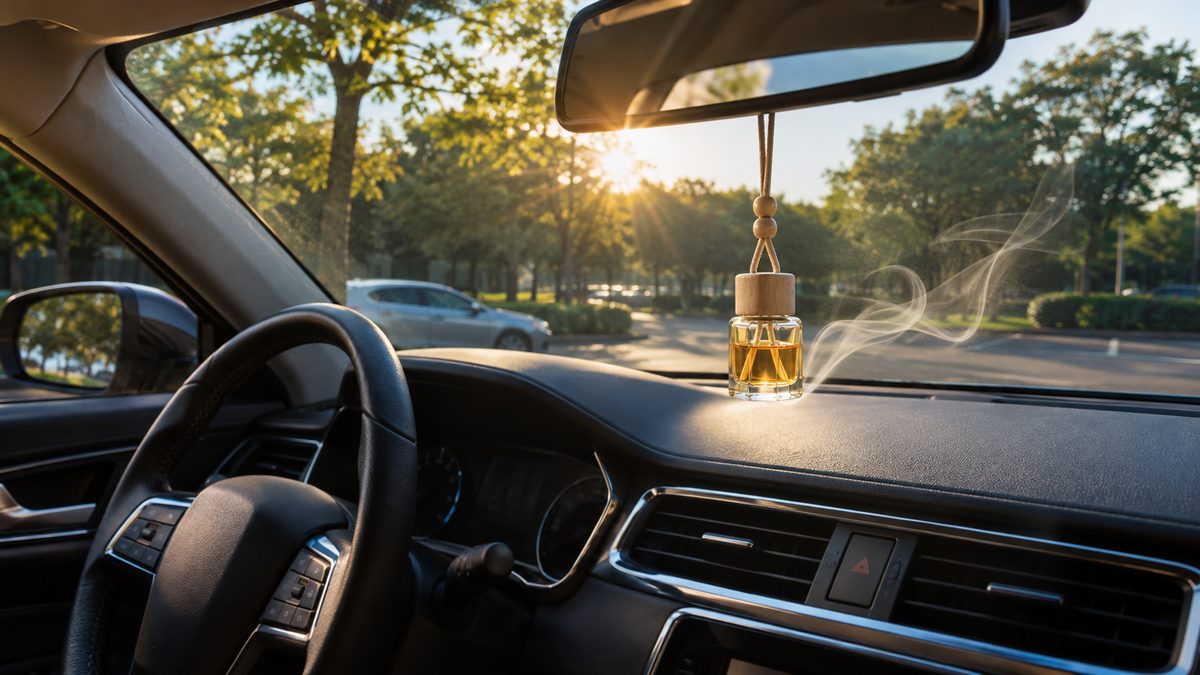
A car air freshener that fills the cabin on a warm afternoon can be silent the next cold morning, and can turn harsh after a summer in direct sun. The fragrance has not run out and the formula has not changed — the interior temperature has.
This article explains how temperature swings inside a parked car drive fragrance release, why the same product smells different at different times of day, and how to spec a car fragrance for the whole cycle.
Table of Contents
- The thermal environment of a parked car
- How temperature drives fragrance release
- Burst release and cold-morning silence
- Thermal degradation and off-odours
- How formats respond: liquid, gel and solid
- Material and plastic compatibility under heat
- Testing a car fragrance against the cycle
- Practical guide: speccing a car fragrance for the cycle
- Frequently asked questions
- Conclusion
The thermal environment of a parked car
A closed car in the sun acts as a greenhouse: short-wave sunlight enters through the glass, is absorbed by the seats and dashboard, and re-radiated as heat that the glass traps. Interior temperatures can climb well above the outside air — commonly into the 60–80°C range on a hot day — and then fall sharply overnight. The product does not experience one temperature; it experiences a daily cycle with a swing of tens of degrees.
Why the swing matters more than the peak
The peak gets the attention, but the daily swing is what stresses the product. Every cycle expands and contracts the materials and drives a burst of evaporation followed by a near-stop, and the damage is cumulative as well as chemical.
Surface versus air temperature
The dashboard and seats run hotter than the air, and a fragrance clipped to a vent or hung from the mirror sits in a different microclimate than one on the dash. Where the product is placed changes its thermal load, so the brief should state the placement, not just "a car".
How temperature drives fragrance release
Fragrance leaves a product by evaporation, and evaporation rate rises steeply with temperature. A warmer product delivers more fragrance per hour; a colder one delivers less. This is the entire reason a car freshener seems strong on a hot afternoon and weak on a cold morning — the same device, the same fragrance, a different release rate set by the temperature of the moment.
The release curve over a day
Think of the daily release as a curve that tracks temperature: low overnight, climbing through the morning, peaking in the afternoon heat, falling again. The customer experiences this as inconsistency, but it is physics working as designed. The goal is to flatten the curve enough that both the hot and cold ends stay inside an acceptable band — usually by weighting the fragrance toward lower-volatility materials that release more evenly.
Burst release and cold-morning silence
The two complaints that define car fragrance are the opposite ends of the same curve. Burst release is the overwhelming blast on a hot day, sometimes harsh enough to be unpleasant; cold-morning silence is the near-absence of scent when the cabin is cold. Both trace to a release rate that is too strongly coupled to temperature.
| Condition | What the customer notices | Design lever |
|---|---|---|
| Hot afternoon | Overpowering or harsh blast | Lower-volatility blend, rate-limiting format |
| Cold morning | No detectable scent | Format that releases at low temperature |
| Repeated cycling | Fragrance fades early | Thermal stability, adequate payload |
The target is not "as strong as possible" but a release rate that stays inside a pleasant band across the daily cycle — taming the hot end and lifting the cold end, measured in the cabin rather than a beaker.
Thermal degradation and off-odours
Heat does more than speed evaporation; it can chemically change the fragrance. Some components oxidise or decompose at the temperatures a dash reaches, producing harsh, sour or "burnt" notes the customer reads as a cheap product. The degradation is often invisible in the bottle but obvious in the air, because the breakdown products are themselves volatile and strongly odorous.
Stability is not the same as volatility
A fragrance can be non-volatile enough to release slowly and still be thermally fragile. Stability testing must therefore look at what happens to the scent after heat exposure, not just how fast it evaporates. A hot soak followed by a sniff against the reference catches the degradation that a simple weight-loss measurement misses. Packaging can also shield the product — a clip that positions it in the shade of the vent, or a holder that insulates it from the dash — which is a legitimate part of the design.
How formats respond: liquid, gel and solid
Different car-fragrance formats respond differently to the same thermal cycle because they release by different mechanisms. A liquid in a vented reservoir releases continuously; a gel releases by evaporation from a matrix that slows it; a solid or card releases by diffusion through the substrate.
| Format | Release mechanism | Hot-day behaviour | Cold-day behaviour |
|---|---|---|---|
| Vented liquid | Evaporation from open surface | Strong burst, faster depletion | Weak, slow release |
| Gel | Evaporation through a matrix | Moderated burst | Reduced but present |
| Solid / card | Diffusion through substrate | Lower, more even release | Low but steady |
The format is therefore part of the fragrance decision, not a separate packaging choice. A blend perfect in a vented liquid can be wrong in a card, because the release mechanism and the thermal coupling both change. The card's own behaviour is treated in our note on scent card substrate absorption.
Material and plastic compatibility under heat
The interior heat is also a materials problem. Plastics soften, adhesives creep, and the fragrance itself can attack certain polymers — a failure that heat accelerates. A clip fine at room temperature can sag or fail at dashboard temperatures, and a fragrance harmless to a polymer in a cool room can craze or dissolve it when hot.
For dealer-facing formats that must survive a dashboard, the customisation process covers clip and holder pairing.
Test the whole assembly, not the parts
Test the assembled product — fragrance, reservoir, clip and holder — at the temperatures the interior actually reaches, looking for deformation, leakage and polymer attack together. Testing the clip alone at room temperature says nothing about how it behaves loaded with fragrance at high heat. The polymer attack mechanism itself is detailed in our plastic compatibility note.
Testing a car fragrance against the cycle
A car fragrance should be tested against the cycle, not a single temperature. The minimum programme is a repeating hot-cold cycle — a hot soak near the upper interior range followed by a return to a cool baseline, repeated many times — with evaluation of scent quality, release rate and physical integrity at the ends and after the full sequence.
What to record through the cycle
Record scent character against the reference after heat, release intensity at both the hot and cold ends, and any physical change after cycling. A single hot soak reveals degradation; the repeated cycle reveals the cumulative damage a one-day test cannot.
Practical guide: speccing a car fragrance for the cycle
Step 1 — State the placement and the climate
Tell the supplier where the product will sit — vent, mirror, dash — and the temperature range of the target market, because placement changes the thermal load.
Step 2 — Choose the format with the thermal behaviour in mind
Pick the release mechanism for the cycle: a gel or card for a more even release, a vented liquid for higher intensity, knowing the burst it carries.
Step 3 — Weight the fragrance toward lower volatility
Ask the formulator to build the blend so the hot end stays pleasant and the cold end still registers, rather than maximising first-day intensity.
Step 4 — Test the assembly hot, not just the parts
Run the fragrance, reservoir, clip and holder together at interior temperatures, checking for leakage, softening and polymer attack.
Step 5 — Run a repeated hot-cold cycle
Cycle the product many times between the upper and lower range, and record scent quality and physical integrity after the full sequence.
Step 6 — Validate in a real vehicle
Place a prototype in an actual parked car for a few days to confirm the lab protocol reflects real sunlight, humidity and surface gradients.
Frequently asked questions
What is a private label car fragrance?
A car air freshener produced to your brand's specification — your fragrance, format and packaging — by a supplier, while you own the brand and sell under your own name.
What is a typical minimum order quantity for car fragrances?
Minimums depend on the format and packaging, commonly from a few hundred to a few thousand units per SKU, with custom formats carrying higher minimums than stock options.
How hot does a parked car interior actually get?
On a hot sunny day a closed interior can reach well above the outside temperature, commonly into the 60–80°C range, with dashboard surfaces running hotter than the air.
Why does my car fragrance smell strong on hot days and weak on cold mornings?
Fragrance release is driven by evaporation, and evaporation rate rises steeply with temperature. The same device releases far more fragrance when the cabin is hot than when it is cold.
What causes a car fragrance to turn harsh after a hot summer?
Heat can oxidise or decompose fragrance components, producing volatile breakdown products with harsh or burnt notes.
Which car fragrance format is most stable in heat?
No single best format; each trades intensity against evenness. A vented liquid bursts in heat, while a gel or card moderates the hot end and holds a steadier release.
Should I test my car fragrance at a single high temperature?
No. A single hot soak reveals degradation, but the real damage comes from the daily hot-cold cycle, which is cumulative and mechanical. Test with a repeated cycle and evaluate after the full sequence.
Does the plastic clip need testing with the fragrance?
Yes. Fragrance can attack some polymers, and heat accelerates the attack, so a clip fine at room temperature can soften or fail on a hot dash. Test the fragrance, reservoir, clip and holder together.
Conclusion
A car fragrance lives in the most thermally hostile environment any scent product endures, and its behaviour is written by that environment: strong in the heat, silent in the cold, degrading under the daily swing. Designing for it means treating temperature as the primary specification.
The practical path is to choose the format for its thermal behaviour, weight the fragrance toward an even release, and test the whole assembly through a repeated hot-cold cycle. A product that holds its scent and physical integrity across the cycle is one the customer will reorder.
Discuss your fragrance programme with our team:
WhatsApp: +86 17324762943
Email: adon@customperfumeoem.com
Website: customperfumeoem.com