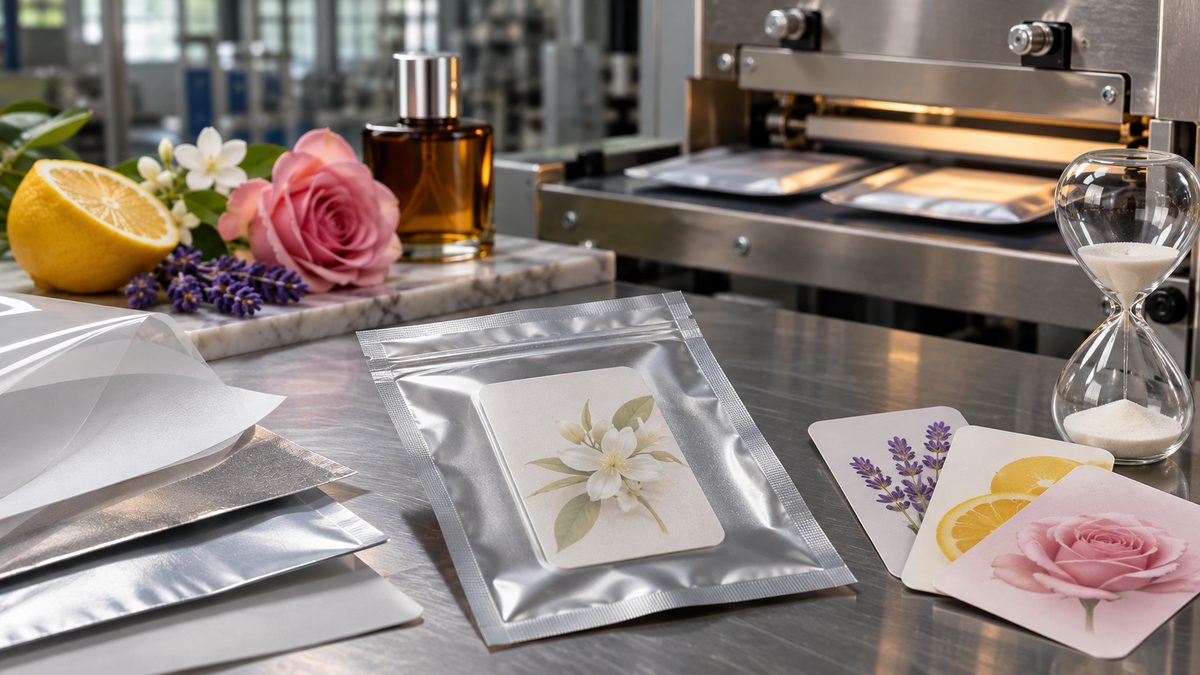
Substrate Absorption Rates and Scent Consistency Across Print Runs
A scent card smells perfect on the first print run, and then the second run — same fragrance, same design — comes out weak, or oily, or blotchy where the ink sits. The brand blames the fragrance, but the fragrance has not changed: the subst

A scent card smells perfect on the first print run, and then the second run — same fragrance, same design — comes out weak, or oily, or blotchy where the ink sits. The brand blames the fragrance, but the fragrance has not changed: the substrate has, and its absorption behaviour changed with it, pulling a different amount of oil into the card on every run.
This article explains how the substrate governs how much fragrance a scent card holds and how consistently it holds it, and how to spec a substrate and load so the card smells the same from the first run to the last.
Table of Contents
- How a card holds fragrance: absorption and retention
- Substrate properties that set absorption
- How print and coating change absorption
- Why scent consistency drifts across print runs
- Measuring the fragrance load on a card
- Specifying the substrate for repeatable results
- Failure modes: weak scent, staining and blotching
- Practical guide: holding scent-card consistency
- Frequently asked questions
- Conclusion
How a card holds fragrance: absorption and retention
A scent card works by taking fragrance into its fibre structure and releasing it slowly from the surface and the pores. The amount it can hold is set by the substrate's porosity and its affinity for the fragrance, and the release rate is set by how much is held near the surface versus trapped deeper in the sheet. Both depend on the paper or board, not just on the oil poured onto it.
Absorption is not the same as retention
A substrate can absorb a lot and hold none of it — the oil wicks in and evaporates out in a day — or absorb little and hold it long. Absorption is how fast and how much the liquid enters the sheet; retention is how long the sheet keeps it. A spec that chases only "how much oil it takes" produces a card that smells strong for a day and dead for a month.
The fibre structure is the storage system
Fragrance sits in the spaces between fibres and on their surfaces. The size, number and connectivity of those spaces — the porosity — determine capacity, while the fibre chemistry determines how strongly the oil is held. Both vary by furnish, formation and calendering, which is why two papers of the same grammage behave completely differently.
Substrate properties that set absorption
Three substrate properties dominate scent-card behaviour: grammage (weight per area), porosity, and surface treatment. Grammage sets the total material available to hold oil; porosity sets how readily oil enters and moves through the sheet; surface treatment — size, coating, calendering — sets how much the surface resists or accepts the liquid.
| Property | What it controls | Effect on scent card |
|---|---|---|
| Grammage | Total fibre mass available | Higher grammage holds more oil |
| Porosity | How readily oil enters and moves | Open pores absorb fast; tight pores resist |
| Surface treatment | Surface acceptance and sealing | Coatings can block or slow absorption |
| Calendering | Surface smoothness and density | Heavy calendering can close the surface |
The practical point is that the substrate must be chosen for the load and life you want, then held constant. A change in any one of these properties — even a "similar" paper from a different mill — shifts how much fragrance the card takes and how fast it releases it.
How print and coating change absorption
Printing and finishing change the substrate's absorption exactly where they are applied. Ink and varnish partially seal the surface, so a heavily printed area absorbs less fragrance than an unprinted one — which is why a card can smell uneven.
Ink coverage as a variable in the fragrance spec
The fragrance load is applied to a sheet whose absorption has already been altered by print. If the design changes between runs — more ink, a new varnish, a lamination — the effective substrate changes too, even though the paper is nominally the same. The print spec and the fragrance spec must be managed as one. A full lamination can nearly seal the card and suppress release; a porous varnish leaves the surface open, so the choice of finish is a performance decision.
Why scent consistency drifts across print runs
The most common cause of run-to-run drift is a silent change in the substrate or the finish. A buyer reorders the same card and gets a sheet from a different batch, a different mill or a different lot of coating, and the absorption shifts by a few percent — enough to move the card from "right" to "weak" or "oily". The fragrance has not changed; the thing absorbing it has.
Batch variation is normal, but it must be controlled
Paper and board vary within a grade, and that variation is legitimate up to a point. The problem is the absence of a control on it. Specify the substrate by a measurable property — grammage, porosity, absorbency — with a tolerance, rather than reordering "the same paper" by name. Record the substrate batch, print coverage and finish on every run, alongside the fragrance load, so a drifting run can be traced. The complaint logic is the same as in our scent-card complaint triage.
Measuring the fragrance load on a card
Consistency cannot be managed by smell alone; it needs a measurement. The fragrance load is typically tracked by weight gain — the mass the card picks up when the fragrance is applied — expressed against the card's own weight or area. This gives a repeatable number that can be checked on every run.
Weight gain as the production control
Weigh cards before and after application, and record the load as a percentage or per-card mass. This catches a substrate that suddenly absorbs less, long before a nose would. For measuring the fragrance actually held without ruining the card, see our note on non-destructive payload measurement.
Specifying the substrate for repeatable results
The durable fix for run-to-run drift is a substrate specification that pins the measurable properties down and holds them across batches. Name the grade, the grammage, the porosity or absorbency target, and the surface treatment, each with a tolerance, and require the mill to certify each batch against them.
For card formats and finishes, the packaging page shows how substrate choice interacts with the rest of the card.
Write the tolerance, not just the grade name
A grade name is a starting point, not a control. Two batches of "the same" paper can differ enough to shift the scent, so the spec must state the acceptable range for the properties that matter. The print coverage and finish change the effective absorption, so they belong in the same controlled document — when the design, varnish or lamination changes, the fragrance load must be re-validated against the new effective substrate.
Failure modes: weak scent, staining and blotching
The failures that trace back to the substrate show up in three characteristic ways, each pointing at a different cause. Recognising which one you have keeps you from fixing the wrong variable.
| Failure | What it looks like | Most likely substrate cause |
|---|---|---|
| Weak scent | Card smells faint or fades fast | Low porosity, sealed surface, heavy print |
| Oily staining | Oil visible on or bleeding through | Over-absorption or poor retention |
| Blotchy scent | Uneven strength across the card | Uneven print coverage or surface treatment |
Each maps to a substrate or finish variable, not to the fragrance formula. Checking the substrate and the print first — before reformulating — is the fastest route to the real fix and the cheapest.
Practical guide: holding scent-card consistency
Step 1 — Choose the substrate for the load and life you want
Pick grammage, porosity and surface treatment for the absorption and retention the product needs, not for appearance alone.
Step 2 — Specify measurable properties with tolerances
Write the grade, grammage, porosity and absorbency target with acceptable ranges, and require the mill to certify each batch.
Step 3 — Treat print and finish as part of the fragrance spec
Record ink coverage, varnish and lamination with each run, and re-validate the fragrance load when the design or finish changes.
Step 4 — Control the load by weight gain
Weigh a sample of cards before and after application on every run, and track the load as a percentage or per-card mass.
Step 5 — Document substrate, print and load on every run
Keep a run record of substrate batch, print coverage, finish and fragrance load so a drifting run can be traced to its cause.
Step 6 — Diagnose failures against the substrate first
When a card comes out weak, oily or blotchy, check porosity, print coverage and retention before touching the fragrance.
Frequently asked questions
What is a private label scent card?
A fragrance-impregnated card produced to your brand's specification — your fragrance, substrate and print design — by a supplier, while you own the brand and distribute the card under your own name.
What is a typical minimum order quantity for scent cards?
Minimums depend on the substrate, print and fragrance, commonly from a few thousand to tens of thousands of cards per SKU, with bespoke shapes and finishes carrying higher minimums.
How does a scent card hold fragrance?
The fragrance enters the spaces between the paper or board fibres and is released slowly from the surface and pores. Capacity is set by porosity and grammage; retention by fibre chemistry and surface treatment.
Why does the same card smell weaker on the second print run?
Usually because the substrate or finish changed silently — a different paper batch, mill, or heavier print coverage — shifting how much fragrance the card absorbs.
Does printing affect how much fragrance a card holds?
Yes. Ink and varnish partially seal the surface, so heavily printed areas absorb less, and a lamination can nearly seal the card.
How is the fragrance load on a card measured?
Typically by weight gain: cards are weighed before and after fragrance application, and the load is recorded as a percentage or a per-card mass.
What causes an oily stain on a scent card?
An oily stain usually means the substrate over-absorbed or retains poorly, so the oil sits at or bleeds through the surface. The fix is in the substrate's porosity and retention.
How do I make my scent cards consistent from run to run?
Specify the substrate by measurable properties with tolerances, treat print and finish as part of the fragrance spec, and control the load by weight gain.
Conclusion
A scent card is a substrate first and a fragrance second, and the consistency of the product is governed by the paper or board far more than by the oil. When runs drift, the substrate or the finish has almost always moved silently, and the fragrance gets blamed for a change it never made.
The answer is to treat the substrate as a controlled component with measurable tolerances, manage print and finish as part of the fragrance spec, and control the load by weight gain on every run. Then the card smells the same from the first run to the last.
Discuss your fragrance programme with our team:
WhatsApp: +86 17324762943
Email: adon@customperfumeoem.com
Website: customperfumeoem.com