
Plastic Compatibility: How Fragrance Attacks ABS and PC
A clip-on car diffuser ships in a housing that looks flawless, then weeks later the housing develops fine cracks, turns cloudy, or softens and deforms in the customer's hand. The plastic was specified for its look and its cost, not for what
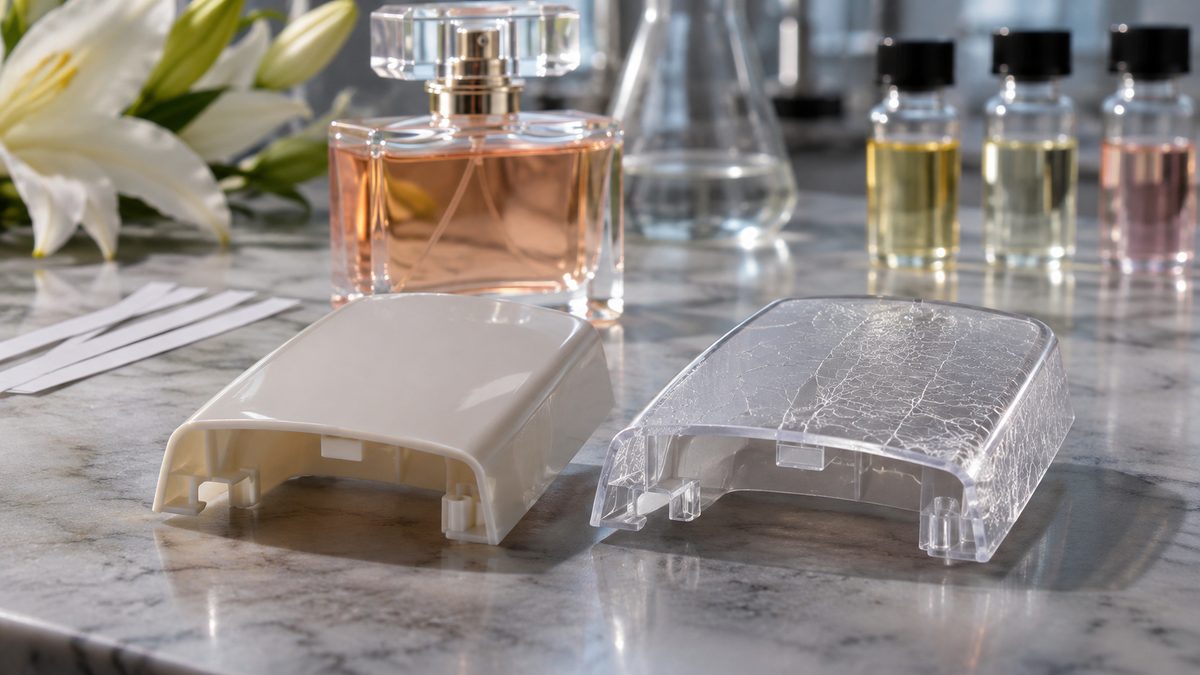
A clip-on car diffuser ships in a housing that looks flawless, then weeks later the housing develops fine cracks, turns cloudy, or softens and deforms in the customer's hand. The plastic was specified for its look and its cost, not for what the fragrance would do to it — and the fragrance, a cocktail of solvents in everything but name, went to work the moment the two touched.
This article explains how fragrance ingredients attack ABS and polycarbonate, why the failure is delayed, and how to spec a plastic that survives contact for the life of the product.
Table of Contents
- Fragrance as a solvent, not just a scent
- How ABS fails: solvent attack and stress cracking
- How polycarbonate fails: crazing and clouding
- Environmental stress cracking as the hidden cause
- Choosing a compatible material instead
- Testing plastic compatibility before launch
- Design mitigations when the material cannot change
- Practical guide: speccing fragrance-safe plastic
- Frequently asked questions
- Conclusion
Fragrance as a solvent, not just a scent
A fragrance oil is a concentrated mixture of esters, terpenes, ketones, aldehydes and alcohols — the same chemical families as industrial solvents. To a plastic housing, the fragrance is a solvent bath at close range.
Contact, not immersion
The damage does not require immersion. Vapour, a slow leak or proximity to a saturated reservoir is enough, because volatile components migrate into the polymer over time.
Heat multiplies the attack
Every solvent-polymer interaction accelerates with temperature, and a car interior is exactly the hot environment that turns a slow attack into a fast one. A plastic that survives contact in a cool room can fail within weeks on a hot dashboard, which is why car-fragrance housings need a higher standard than home products.
How ABS fails: solvent attack and stress cracking
ABS — acrylonitrile butadiene styrene — is cheap, mouldable and good-looking, but its butadiene phase is vulnerable to many solvents. Fragrance components can soften the surface, and the same components can act as stress-cracking agents that open microscopic cracks at points of residual moulding stress.
Softening, swelling and surface whitening
The first sign is often a change in surface feel — a softening or a dull, whitened patch where the fragrance has attacked. Swelling follows, and the material loses stiffness and gloss. By the time the customer notices, the surface polymer structure has already been altered, and the part cannot be restored by cleaning.
Why the failure is delayed
Solvent attack is rarely instantaneous. The components must diffuse into the polymer, concentrate at the surface and begin to disrupt the chains — a process measured in days to weeks. This delay is dangerous precisely because the product passes outgoing inspection and fails later, in the customer's car, after the batch has shipped.
How polycarbonate fails: crazing and clouding
Polycarbonate is chosen for clarity and toughness, but it is notably prone to environmental stress cracking with many solvents. The classic failure is crazing — a network of fine surface cracks — often followed by loss of transparency.
Clarity is the first casualty
A clear polycarbonate window over a fragrance reservoir can turn milky as crazing develops, ruining the one property the material was chosen for. The clouding is the material itself, fractured at the surface, not a film that can be wiped away. Crazing concentrates where the part carries internal stress from moulding — sharp corners, gate areas, thin sections.
Environmental stress cracking as the hidden cause
Many failures attributed to "bad material" are actually environmental stress cracking: a stress-cracking agent plus internal stress, neither of which alone would fail the part. Fragrance is the agent, moulding stress the load.
| Factor | Role in failure | How to control it |
|---|---|---|
| Stress-cracking agent | The fragrance component attacking the polymer | Choose a compatible material or barrier |
| Internal moulding stress | Concentrates the attack at weak points | Optimise gate, wall and cooling design |
| Temperature | Accelerates diffusion and attack | Test at the real service temperature |
| Time in contact | Determines cumulative exposure | Test over the product's intended life |
Material selection cannot be separated from moulding design and service conditions. A compatibility test that ignores stress, or a stress analysis that ignores the fragrance, will pass a part that fails in the car.
Choosing a compatible material instead
The robust fix is usually to change the plastic rather than fight the fragrance. Polyolefins such as polypropylene and certain polyethylene grades are far more resistant to fragrance solvents than ABS or polycarbonate, and they are widely available and mouldable. The trade-off is usually appearance and stiffness, so the choice should be made with the designer, not after tooling is cut.
| Material | Resistance to fragrance solvents | Typical trade-off |
|---|---|---|
| ABS | Poor — prone to softening and stress cracking | Cheap, good finish |
| Polycarbonate | Poor — prone to crazing and clouding | Clarity, toughness |
| Polypropylene | Good — resistant to many solvents | Softer look, lower gloss |
| Polyethylene | Good for many grades | Flexible, less rigid |
Confirm any choice with a test against your exact fragrance, because the answer depends on the specific blend, not the polymer family name. A grade that survives one fragrance can fail another, and a "resistant" polymer still deserves verification. For the dealer-facing formats these housings sit in, see our car fragrance pack planning note.
Testing plastic compatibility before launch
Compatibility is established by test, reproducing the real fragrance, concentration, temperature and time. A room-temperature dunk of a neat solvent is not a substitute.
A practical compatibility programme
Expose the moulded part — not a raw plaque — to the fragrance, in contact and vapour, at maximum service temperature, inspecting for softening, swelling, crazing, clouding and cracking. Include a stressed part, because the stressed part is the one that fails. The same rigour applies to our ingredient safety gate note.
Design mitigations when the material cannot change
When the material is fixed — a brand requires a specific finish, or the tooling is already cut — mitigation is still possible, though second best. A barrier layer or liner between the fragrance and the plastic, a reduction in residual moulding stress, and keeping the reservoir physically separate from stressed surfaces all extend the part's life.
When the housing must stay a specific polymer, the packaging options include barrier and liner choices to separate the fragrance from the plastic.
Barriers and stress reduction
A compatible film or liner can isolate the fragrance from the vulnerable plastic, and a design that vents vapour away from stressed regions reduces local exposure. These are engineering patches, not cures, and they must be validated by the same test, because a barrier that fails at a seam is no barrier. Adjusting the moulding — gate location, wall thickness, cooling — attacks the other half of stress cracking, and a part with lower residual stress tolerates a given fragrance far longer.
Practical guide: speccing fragrance-safe plastic
Step 1 — Get the exact fragrance composition to the material supplier
Provide the real blend, not a generic "fragrance oil", so the material recommendation is based on what will actually contact the plastic.
Step 2 — Choose the material for compatibility first
Select a solvent-resistant grade such as polypropylene or polyethylene unless appearance forces ABS or polycarbonate, and confirm with a test.
Step 3 — Test the moulded, stressed part at service temperature
Expose the actual assembly, in contact and vapour, at the maximum temperature the product will see, and inspect for softening, crazing and cracking.
Step 4 — Run the test for the product's intended life
Use an accelerated exposure that covers the real service period, and validate the acceleration against real-world results.
Step 5 — Reduce moulding stress in the design
Optimise gate location, wall thickness and cooling to lower residual stress, which is the load half of stress cracking.
Step 6 — Add a barrier if the material cannot change
Separate the fragrance from vulnerable surfaces with a compatible liner or film, and re-test the full assembly including the seams.
Frequently asked questions
What is a private label car fragrance?
A car air freshener produced to your brand's specification — your fragrance, format and packaging — by a supplier, while you own the brand and sell under your own name.
What is a typical minimum order quantity for car fragrances?
Minimums depend on the format and packaging, commonly from a few hundred to a few thousand units per SKU, with custom formats carrying higher minimums than stock options.
Why does fragrance damage plastic?
Fragrance oils are concentrated esters, terpenes, ketones and alcohols — the same families as many solvents. These diffuse into polymers and soften or crack them.
Which plastics are most vulnerable to fragrance?
ABS and polycarbonate: ABS softens and stress-cracks through its butadiene phase, while polycarbonate crazes and clouds. Polyolefins are generally far more resistant.
Why does the plastic fail only after a few weeks?
Solvent attack is diffusion: components migrate into the polymer before damage becomes visible, so a part can pass inspection and fail later.
What is environmental stress cracking?
Failure caused by a stress-cracking agent — here, fragrance components — combined with internal moulding stress. Neither alone fails the part, but together they open cracks.
Can I keep using ABS or polycarbonate with a barrier?
Sometimes. A compatible liner between the fragrance and the plastic, plus reduced residual stress, can extend life, but the mitigation must be validated with the same test.
How do I test plastic compatibility properly?
Test the actual moulded assembly — not a flat coupon — in contact with the real fragrance and vapour, at maximum service temperature, inspecting for softening, crazing and cracking.
Conclusion
Fragrance and plastic are not neutral neighbours; the fragrance is a solvent, and ABS and polycarbonate are among the polymers least equipped to resist it. The failures are delayed and concentrated at stressed points, which is why they escape inspection and appear in the customer's hands.
The fix is to treat compatibility as an engineering decision made before tooling, not a cosmetic one made after. Choose a resistant polymer, test the real assembly at the real temperature, and reduce moulding stress — and when the material cannot change, separate the fragrance from it and prove the barrier holds.
Discuss your fragrance programme with our team:
WhatsApp: +86 17324762943
Email: adon@customperfumeoem.com
Website: customperfumeoem.com


