Pouch Sealing for Scent Cards: Barrier Choice, Machine Settings and Shelf Life
A scent card is sealed into a pouch that looks tight on the line, but a month later the pouch has opened at a corner, the card smells flat, and the retailer rejects the whole display. The barrier film was right, but the seal was wrong — the
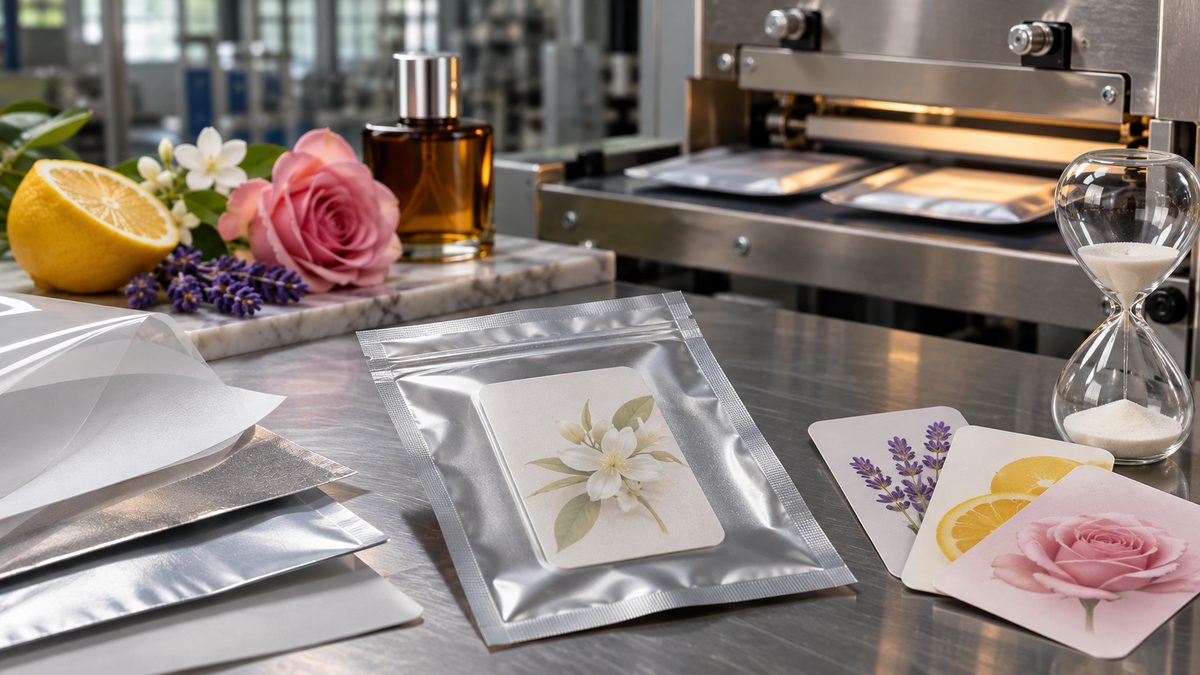
A scent card is sealed into a pouch that looks tight on the line, but a month later the pouch has opened at a corner, the card smells flat, and the retailer rejects the whole display. The barrier film was right, but the seal was wrong — the machine ran too cool, too fast, or with contaminated jaws, and the defect only appeared after the pack had been handled and shipped.
This article covers pouch sealing for scent cards end to end: choosing the barrier film, setting the seal temperature, dwell time, and pressure, testing the seal, and connecting those choices to the shelf life the product must deliver. It is written for buyers who need to specify sealing so that a card stays sealed.
Table of Contents
- Barrier films compared
- Seal integrity
- Machine settings: temperature, dwell, pressure
- Testing seals
- Shelf life from barrier and seal
- Common sealing defects
- Practical guide: specifying pouch sealing for scent cards
- Frequently asked questions
- Conclusion
Barrier films compared
The pouch film sets how much fragrance, oxygen, and moisture move through the pack, and the choice is a cost-versus-life decision. Plain polyethylene is cheap and seals easily but offers little barrier. Metallised polyester adds a vapour-deposited metal layer that reflects light and blocks much of the transmission. An aluminium foil laminate is the highest barrier, effectively blocking volatiles, oxygen, and light, but it is more expensive and seals differently.
| Film structure | Barrier level | Sealing behaviour | Typical use |
|---|---|---|---|
| Plain PE | Low | Easy, wide window | Short-life giveaways |
| Metallised PET | Moderate to high | Moderate window | Mid-range retail |
| Aluminium foil laminate | Very high | Narrower, needs control | Long shelf life, sensitive scents |
The film is only as good as its seal, which is the point buyers most often miss. A foil laminate with a weak seal performs worse than a plain film with a perfect seal, because the pack fails at the seam, not through the film. Select the film and the seal as one decision, not two.
Seal integrity
A seal is a heat-fused bond between the two film layers, and its strength depends on the film's sealant layer reaching its softening temperature and being pressed together for long enough to fuse. A seal that is too cold or too short leaves the layers only lightly tacked; they can peel under the pressure of handling, or leak slowly enough that the card dries out without the pouch visibly opening.
The failure is often silent. A weak seal does not always pop open; it can let fragrance and moisture migrate through the seam at a low rate, so the card fades over weeks while the pouch still looks sealed. This is why seal testing must measure the bond strength and leak rate, not just confirm that the pouch is closed.
Machine settings: temperature, dwell, pressure
Three settings control the seal, and they interact. Temperature must bring the sealant layer to its fusion point without overheating and thinning the film. Dwell time is how long the jaws hold the film; too short a dwell means an incomplete bond. Pressure ensures the two layers make full contact; too little leaves gaps, and too much can squeeze the molten layer thin at the edges.
| Setting | Too low | Too high |
|---|---|---|
| Temperature | Weak, tacked seal | Burned, thinned film |
| Dwell time | Incomplete fusion | Slow output, heat damage |
| Pressure | Gaps, partial contact | Thin edges, channel leaks |
Dialling in the three controls
Finding the window on your film
Every film has a sealing window — the range of temperature, dwell, and pressure within which the seal is strong without damaging the film. Ask the film supplier for the recommended window, then confirm it on your machine, because the actual jaw temperature and the set point can differ. Run a matrix of settings and test the resulting seals to find where your line sits inside the window.
Testing seals
Seal testing has two parts: strength and integrity. A seal-strength test peels the seam apart and measures the force, confirming the bond is robust enough for handling and transport. An integrity test — a dye penetration test or a burst test — checks for pinholes and channels through which fragrance or moisture can pass even when the seam looks solid.
Run both on a sampling basis, not once at commissioning, because seal quality drifts as jaws wear, films change, and lines run. A seal that passes at setup can fail weeks later on a dulled jaw, so the test schedule is part of the specification, not a one-time check.
Shelf life from barrier and seal
Shelf life is the product of the film barrier and the seal integrity together, under the storage conditions the pack will actually meet. A high-barrier film with a perfect seal can hold a card for months; the same film with a channel leak will fade almost as fast as an unsealed card. The shelf-life claim on the label should be based on the sealed pack, not on the film's data sheet.
Connect the three by testing the complete, sealed pouch at the required storage temperature and at intervals, smelling the card against a retained reference. The film data sheet tells you what the material can do; only the sealed-pouch test tells you what your product actually delivers. For the card chemistry that determines what you are protecting, see our scent-card complaint guide.
Common sealing defects
Sealing defects are predictable and mostly preventable. Contamination of the seal area with fragrance or card dust is the most common: the residue prevents fusion and leaves a weak or leaky seam. Wrinkles and creases at the seal fold create channels through which vapour passes. Jaw misalignment or wear produces uneven pressure and a seal that is strong in one spot and weak in another.
Prevent them at the line rather than catching them at inspection. Keep the seal area clean, control the card insertion so the film is not wrinkled, and maintain and align the jaws on a schedule. A sealing line that is cleaned and maintained is cheaper than the returns and retailer rejections that defective seals produce. For how the pouch fits the broader retail pack, review our scent-card packaging guide. The holder and refill structures that use these cards are covered in our starter-holder and replacement-card guide.
Practical guide: specifying pouch sealing for scent cards
Step 1 — Fix the shelf-life target
State how many months the card must keep its scent, because the film and the seal are both specified against that number.
Step 2 — Choose the film against the life
Select the barrier level the shelf life demands, and confirm the film supplier's recommended sealing window.
Step 3 — Find the window on your machine
Run a matrix of temperature, dwell, and pressure, and test the seals to locate where your line sits inside the film's window.
Step 4 — Set strength and integrity tests
Add a seal-strength peel test and a leak or burst test to the QC plan, run on a sampling schedule rather than once.
Step 5 — Keep the seal area clean
Control fragrance and card-dust contamination and wrinkle formation at the seal fold, and maintain jaw alignment.
Step 6 — Age the sealed pouch
Test the complete sealed pack at the required storage temperature and intervals against a retained reference, and base the shelf-life claim on that result.
Frequently asked questions
What is a scent card pouch seal?
A scent card pouch seal is the heat-fused seam that closes the film around the card. The seal's strength and integrity determine whether the pouch holds its barrier over the product's life.
What is a barrier film?
A barrier film is a packaging material that resists the passage of fragrance, oxygen, and moisture. Plain PE is low-barrier, metallised PET is moderate, and aluminium foil laminate is the highest.
What three settings control a heat seal?
Temperature, dwell time, and pressure. Temperature fuses the sealant layer, dwell time lets the bond form, and pressure ensures full contact between the film layers. The three interact, so each has a working window.
Why does a pouch look sealed but still let the card fade?
The seal may be weak or contain pinholes and channels that leak slowly without visibly opening. A leak test or burst test catches this where a simple visual check does not.
What is a sealing window?
A sealing window is the range of temperature, dwell, and pressure within which a film forms a strong seal without damage. Confirm the supplier's window on your own machine, since actual jaw temperature can differ from the set point.
What is the most common cause of a weak seal?
Contamination of the seal area with fragrance or card dust is the most common cause, because the residue prevents the layers from fusing. Wrinkles at the fold and jaw wear are close behind.
How do I test a seal for leaks?
Use a dye penetration test or a burst test to check for pinholes and channels, plus a peel test to measure bond strength. Run both on a sampling schedule, not once at commissioning.
Should the shelf-life claim be based on the film data sheet?
No. Base it on the complete sealed pouch aged at the required storage temperature, because the seal is the pack's weak point and the film data sheet cannot account for it.
Conclusion
Pouch sealing is where scent card shelf life is actually won or lost, because the film only performs as well as the seam that holds it closed. A strong seal on the right barrier delivers months; a weak or contaminated seal quietly bleeds the fragrance out regardless of what the film was rated to do.
Specify the film and the seal as one decision, find the sealing window on your own machine, test strength and integrity on a schedule, and base the shelf-life claim on the aged sealed pouch. That closes the gap between a card that looks sealed and a card that stays sealed.
Discuss your fragrance programme with our team:
WhatsApp: +86 17324762943
Email: adon@customperfumeoem.com
Website: customperfumeoem.com