
Wick Selection for Private Label: What the Factory Should Prove
Ask a candle factory which wick it recommends and you get a size. Ask why, and the answer is often a burn test run on a different wax, in a different vessel, with a different fragrance load — sometimes years earlier. The wick is the cheapes
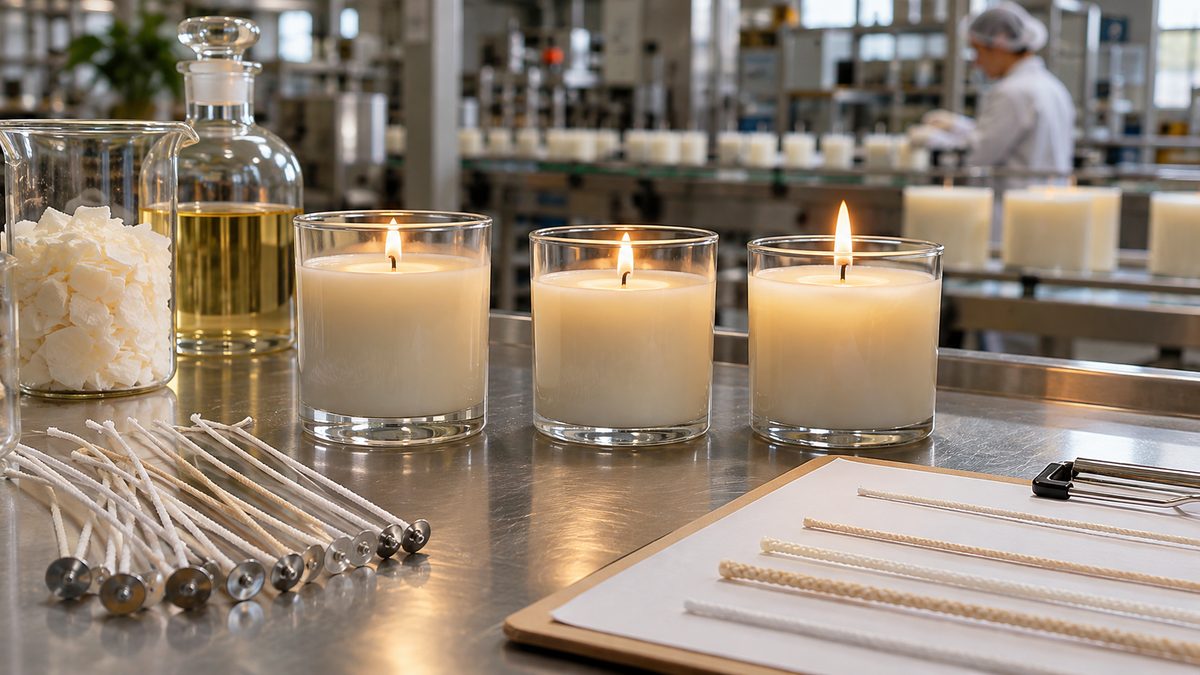
Ask a candle factory which wick it recommends and you get a size. Ask why, and the answer is often a burn test run on a different wax, in a different vessel, with a different fragrance load — sometimes years earlier. The wick is the cheapest component and decides most complaints.
This article sets out what candle wick selection should be able to prove on paper: which wick, chosen against which variables, proven by which tests, recorded in what form, and how to spot a proof package that looks complete but proves nothing.
Table of Contents
- Why wick choice is a system decision
- What defensible burn data looks like
- Placement, priming and what buyers never see
- Failure signatures and what they indict
- The proof package to demand
- Practical guide: qualifying a wick in six steps
- Frequently asked questions
- Conclusion
Why wick choice is a system decision
A wick is not a strength rating. It is a rate: how much fuel it draws per unit time, which depends on braid construction, treatment, diameter and the viscosity of the melted wax. Change the wax blend, the fragrance load or the vessel diameter and the correct rate changes, which is why the vessel formats and the wick have to be chosen together.
The families behave differently, not just bigger or smaller
Flat braid, square braid, curled wicks, self-trimming cotton-paper hybrids and wood all draw and burn differently, and two wicks of nominally the same size from different families are not interchangeable. A curled wick bends toward the pool edge and helps an even burn in a wide vessel; a flat braid in the same vessel may leave wax on the wall.
| Family | Behaviour | Usually suited to | Watch for |
|---|---|---|---|
| Flat braid cotton | Stable, predictable, moderate curl | Paraffin containers, pillars | Mushrooming at high load |
| Curled cotton | Tip bends into the pool, self-trims | Wide containers, soy blends | Drowning if the pool is deep |
| Cotton-paper hybrid | Stiffer, self-trimming, hotter | Hard waxes, difficult pools | Sooting if oversized |
| Wood | Crackle, wide flame, fast pool | Decorative premium lines | Inconsistent lot behaviour |
Priming and sizing are both specification items
Most wicks arrive primed with a coating that helps them light and draw. A wick primed with paraffin behaves differently in the first burn of a natural-wax candle than one primed with a compatible coating, and the difference shows as a hesitant light or an uneven initial pool. Priming belongs in the specification even though it is invisible in the finished product.
Wick size is a rate, not a strength
Going up a size increases the fuel rate and therefore the flame and the pool. It does not increase the amount of fragrance in the candle, and past the point where the pool reaches the vessel wall, the extra rate only overheats the wax. This is why "use a bigger wick" is the most common wrong answer to a weak hot throw.
What defensible burn data looks like
Candle wick selection is defensible only when someone else could repeat the result: four variables named — wax, fragrance and load, vessel, wick — plus conditions, cycle pattern and observations at each cycle.
The variables that must be fixed
A burn log that says "soy blend, 8 per cent, 200 g tumbler, CD 10" is a start, but it omits the wax supplier, the fragrance, the ambient temperature, the burn duration per cycle and the trim length. Each omission is a reason the result may not transfer.
The observations that must be recorded
Pool diameter at defined intervals, flame height, any mushrooming or sooting, container wall temperature, and the condition of the wick at each relight. Photographs at each stage are worth more than adjectives, because "acceptable soot" means something different to every salesperson who writes it.
Placement, priming and what buyers never see
Two candles made from identical components can burn differently because of how the wick was set. Placement is a process control and where many factories are weakest.
Centring tolerance and verticality
A wick set a millimetre off centre produces an asymmetric pool, wax left on one wall and a hotter side that can overheat the vessel. A wick that is not vertical leans as it burns and may drown in its own pool. Ask for the centring tolerance in millimetres and for the method used to hold the wick during the pour, since wax shrinkage can pull a wick off centre after setting.
Tab adhesion and wick height
The tab must be fixed at a temperature that gives a reliable bond, and the exposed wick height must be consistent from candle to candle. A wick trimmed too long smokes on the first light; too short and the customer cannot relight it.
Failure signatures and what they indict
Most wick complaints have a signature that points at a cause before any testing is done, and reading it correctly avoids changing the wrong variable.
| Signature | Most likely cause | Test that confirms it |
|---|---|---|
| Tunnelling, wax on the wall | Wick rate too low for the vessel | Wick ladder at fixed load |
| Wick drowns mid-burn | Curled wick in a deep pool, or oversize pool | Pool depth and wick family trial |
| Soot on the vessel shoulder | Wick rate too high, or a draft | Repeat one size down, then adverse draft |
| Large mushroom, dimming flame | Residue-heavy fragrance or excess dye | Hold load, change concentrate |
| Flame too tall, vessel hot | Oversized wick or a blocked air path | Container temperature record |
| Wick leans and self-extinguishes | Placement or shrinkage during setting | Line audit of centring |
Separating wick from formula
Before blaming the wick, confirm the load and the wax batch. A wick that performed in trials and fails in production usually indicates a change in wax lot, fragrance lot or pour temperature rather than a wick defect. The combustion science behind wax, fragrance and wick explains which interactions to check first.
The proof package to demand
A supplier who has done the work can produce the following without going back to the lab. One who has not will offer a paragraph of reassurance instead.
| Evidence | What it should contain | Weak version |
|---|---|---|
| Wick specification | Family, size, braid, treatment, priming wax, supplier lot | A size number only |
| Burn log | Cycle pattern, pool data, flame, soot notes, photos | A summary sentence |
| Container temperature | Wall temperature at defined points through the burn | None, or a single reading |
| Wax lot traceability | Lot numbers for every trial | "Standard soy blend" |
| Placement record | Centring tolerance and method | Not addressed |
| Change notification | Written notice before any wick substitution | Silent substitution |
Why the change notification matters most
Wick substitution is the quietest change in candle making. A supplier whose usual wick is out of stock may use a neighbouring size that looks identical and burns differently, and nobody notices until the reviews arrive. A written notification clause with a re-test obligation is worth more than any burn report.
Practical guide: qualifying a wick in six steps
Candle wick selection assumes the wax and fragrance are fixed. If they are not, settle them first; a wick cannot be qualified against a moving formula.
Step 1 — Specify the wick as a part, not a size
Family, size, treatment and priming wax, with the supplier's part number. "CD 10" describes a size within a family and leaves the treatment open.
Step 2 — Require a burn log for your exact combination
Your wax, your fragrance at your load, your vessel, in the actual production environment. Data from a similar project is a starting point, not proof.
Step 3 — Ask for container wall temperatures
A wick can produce a beautiful pool and an unsafe vessel. Record the wall temperature at defined points and compare it with the limit your vessel and label can support.
Step 4 — Audit centring and wick height on the line
Measure ten candles from a production run, not three from a sample set. Centring and height are process outputs and they drift.
Step 5 — Repeat across three wax lots
Wax varies between lots, and a wick that works in one may tunnel in the next. Three lots is the minimum that shows whether the choice is robust or lucky.
Step 6 — Put substitution behind a written gate
Any change in candle wick selection — wick, priming or supplier — triggers a re-test and a written notice. Our note on starter assortments and repeat singles shows why the same wick has to hold across a range rather than one SKU.
Frequently asked questions
What does private label candle manufacturing cover?
A factory produces candles to your specification and ships them under your brand. Wax, fragrance, wick, vessel and carton are agreed in writing, and the brand carries the claims and the recall obligation.
Can I supply my own wick to a factory?
Usually yes, and it is a reasonable way to control a critical component. Expect the factory to re-run burn tests on your wick in its own process, and agree who carries the cost of a failed trial.
Does a bigger wick make a candle smell stronger?
It raises output until the pool reaches the vessel wall. Beyond that it overheats the wax, shortens the burn and produces soot without adding throw. Scent strength is a formula and load question first.
How do I know the wick suits my vessel diameter?
By testing: a wick ladder in the actual vessel, with the actual wax and load, judged on how quickly the pool reaches the wall and whether it stays there without overheating.
Why does my candle tunnel even though the factory test passed?
Often because the test ran three hand-poured samples while production runs thousands, or because the wax lot changed. Tunnelling also follows a wick set off centre, which a small sample set will not reveal.
Should the wick be the same across a whole range?
Not necessarily, but the range should be designed around vessel diameters that share a small number of wick sizes.
What does mushrooming tell me?
That residue is accumulating at the tip faster than it burns away, usually from a residue-heavy fragrance or excess dye at a given wick rate. It precedes smoking and should be treated as an early warning.
How often should a wick be re-qualified?
After any change to wax, fragrance, vessel, wick supply or pouring process, and periodically against a retained reference candle to catch drift that nobody reported.
Conclusion
Candle wick selection is where chemistry, geometry and process meet, which is why it attracts blame for problems created elsewhere and escapes blame for problems it causes. The evidence that separates the two is not expensive: a specification, a burn log, a temperature record and a change gate.
A buyer who asks for those four things will find that most factories either have them or can produce them within a week. The ones that cannot are telling you something useful before the first pallet ships.
Discuss your fragrance programme with our team:
WhatsApp: +86 17324762943
Email: adon@customperfumeoem.com
Website: customperfumeoem.com


