Measuring Fragrance Payload Without Destroying the Card
A scent card passes every visual check and still ships weak, because no one measured how much fragrance the card actually holds. The only number anyone tracked was how much oil was applied — not how much stayed in the substrate — and the tw
A scent card passes every visual check and still ships weak, because no one measured how much fragrance the card actually holds. The only number anyone tracked was how much oil was applied — not how much stayed in the substrate — and the two drift apart the moment absorption varies. By the time a customer notices, the batch is already in their hands.
This article explains how to measure the fragrance payload of a scent card, which methods destroy the card and which do not, and how to use a non-destructive reading to catch drift early.
Table of Contents
- Payload versus applied: what you need to know
- Destructive methods and what they establish
- Non-destructive methods and how they work
- Calibration: turning a signal into a payload
- Choosing a method for your operation
- Using the measurement to catch drift early
- Limits and what the number cannot tell you
- Practical guide: measuring scent-card payload
- Frequently asked questions
- Conclusion
Payload versus applied: what you need to know
The applied amount is what the process puts onto the card; the payload is what the card actually holds after the oil has absorbed, spread and partially evaporated. The two differ because absorption varies with the substrate and the environment, so a process that applies a fixed amount can still deliver cards with different payloads — and it is the payload, not the application, that determines how the card smells and for how long.
Why applied quantity is a misleading control
Measuring the oil at the nozzle tells you the process is dosing consistently; it tells you nothing about whether the card took it up consistently. A substrate that suddenly absorbs less produces a weak card even when the application is perfectly steady. The control you need is on the card, not the nozzle.
Payload predicts the product
Release rate and longevity both follow from how much fragrance the card holds and where it sits in the fibre structure. A weak card is, before anything else, a card with a low payload, so payload is the single most informative number in scent-card QC.
Destructive methods and what they establish
The reference methods for payload are destructive: they extract the fragrance from the card and measure it directly. Solvent extraction dissolves the oil out and quantifies it; direct weight difference measures the card before and after driving the fragrance off.
| Method | How it works | Main drawback |
|---|---|---|
| Solvent extraction | Dissolves fragrance out, quantifies residue | Time and solvent, destroys the card |
| Weight-loss by heating | Drives off volatiles, weighs the difference | May miss deeply held oil or other volatiles |
Solvent extraction is the gold standard for accuracy, but it destroys the card and takes time. Weight-loss by heating is simpler but risks driving off non-fragrance volatiles or failing to remove deeply held oil, so it must be validated against extraction for the specific substrate and fragrance.
Non-destructive methods and how they work
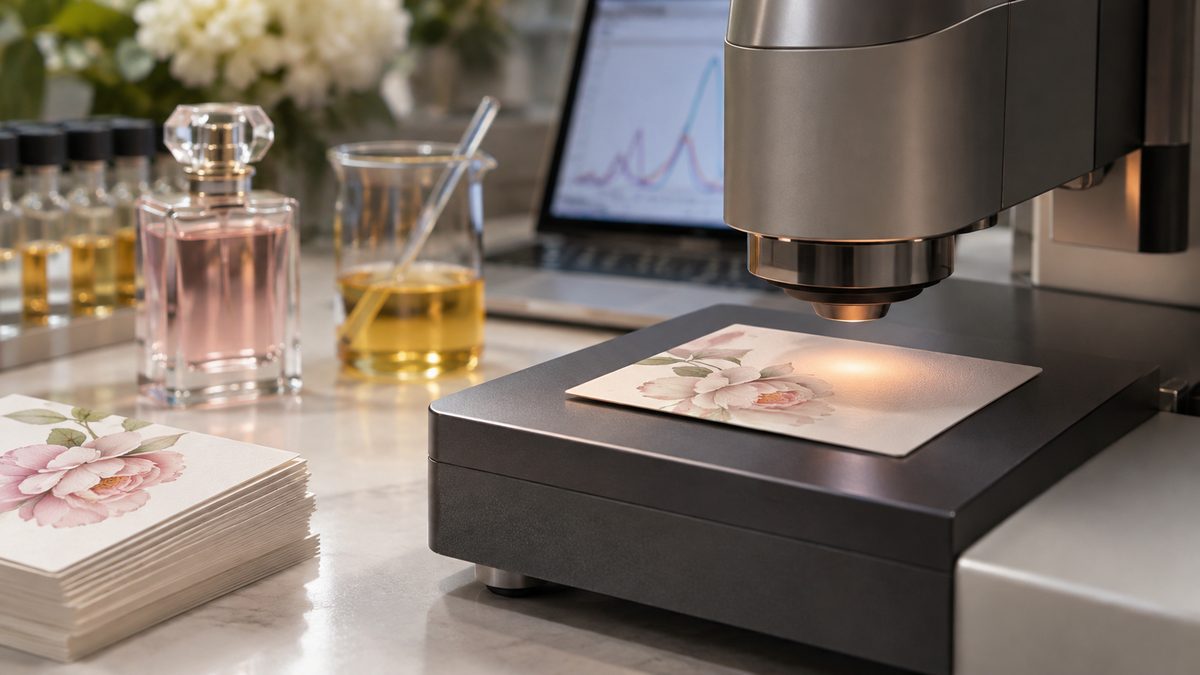
Non-destructive methods read the card without ruining it, which is what makes them usable as a high-frequency production check. The two families in practical use are spectroscopic — measuring how the card interacts with light, which changes with fragrance load — and headspace analysis, which measures the vapour the card gives off as a proxy for what it holds.
Spectroscopic reading of the card
Near-infrared and related techniques shine light at the card and read the absorption pattern, which shifts with the amount and type of fragrance present. The reading is instant and leaves the card intact, so it can run on every card on the line. The catch is that it is indirect: the signal must be calibrated against a destructive reference before the number means anything. Headspace analysis measures release at a moment, not the total held, so it is a proxy that must be interpreted carefully.
Calibration: turning a signal into a payload
The non-destructive methods all share one requirement: calibration. A spectroscopic reading or a headspace concentration is a signal, not a payload, and it only becomes a payload when correlated against the destructive reference across the range you care about. Without that correlation, the instrument produces a number with no meaning.
| Method | Destructive? | Measures | Main requirement |
|---|---|---|---|
| Solvent extraction | Yes | Total payload directly | Time and solvent |
| Weight-loss by heating | Yes | Volatile payload | Validation against extraction |
| Spectroscopic (e.g. NIR) | No | Signal correlated to payload | Calibration against reference |
| Headspace analysis | No | Vapour concentration | Controlled conditions, calibration |
Build the calibration on the actual substrate and fragrance, not a generic model, because the signal depends on both. A calibration built on one paper and one blend will misread another, and a misread number is worse than no number at all.
Choosing a method for your operation
The right method depends on what you are trying to control. For periodic verification and calibration, the destructive reference is correct; for catching drift on the line, a calibrated non-destructive method is the practical choice. Most operations end up running both — the reference occasionally, the fast method constantly.
For the card formats this QC applies to, see our products page.
Match the method to the decision
If the question is "is this batch within spec", a calibrated spectroscopic check answers it fast. If the question is "what is the true payload", the reference answers it accurately but slowly. Decide whether you check every card, a sample per run, or a sample per batch, set by the risk — a substrate with known variation justifies more checking. The weight-based production control in our substrate absorption note pairs naturally with these measurements.
Using the measurement to catch drift early
The whole point of measuring payload is to see drift before the customer does. Track the reading across runs and watch the trend, not just the pass/fail, because a payload drifting down run over run is a warning that a failure is coming even while every individual card still passes.
Chart the trend, not the snapshot
Plot payload against run or batch, and look at the direction of travel. A stable line is a healthy process; a downward drift points at a substrate or process change quietly reducing the product. When weak-scent complaints arrive, check the payload record for the affected batch before blaming the fragrance — the triage in our scent-card complaint note walks through it.
Limits and what the number cannot tell you
A payload number is powerful but bounded. It tells you how much fragrance the card holds, not whether it is evenly distributed, how it will release over weeks, or whether the scent character has changed.
Payload is necessary but not sufficient
A card can have the right payload and still be wrong — the oil concentrated in one corner, or degraded by heat into an off-odour. The payload measurement catches quantity, and it should be paired with a sensory evaluation and, where relevant, a check of distribution and character. Fix the measurement conditions too: payload readings, especially headspace, are sensitive to temperature and time, so hold the temperature, equilibration time and instrument settings constant, or the trend you are reading is noise.
Practical guide: measuring scent-card payload
Step 1 — Establish the destructive reference first
Run solvent extraction on a set of cards to establish the true payload, and validate any heating method against it for your substrate and fragrance.
Step 2 — Calibrate a non-destructive method to the reference
Correlate a spectroscopic or headspace signal against the reference across the full range you care about, on the actual substrate and blend.
Step 3 — Fix the measurement conditions
Set the temperature, equilibration time and instrument settings, and hold them constant so the trend you read is real, not noise.
Step 4 — Run the fast method at the chosen frequency
Check every card, a sample per run, or a sample per batch, set by the risk in your substrate and process.
Step 5 — Chart the trend, not just the pass/fail
Plot payload across runs and watch the direction, so a downward drift is caught while every card still passes.
Step 6 — Pair the number with a sensory check
Use payload for quantity, and pair it with a smell test for character and evenness, because no single number replaces the nose.
Frequently asked questions
What is a private label scent card?
A fragrance-impregnated card produced to your brand's specification — your fragrance, substrate, shape and print — by a supplier, while you own the brand and distribute the card under your own name.
What is a typical minimum order quantity for scent cards?
Minimums depend on the substrate, print and fragrance, commonly from a few thousand to tens of thousands of cards per SKU, with bespoke shapes and finishes carrying higher minimums.
What is the fragrance payload of a scent card?
The amount of fragrance the card actually holds after the oil has absorbed and partially evaporated. It is distinct from the applied amount, and it determines how the card smells and for how long.
What is the difference between payload and applied amount?
The applied amount is what the process puts onto the card; the payload is what the card retains. Absorption varies with the substrate and environment, so a fixed application can deliver different payloads.
Can I measure payload without destroying the card?
Yes. Spectroscopic methods such as near-infrared read the card's interaction with light and leave it intact, and headspace analysis measures the vapour above the card. Both are indirect and must be calibrated against a destructive reference.
What is the reference method for measuring payload?
Solvent extraction, which dissolves the fragrance out and quantifies it. Weight-loss by heating is simpler but must be validated against extraction.
Why does my non-destructive reading need calibration?
Because a spectroscopic or headspace signal is a number, not a payload. It only means something once correlated against the destructive reference on the actual substrate and blend.
What does a payload measurement not tell me?
It tells you quantity, not distribution, not release over time, and not whether the scent character has changed. Pair it with a sensory check.
Conclusion
The fragrance payload is the number that actually predicts how a scent card performs, and it cannot be managed by smell or by measuring the oil at the nozzle. The card itself has to be read, and the reading has to mean something — which is what calibration against a destructive reference provides.
Build the reference first, calibrate a fast non-destructive method to it, fix the conditions, and watch the trend rather than the pass/fail. Done that way, a weak batch is caught as a downward drift weeks before it becomes a customer complaint.
Discuss your fragrance programme with our team:
WhatsApp: +86 17324762943
Email: adon@customperfumeoem.com
Website: customperfumeoem.com