Stock Moulds vs Custom Tooling for Perfume Bottles: The Break-Even Point
Every private label bottle programme reaches the same fork: use a mould that already exists, or pay to cut one. The stock option is cheap, fast and available to your competitors. The custom option costs four or five figures before a single
Every private label bottle programme reaches the same fork: use a mould that already exists, or pay to cut one. The stock option is cheap, fast and available to your competitors. The custom option costs four or five figures before a single unit is filled, and the quote that arrives for it rarely includes everything you will eventually spend.
This article works through the economics honestly, including the cases where custom tooling never breaks even on unit cost and has to be justified by something other than price, and sets out what a mould quote should itemise before you compare it with a stock bottle.
Table of Contents
- What a mould actually is in a bottle programme
- The break-even arithmetic
- Costs that never appear on the tooling quote
- Validation, yield and the first production run
- Ownership, storage and the exit
- Practical guide: deciding in six steps
- Frequently asked questions
- Conclusion
What a mould actually is in a bottle programme
A custom perfume bottle mould covers several different purchases depending on material and process, and vendors quote them in ways that are hard to compare.
Glass, PET and aluminium are not comparable
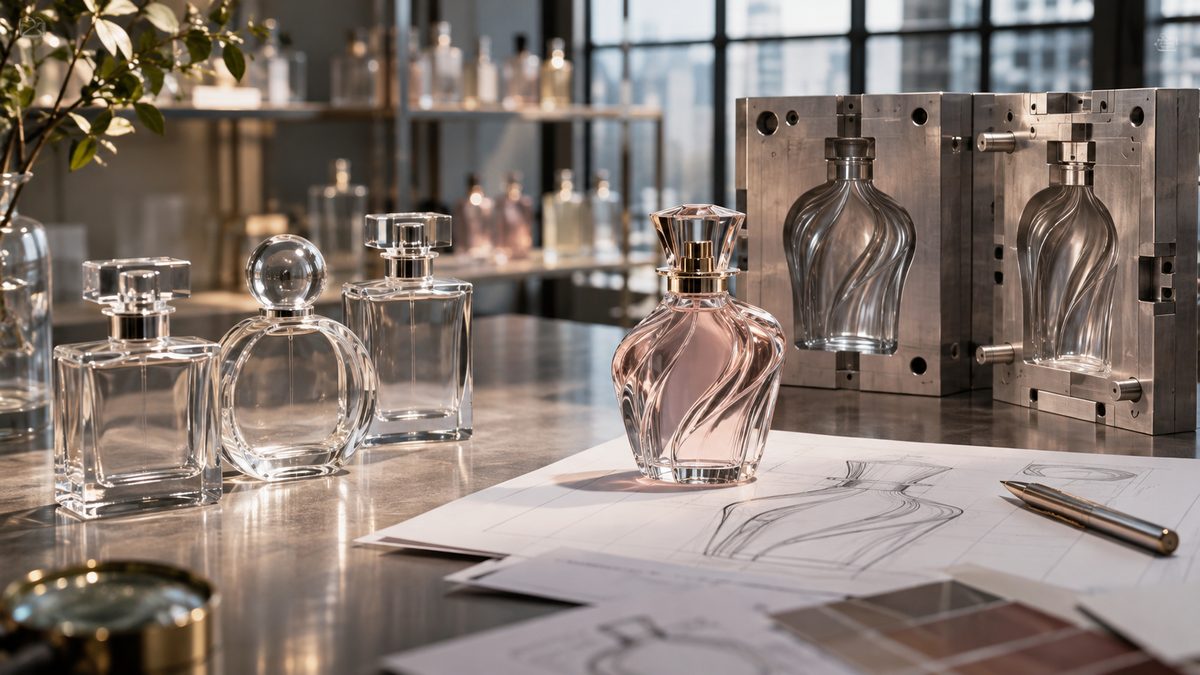
A glass container is formed from a gob in a blank mould and finished in a blow mould, with a neck ring defining the finish. A PET bottle needs an injection mould for the preform plus a separate blow mould, so the preform constrains the shape. An aluminium bottle is impact-extruded from a slug and needs a die plus decoration tooling. Cost, lead time and minimum run differ by an order of magnitude, and a quote saying only "mould" is not a quote.
Cavitation decides the unit price
More cavities means more units per machine cycle: lower conversion cost per unit, higher tooling price, and a higher minimum economic run, because a high-cavity tool only earns its keep over a long run. Four cavities and eight cavities are different unit economics, not different prices for the same thing.
Why the break-even moves with cavitation
The saving from a larger tool applies to the whole volume, so break-even falls as cavitation rises — but tool cost and minimum run rise with it. The result is a narrow band where a high-cavity tool beats both a stock bottle and a low-cavity tool, and buyers who compare only the tooling price never find it.
The break-even arithmetic
The custom perfume bottle mould calculation is simple and almost always done wrong, because the numerator is incomplete and the denominator is assumed rather than measured.
| Dimension | Stock mould | Custom tooling |
|---|---|---|
| Upfront cost | None beyond samples | Mould, neck ring, decoration, sampling |
| Lead time to first fill | Days to weeks | Weeks to months, plus trials |
| Minimum run | Set by the supplier's stock policy | Set by cavitation and machine setup |
| Unit price | Fixed by catalogue | Falls with cavitation and volume |
| Differentiation | None; competitors can buy the same pack | Shape, weight and finish are yours |
| Cost of a change | Switch to another stock item | New tool or rework, weeks and money |
| Risk if volume disappoints | Low; you buy less | High; tooling is sunk |
The numerator is not the mould price
Add every cost that only exists because the tool exists: the mould itself, the neck ring or preform tool, decoration tooling such as screens or stamping dies, samples from the trial run, fill and compatibility trials, drop testing, and the scrap from setting up. A tooling quote of one number and a true programme cost that is half again as large is the normal case, not the exception.
The denominator is a measurement, not a guess
The unit saving is the stock bottle's landed cost minus the custom bottle's landed cost at the volume you will actually order, not at the volume in your business plan. This is where most models fail: the custom unit price is quoted at the tool's economic run, while the actual order pattern is four small drops a year, each carrying a setup charge that the model ignored.
Costs that never appear on the tooling quote
The gap between a quote and a budget is made of a few items, all of them predictable.
Decoration tooling and its tolerances
Screens, stamping dies and label dies are separate purchases, each with its own lead time and registration tolerance. A perfectly moulded bottle can still fail because the decoration sits a millimetre off on a curved shoulder, and the fix is a new screen. Ask for the tolerance in millimetres and for the sample that proves it.
Mould wear, refurbishment and drift
Glass moulds wear, producing weight variation and seam marks long before they fail. A tool has a finite life in cycles, and refurbishment usually falls due during a successful programme rather than after it. Budget it, and ask for the acceptance window on bottle weight, because wear erodes that first.
Validation, yield and the first production run
The first run from a new tool is a test, not a production batch, and it should be budgeted and scheduled as one.
What the trial has to prove
Dimensional conformity against the drawing, weight consistency across cavities, closure torque and leak performance with the real pump, drop resistance from a defined height, and fragrance compatibility over a defined period. Each can fail independently and each fix costs a cycle.
| Check | Method | Fail signature | Consequence |
|---|---|---|---|
| Dimensions | Measurement across cavities | Ovality, height spread | Cap fit, conveyor jams |
| Weight | Per-cavity weighing | Drift beyond the agreed window | Fill variance and cost creep |
| Closure | Torque and leak test with the production pump | Seep at the shoulder | Returns and stained cartons |
| Compatibility | Filled and stored for a defined period | Stress cracking, panel deformation | Recall risk |
| Drop | Defined height onto a hard surface | Shatter at the base | Safety and freight claims |
Yield assumptions that quietly break the model
Reject rates on a new tool are higher than on a mature one, and the rejects are charged to you. If the model assumes two per cent loss and the first three runs deliver eight, the unit cost moves enough to erase the saving. Ask for the expected reject rate and how scrap is credited.
Ownership and the exit
Tooling is an asset only if the paperwork says it is, and the default in many contracts is that the supplier holds it.
The register question
Ask whose name appears on the mould register and what happens on termination. A tool paid for by the brand but registered to the factory is a hostage, and the ransom is priced at the moment you are least able to negotiate. The fix is a clause, an inventory entry and photographs of the tool with its identification number, agreed before the first invoice.
What moving a tool actually involves
Even with clear ownership, moving a mould means transport, re-qualification at the new site, new trial samples and a new set of compatibility tests. That cost belongs in the model as an exit value, not as a legal footnote. Our note on packaging obligations covers the compliance side of changing a pack mid-life.
Practical guide: deciding in six steps
Run these in order. The output of each is an input to the next, and the last step is the only one that should produce a decision.
Step 1 — Price the stock bottle with decoration included
A catalogue price without printing, coating or assembly is not the comparison point. Get a landed cost for the finished, decorated pack at your real order size, from the packaging range your supplier stocks.
Step 2 — Ask for the tooling quote split by line
For a custom perfume bottle mould, the mould, neck ring or preform, decoration tooling and trials should each be a line. A single figure cannot be audited and usually hides the items you will be invoiced for later.
Step 3 — Convert every cost into a per-unit figure at three volumes
Amortise the full numerator over low, mid and high annual volumes. The curve usually has a knee, and the knee is the number you want rather than a single break-even point.
Step 4 — Re-price at two cavitation levels
Ask what the unit price would be with a tool of half the cavitation. If the difference is small, the tool is not the cost driver and the decision is about differentiation rather than money.
Step 5 — Add validation and scrap explicitly
Trials, rejects and refurbishment belong in the numerator. A model without them will show a break-even that the first production run disproves.
Step 6 — Fix ownership before you pay
Register the tool in your name, agree storage, and state the transfer conditions. Then, and only then, place the order. The customization process sets out where tooling sits relative to formula and artwork approval.
Frequently asked questions
What is private label packaging?
Supply of a standard or semi-standard container, closure and decoration under a buyer's brand. The buyer owns the brand and specification; the supplier owns the tooling unless transferred.
How many units do I need before a custom mould makes sense?
There is no universal number. It depends on material, cavitation, tooling price and the gap against the stock alternative. The honest answer comes from amortising the full cost at your real order pattern.
Can I use the same bottle for several fragrances?
Yes, and it is usually the right move for a range. One mould across three SKUs spreads the tooling over a larger volume, which is often what makes the economics work at all.
Does a custom perfume bottle mould always reduce unit cost?
No. At low volume it usually raises it. Custom tooling buys differentiation, weight and a shape competitors cannot buy; treating it as a cost-reduction project is how the business case goes wrong.
What is the break-even point in practice?
It is the volume at which the tooling plus validation cost divided by the per-unit saving reaches one. Because the saving is often negative at launch, many programmes break even only in the second or third year, if at all.
Who owns the mould if I pay for it?
Whoever the register names, which is not always the payer. Insist on a written assignment, an identification number and a storage agreement before the tool is cut.
How long does a new bottle tool take?
Sampling, tool cutting, trial shots and approval usually run over weeks to months. The trial cycles, not the machining, are what move the date.
What happens when the mould wears out?
Weight variation and seam marks appear first. Refurbishment or replacement is a real cost within the life of a successful programme and belongs in the model from the start.
Conclusion
Stock tooling is a decision to compete on everything except the bottle, which is often right and occasionally fatal. A custom perfume bottle mould is a capital decision disguised as a packaging choice, and it pays only when volume, price gap and differentiation support it together.
Model the full numerator, measure the denominator at your real order pattern, and settle ownership before money moves. A programme that does those three things can defend its bottle choice to a finance director; one that compares two quotes cannot.
Discuss your fragrance programme with our team:
WhatsApp: +86 17324762943
Email: adon@customperfumeoem.com
Website: customperfumeoem.com