EU Packaging Rules in 2026: What Private Label Perfume Brands Need to Know
The EU packaging regulation is now applying. Learn what perfume brands should check when sourcing bottles, pumps and cartons.

Industry update · 7 November 2026
Perfume packaging decisions now deserve a closer look from brands selling in Europe. The EU Packaging and Packaging Waste Regulation (PPWR), Regulation (EU) 2025/40, began applying on 12 August 2026, with different requirements phased in over time. For private label perfume buyers, the immediate opportunity is to build a reliable picture of every packaging component before committing to a bottle, pump and carton.
This industry update explains the timeline and the practical questions to discuss with a perfume OEM partner. It focuses on packaging; cosmetic formula, labelling and product safety obligations still need their own review.
Table of Contents
- What changed in 2026?
- The timeline for perfume packaging buyers
- What to check in a perfume pack
- Compare packaging choices
- Practical sourcing steps
- Frequently asked questions
- Conclusion
What changed in 2026?
The PPWR entered into force on 11 February 2025 and generally applies from 12 August 2026. It establishes a framework covering packaging across its life cycle. It applies to packaging materials generally, so a perfume project can involve several components and separate supply-chain responsibilities. The previous Packaging and Packaging Waste Directive was generally repealed on the application date, with some provisions continuing under transitional arrangements. See the European Commission’s packaging overview.
For a brand, the business impact is concrete: a change to a coating, pump, insert or supplier can alter the evidence needed to assess the pack. A material specification should travel with the approved component, not be collected only after artwork is complete.
The timeline for perfume packaging buyers
| Milestone | What it means | Buyer action |
|---|---|---|
| 11 February 2025 | Regulation entered into force. | Identify the exact packaging and economic operators involved. |
| 12 August 2026 | General application begins; individual provisions and transitions differ. | Review current obligations with the responsible EU operators and advisers. |
| From 2028 | The Commission describes a phased harmonised packaging-labelling system; specific rules and timings depend on the legal provision and implementing measures. | Reserve artwork space and monitor implementing rules before printing future stock. |
| From 2030 and later | Further recyclability, recycled-content and other measures apply on their own terms and schedules. | Request component data now; review specific requirements, exemptions and later acts before committing to a design. |
The Commission’s August 2026 announcement gives an overview. Its implementation guidance explains that the general recyclability requirement applies from August 2026, while the detailed design-for-recycling criteria have their own later timing. Do not treat every 2030 measure as already applicable or assume the same deadline for every component.
What to check in a perfume pack
Glass bottle and decoration
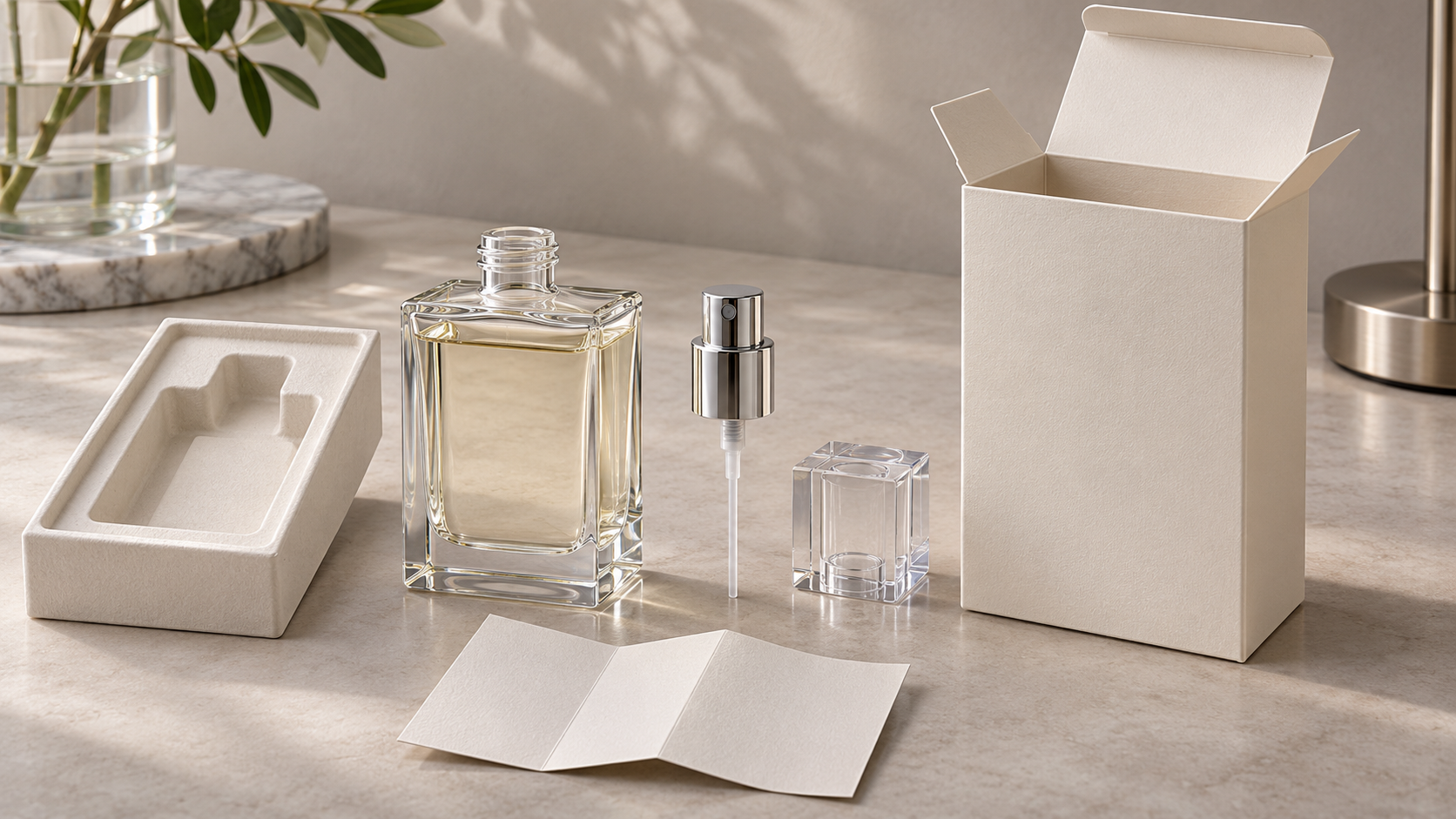
Request bottle weight and material specifications, including coatings, printing and any permanent attachments. A glass bottle is not automatically recyclable in every local system: colour, coatings, remaining contents and attached components can affect practical handling. Ask for evidence relevant to the actual design and market rather than relying on a generic supplier claim.
Pump, cap and closure
A perfume atomizer can contain several materials, including metal, plastics and elastomers. Ask for a breakdown by component and how the assembly is attached. A removable closure may support separation, but removal must be safe and practical; changes must not compromise leak resistance, spray function or product compatibility.
Carton and protective insert
Identify board, coatings, foil, lamination and inserts. Consider whether the structure protects the bottle with fewer materials, then verify transport performance. A smaller carton is not useful if it causes more breakage. Compare packaging options with a filled and assembled sample, using agreed handling tests and acceptance criteria.
Compare packaging choices
| Decision | Potential benefit | Trade-off and evidence to request |
|---|---|---|
| Stock glass bottle | Existing tooling can reduce development complexity. | Request material and weight data, neck dimensions and decoration details. |
| Custom coated bottle | Distinctive visual identity. | Ask about coating composition, assessment evidence, durability and recyclability impact. |
| Mixed-material pump | Established spray performance and product protection. | Request a material breakdown and assess separation alongside leak and spray tests. |
| Paper-based insert | May simplify a predominantly paper secondary pack. | Confirm coating, fit and transit protection; paper appearance alone is not proof of recyclability. |
| Refillable format | Can support reuse when the system is actually operated and used. | Clarify refill availability, instructions, durability, cleaning and applicable legal conditions. |
Explore our perfume packaging options, OEM and ODM services and perfume collection when preparing a development brief.
Practical sourcing steps

- Map the complete pack. List the bottle, pump, cap, label, carton, insert and transport packaging for each SKU. Record weights, materials, coatings and suppliers.
- Identify the destination and operators. Confirm where the product will be placed on the EU market and which party acts as manufacturer, importer, distributor or other relevant economic operator for each obligation.
- Request traceable evidence. Obtain dated component specifications and supporting declarations. Ask about mixed materials, recycled content claims and any changes in supply.
- Assess the actual assembly. Review applicable rules, Commission guidance and relevant national producer-responsibility arrangements with qualified advisers. Avoid unsupported claims such as “fully recyclable everywhere.”
- Approve function as well as design. Test closure integrity, compatibility, decoration durability and transit protection on the final filled pack.
- Control revisions. Keep the approved bill of materials and artwork version. Reassess when the supplier, material, coating or packaging construction changes.
Frequently asked questions
What is private label perfume packaging?
It is the bottle and associated packaging supplied for a perfume sold under the buyer’s own brand. The amount of customization depends on the project and agreement.
Can I customize a stock perfume bottle?
Often, stock bottles can be combined with selected caps, labels, decoration and cartons. Confirm minimum order quantities and compatibility with your supplier.
What information should I give a perfume OEM?
Provide your target markets, intended retail price, bottle size, forecast quantities, fragrance brief, packaging preferences and launch schedule.
Does the PPWR apply to perfume packaging?
The regulation covers packaging generally, including packaging used for perfume. The obligations and responsible economic operators depend on the specific packaging and circumstances.
Did all PPWR requirements begin on 12 August 2026?
No. That is the general application date. Individual provisions, transitional measures and future implementing rules have different dates and conditions.
Is every glass perfume bottle automatically recyclable?
No. Assess the actual bottle and attached components, coatings and local collection and recycling context. A material description by itself is not sufficient evidence for a broad claim.
Must every perfume bottle use recycled plastic by 2030?
No blanket conclusion follows. Recycled-content requirements concern specified plastic parts and categories and include conditions and exceptions. Assess the actual component against the applicable provisions and subsequent rules.
Does a refillable bottle automatically satisfy every reuse requirement?
No. Reusability involves the packaging’s design and the relevant reuse system and legal conditions. A refill concept should be assessed and documented for its intended market.
Conclusion
The PPWR makes packaging data a strategic part of perfume sourcing. Brands can prepare by mapping components, requesting evidence, identifying responsible parties and testing the complete pack. Start early: a well-documented bottle, pump and carton are easier to assess and update as detailed rules develop.
Discuss your next fragrance project with our team:
WhatsApp: +86 17324762943
Email: adon@customperfumeoem.com
Website: customperfumeoem.com