Choosing a Candle Vessel System Before Choosing a Wax
Most candle programmes treat candle vessel selection as a packaging decision and choose the wax first. The order is backwards. The vessel sets the burn diameter, heat retention, wick length, achievable fragrance load and fill weight, and by
Most candle programmes treat candle vessel selection as a packaging decision and choose the wax first. The order is backwards. The vessel sets the burn diameter, heat retention, wick length, achievable fragrance load and fill weight, and by the time a wax is selected those constraints are expensive to change.
This article explains how the vessel behaves as a thermal system before any wax is poured, compares the main vessel families on tooling and risk, and gives a specification sequence that keeps candle vessel selection from becoming a late-stage redesign.
Table of Contents
- The vessel is a thermal system
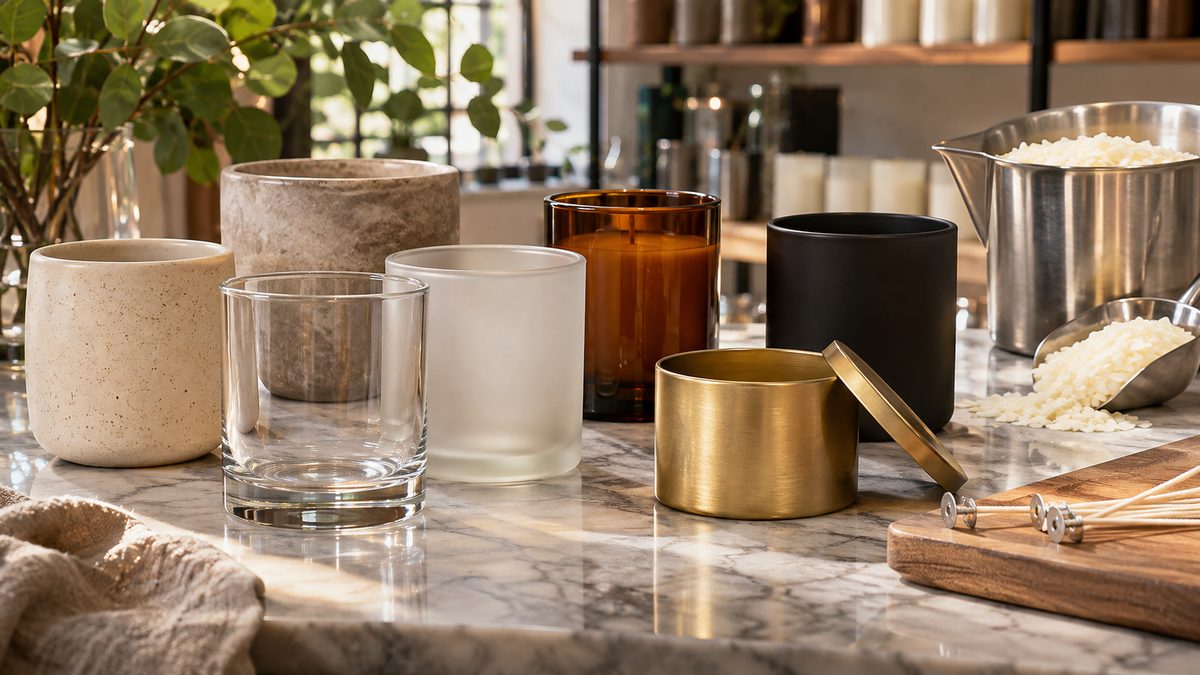
- Vessel families and their constraints
- What glass specification must fix
- How the vessel decides the wax
- Tooling, MOQ and freight
- Practical guide: specifying a vessel first
- Frequently asked questions
- Conclusion
The vessel is a thermal system
Diameter decides the wick, not volume
Choose the diameter first, then the wick, then the wax blend that carries the required load. A wick is sized to the melt pool it must create, so two vessels holding the same 200 g of wax can need different wicks if one is wide and shallow and the other narrow and deep.
Depth matters too. A deep vessel with a narrow opening retains heat and can overheat the melt pool late in the burn, while a shallow wide vessel loses heat quickly and may struggle to reach the edge. The shape of the pool over the life of the candle is a vessel property before it is a wick property.
Wall and base thickness change the burn
Thick walls insulate the pool and slow heat loss, which can widen the pool but also raise the temperature at the wick. A thick base adds thermal mass, so the last third of the burn behaves differently from the first. Neither is automatically better; the vessel's mass belongs in the burn test, not only in the packaging specification.
Why thermal shock cracks a vessel that passed a burn test
Glass fails when one region expands faster than another. A thick-walled tumbler can pass a steady burn and still crack when a consumer sets it on a cold surface or adds a lid while warm. Annealing relieves the residual stress from forming, but it does not make the glass immune to a steep temperature gradient. Vessel selection therefore includes a thermal-shock test, not only a drop test.
Vessel families and their constraints
Each family carries a different cost structure and a different failure mode. The table compares them at the level a buyer needs before requesting samples; the detailed specification still has to be written per supplier.
| Vessel family | Thermal behaviour | Tooling and minimum | Main risk |
|---|---|---|---|
| Moulded glass | Retains heat; thick walls slow cooling | High mould cost, high minimum per colour | Thermal shock and visible mould seams |
| Blown glass | Thinner, more variable wall | Lower tooling but looser tolerance | Wall variation changing the burn |
| Tinplate | Conducts heat; exterior gets hot | Low tooling, moderate minimum | Seam integrity and coating attack |
| Ceramic | Slow to heat, slow to cool | Mould plus glaze minimum per colour | Glaze crazing and poor wax adhesion |
| Concrete | High mass, uneven conductivity | Mould cost moderate, heavy freight | Porosity, oil weeping and staining |
What glass specification must fix
Tolerance, annealing and the rim
Wall thickness tolerance is the single most under-specified glass property. A nominal 3 mm wall that varies from 2.4 to 3.6 mm changes the heat path and the wick performance between units. Ask for a tolerance range, a sampling plan and a measurement method, plus the annealing record and thermal-shock test condition.
The rim matters more than it looks. A wavy rim prevents a lid from sealing, and a sharp or chipped rim is a handling complaint. Specify rim flatness, chip limits and the lid fit as a functional requirement, then test a filled, closed unit rather than an empty one.
Neck opening and headspace
A narrow neck limits oxygen at the flame and can make the candle burn unevenly or extinguish near the end. It also complicates filling and wick centring. The headspace above the wax, the neck diameter and the wick height together decide how the candle behaves in the first and last burns, so they belong in the drawing that the supplier quotes against.
Decoration and compatibility
Spray coating, frosting, printing and adhesive labels all interact with heat and wax. A frosted finish can show fingerprints and wax residue; a printed wrap can lift when warm; a label adhesive can fail at the vessel's exterior temperature. Test decoration on a filled candle that has burned, not on a blank sample.
| Specification field | What it controls | Failure when left loose |
|---|---|---|
| Inside diameter | Wick size and pool width | Tunnelling or overheating |
| Wall tolerance | Heat path between units | Inconsistent burn across a batch |
| Base thickness | Thermal mass at the end of burn | Late-stage cracking or scorching |
| Rim flatness | Lid seal and handling | Leaks and chipped rims |
| Annealing record | Residual stress in the glass | Thermal-shock failure in use |
How the vessel decides the wax
Adhesion, shrinkage and the wet spot argument
Container waxes are formulated to adhere to glass as they cool. Whether they do depends on the cooling rate, the pour temperature and the vessel's thermal mass. A thick glass wall cools the wax slowly and can improve adhesion; a cold room can cause the wax to pull away and leave wet spots. Those spots are often cosmetic, but they are also a signal that the cooling profile and the vessel are not matched.
Shrinkage is a wax property, but the vessel determines whether shrinkage becomes a visible defect. A clear glass vessel shows every gap; an opaque tin hides it. If the brand's packaging concept depends on a clear vessel, the wax and the pour schedule have to be chosen for appearance, not only for throw.
The vessel sets the maximum practical fragrance load
Fragrance load has a ceiling set by the wax, but the vessel shifts it. A wider vessel needs a larger wick and a hotter pool, which reduces the load the system can burn cleanly; a narrow one may tolerate more load but struggle to throw. A load approved in one vessel cannot be transferred without a new burn test.
Tooling, MOQ and freight
Tooling cost follows the material. A glass mould is the most expensive and the least flexible, and a colour change can carry its own minimum. A ceramic body needs a mould plus a glaze run, so the effective minimum is often set by the glaze. Tinplate tooling is comparatively cheap, which is why small brands start there and move to glass when volume justifies it.
Freight is the other half of candle vessel selection. Glass is heavy and bulky, so packed volume and the drop-test standard matter as much as the unit price. A taller vessel can cost more to ship than a shorter one of the same capacity. Ask for the packed dimensions, gross weight and drop-test report before comparing quotes.
Practical guide: specifying a vessel first
Step 1 — Fix the burn diameter and the fill weight
In candle vessel selection, decide the inside diameter at the wax surface and the grams of wax the vessel will hold. These two numbers drive the wick, the load and the burn time, and they are cheaper to change on paper than in a mould.
Step 2 — Choose the family against channel and freight
Match glass, tin, ceramic or concrete to the retail channel, the weight the customer expects and the freight budget. A premium material that arrives cracked or overweight is not premium.
Step 3 — Write tolerances, not nominal dimensions
Specify wall and base thickness ranges, rim flatness, capacity tolerance and lid fit, with a sampling plan. A nominal figure without a range is not a specification.
Step 4 — Test thermal shock and drop as a filled unit
Fill, wick and burn the actual vessel, then test the empty and the burned unit. A vessel that survives a drop test when empty can fail when full and warm.
Step 5 — Run the wax and wick trial inside that vessel
Do not approve a wax on a standard lab container and then transfer it. The vessel's mass and geometry are part of the combustion system, so the trial has to happen in the final article.
Step 6 — Confirm decoration after a burn
Check print, frost, coating and label adhesion on a candle that has burned to the last third. Heat exposure is the condition decoration actually sees.
Step 7 — Lock the drawing and the packed specification
Attach the approved drawing, the packed dimensions and the test reports to the purchase order, and link them to the packaging specification. Our candle pack planning note covers how the shelf and gift channel change those requirements.
Frequently asked questions
What is private label candle manufacturing?
A candle factory pours the wax, sets the wick and fills the vessel you chose, then packs it under your label. The brand owns the design and claims.
What is a typical minimum order?
Glass and ceramic drive it: a mould and colour run must be amortised. Tin allows a much smaller first order.
How long does development take?
Sampling the vessel, matching wax and wick, then burn testing takes weeks. The mould or container shipment usually lands last.
Should I choose the vessel or the wax first?
The vessel. Diameter, depth and mass constrain the wick and the wax, and changing a mould later is far more expensive than changing a wax blend.
Why does the same wax perform differently in two vessels?
Because the vessel changes heat retention, pool width and wick length. The wax is one part of a combustion system, and the vessel is another.
Are wet spots a defect?
They are usually cosmetic and result from cooling and adhesion, not from a bad wax. In clear glass they matter commercially, so specify the appearance and match the pour schedule to the vessel.
How thick should the glass be?
There is no single answer; the range has to suit the diameter, the burn and the thermal-shock requirement. Specify a tolerance and test the actual unit rather than copying a number from another project.
Can I change the vessel colour after approval?
Only with a new sample and usually a new minimum. Colour changes can alter heat absorption and mould running, so treat them as a specification change, not a decoration choice.
Conclusion
The vessel is not packaging that arrives after the candle is designed. It is the thermal environment the candle burns in, and candle vessel selection fixes the wick, the load and the appearance before the first wax sample is poured. Choosing it first turns a chain of late surprises into constraints that can be tested in order.
That order also protects the launch budget. Moulds, minimums and freight are decided early, while the wax and wick remain adjustable. A programme that reverses the sequence spends its flexibility on the most expensive item and discovers the burn problems when there is no time left to solve them.
Discuss your fragrance programme with our team:
WhatsApp: +86 17324762943
Email: adon@customperfumeoem.com
Website: customperfumeoem.com