
Candle Warning Symbols and Multilingual Artwork: Managing Variants
A brand ships one candle into five markets and ends up with five artwork files, three warning-wordings and a label that no longer matches the approved safety text. When a retailer asks for the French version, the team realises the warning b
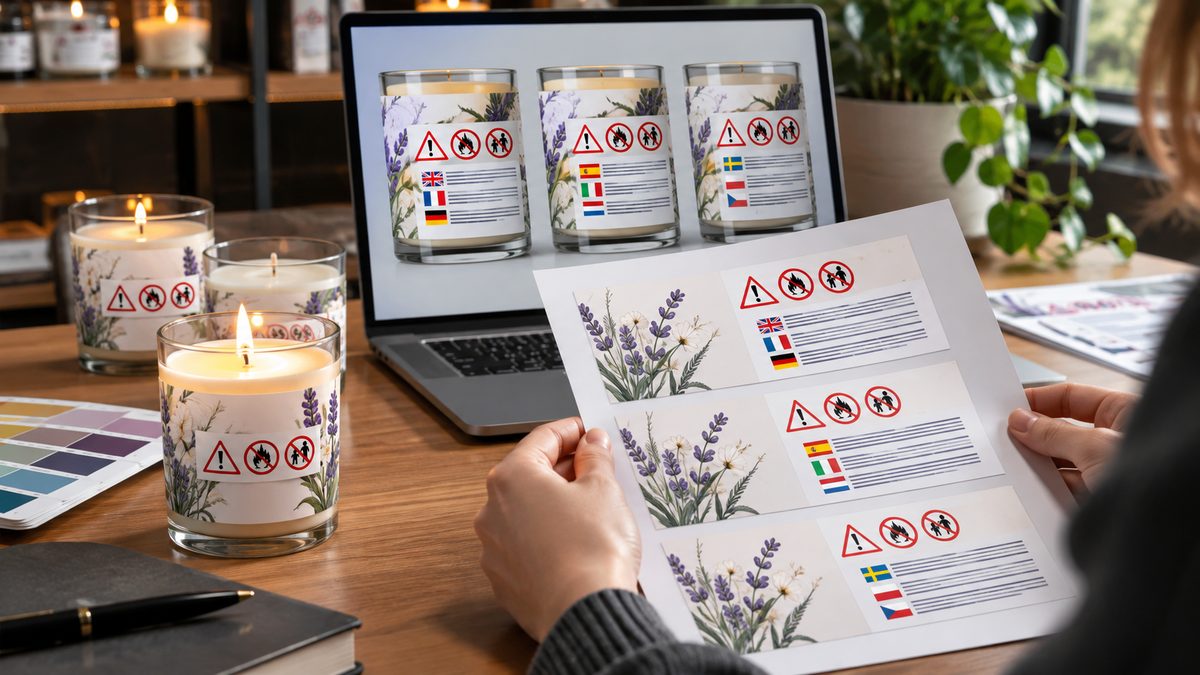
A brand ships one candle into five markets and ends up with five artwork files, three warning-wordings and a label that no longer matches the approved safety text. When a retailer asks for the French version, the team realises the warning block was never designed to scale.
This article explains what a candle warning label must communicate, how the pictogram-and-text block is structured across languages, and how to manage artwork variants so one master file drives every market without a compliance miss. It covers the warning elements, translation workflow, variant naming and the inspection checks that catch a wrong label before it reaches a shelf.
Table of Contents
- What a warning block must contain
- Pictograms and the text that travels with them
- Multilingual layouts: space and legibility
- Variant logic: market, channel and language
- An artwork workflow that prevents drift
- Where variant errors actually happen
- Inspection checks for warning labels
- Practical guide: managing warning-label variants
- Frequently asked questions
- Conclusion
What a warning block must contain
Candle warnings are a small set of fire-safety instructions that regulators and retailers expect to see together. The core items are nearly universal: keep away from children and pets, never leave a burning candle unattended, trim the wick, and keep clear of drafts and flammable material.
| Warning element | Purpose | Typical wording style |
|---|---|---|
| Unattended-burning warning | Prevent house fires | "Never leave a burning candle unattended" |
| Keep-away instruction | Protect children and pets | "Keep out of reach of children and pets" |
| Wick-trim instruction | Reduce sooting | "Trim wick to 5 mm before each use" |
| Burn-surface instruction | Avoid heat damage | "Burn on a heat-resistant surface" |
| Stop-burn instruction | Prevent overheating | "Stop use when 10 mm of wax remains" |
Because wording varies by jurisdiction and retailer style guide, the label text should be treated as a controlled document with a version number, not free-form copy. Confirm the exact mandatory wording against the current official text for each market before locking artwork.
Pictograms and the text that travels with them
A pictogram crosses language barriers but not always legal ones. Some symbols are recognised because an industry body publishes them; a few markets or large retailers demand a specific set, while others accept symbols only when paired with text.
The common set includes a flame with a crossed-out eye, a child-and-pet figure with a prohibition bar, a scissors-on-wick mark, and a surface-placement icon. These symbols reduce translation burden but do not remove it: the text remains the legally operative part in most retail reviews.
Why a pictogram alone is rarely enough
A symbol communicates intent only if the reader already knows its meaning, which regulators cannot assume. In practice, auditors read the text block, not the icons, when approving a label. Treat pictograms as visual reinforcement and keep the full text in every required language.
Multilingual layouts: space and legibility
Adding a second or third language multiplies the warning block's footprint. The same five instructions that fit on the back of a jar in English may not fit when repeated in German, which tends to run 20–30% longer than the English source.
Designing for the longest language first
Set the label real estate from the longest translation, not the shortest. If the block must hold English, German and French, lay it out with German as the worst case, then confirm the other languages fit without shrinking below a legible point size.
Expanding formats that avoid redrawing
Three structures handle most multilingual cases: a stacked block where each language sits under its flag or code, a fold-out booklet label when the container is too small, and a separate base label that carries symbols while the multilingual text moves to the outer carton.
Variant logic: market, channel and language
A "variant" is the combination of market, channel, language and sometimes fragrance-specific text such as a burn-time or allergen note. Untangling these axes keeps the master artwork stable while each variant remains traceable.
Separating the axes
Market determines which regulator's wording applies; channel determines whether a distributor's logo appears; language determines the translation; fragrance determines variable fields like burn time. Keep these as separate fields in the artwork database rather than mixed into one file name.
Naming that survives an audit
A file name should encode brand, SKU, market and revision in a fixed order, for example BRAND_SKU_EU_FR_R02. Any scheme is acceptable as long as one person can read it and tell, without opening the file, whether it is the approved version.
An artwork workflow that prevents drift
Warning text must be approved separately from the decorative artwork, because the two change on different schedules. A label that looks right can still carry an outdated safety sentence, and an artwork proof alone does not catch that.
Approval gates and revision control
Route the warning text through a compliance owner before the designer places it, then freeze that text in the master file. Version the text block independently of the artwork revision so a French wording change does not renumber the English-only label.
| Change type | Who approves | What gets re-checked |
|---|---|---|
| Decorative artwork | Design owner | Print proof only |
| Warning wording | Compliance owner | Verbatim text match |
| Translation | Human translator + reviewer | Character-for-character |
| New market | Compliance + design | Full label against that market's rules |
Where variant errors actually happen
Variant mistakes cluster in three places: the wrong file being printed for a market, the text block updated on the master but not on a derived variant, and a translation that fits the layout but was never proofed by a native speaker.
The wrong-file and translation problems
When a printer holds a dozen near-identical files, one digit separates the French from the Dutch label. Embed the market code as a visible two-letter field in the label's non-print area, so the inspector can verify the file at a glance. Machine translation can render a safety instruction ambiguously, so use a human translator who knows the category and have a second reviewer compare the laid-out text character by character.
Inspection checks for warning labels
Label inspection is where a variant mistake is cheapest to catch, because the goods are still at the factory. Compare the printed label against the approved artwork and the approved text block, not against memory.
Check the market code, the revision number, the presence of every required language, and the two highest-risk instructions — the unattended-burning and keep-away lines. Verify legibility at the approved point size and that no line is cut off at the container's curvature. Label size and curvature are set by the container, which is a packaging decision; artwork files are exchanged with our compliance team through the contact page. For the burn behaviour behind those warnings, see our piece on scented candle combustion science.
Practical guide: managing warning-label variants
Step 1 — Build the master warning text in one language
Write the full instruction set in the source language and have a compliance owner sign it before any design work starts.
Step 2 — List every market, channel and language
Produce a matrix of market, channel and required languages, and mark which fields are variable per fragrance.
Step 3 — Lay out the longest language first
Set the label area using the longest translation as the worst case, then confirm every other language fits at the approved minimum point size.
Step 4 — Fix a naming convention and revision field
Adopt a fixed naming order that includes market and revision, and version the text block separately from the artwork.
Step 5 — Route translations through human proofing
Use a category-literate translator and a second reviewer, and confirm the laid-out text matches the approved string character for character.
Step 6 — Inspect by market code and wording on the line
Have the inspector verify the embedded market code, the revision, and the two highest-risk sentences on a photographed sample.
Frequently asked questions
What is private label candle manufacturing?
It is the production of candles under your brand by a factory that uses your approved fragrance, container, label and warning text while handling compounding, filling, finishing and documentation.
What is a typical minimum order quantity for scented candles?
A common starting point is a few thousand units per fragrance, with smaller runs available at a higher unit cost because set-up is spread over fewer pieces.
What is the difference between FOB and DDP shipping for candles?
FOB places the goods on board the vessel at origin with the buyer carrying freight and import costs, while DDP has the seller carry freight, duty and clearance to the door.
Which candle warning statements are mandatory?
The recurring set covers unattended burning, keeping the candle away from children and pets, wick trimming, burning on a heat-resistant surface, and stopping when a small amount of wax remains. Confirm the current official wording for each market.
Can I use pictograms instead of translated text?
Generally no. Pictograms reinforce meaning but do not replace the operative text in most retail compliance reviews. Keep the full wording in every required language.
How do I stop the wrong language file being printed?
Embed a visible two-letter market code in the label's non-print area, fix a naming convention that includes market and revision, and have inspection verify the code on the line.
What point size should a candle warning label use?
There is no single figure; it depends on container size and the retailer's artwork rules. Design from the longest language first and confirm the minimum against the market's current requirements.
How do I prove a label is the approved version?
Keep a revision field in the file name, version the warning text separately from the artwork, and file the photographed, labelled sample against the order.
Conclusion
A candle warning label is a compliance document that happens to be printed artwork, and it fails exactly where those two roles separate — a right-looking label with an outdated sentence, or a correct text block laid into the wrong market's file.
The fix is structural rather than creative: one signed master text, a market-and-language matrix, a naming convention with a revision field, and a line-side check that compares the printed label to the approved text verbatim. When those controls are in place, adding a market becomes a data entry, not a redesign.
Discuss your fragrance programme with our team:
WhatsApp: +86 17324762943
Email: adon@customperfumeoem.com
Website: customperfumeoem.com


