Candle Testing Beyond the Burn Test: What Buyers Now Ask For
Every candle supplier runs a burn test. Far fewer can send a buyer a report that covers the last third of the jar, the coldest corner of a warehouse, the batch made on a Friday afternoon with the final drum of wax, and the soot measured rat
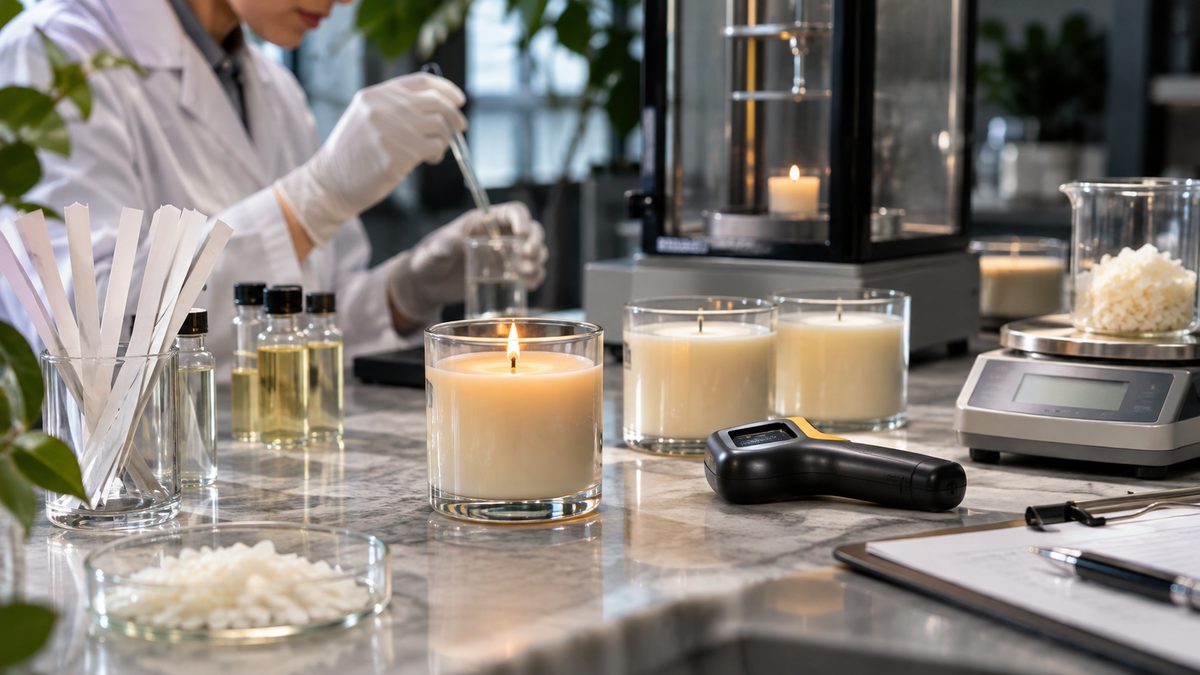
Every candle supplier runs a burn test. Far fewer can send a buyer a report that covers the last third of the jar, the coldest corner of a warehouse, the batch made on a Friday afternoon with the final drum of wax, and the soot measured rather than eyeballed. The test exists; the evidence does not.
Buyers have moved on from asking whether a burn test was done to asking what it covered. This article sets out what standard candle testing actually measures, which additional tests a retail technical team now expects, how to size samples so the results mean something, and what a usable test report contains.
Table of Contents
- What a burn test measures, and what it misses
- The candle testing matrix buyers ask for
- Stability, transport and shelf life
- Safety standards and the document set
- What a usable test report contains
- Practical guide: commissioning testing
- Frequently asked questions
- Conclusion
What a burn test measures, and what it misses
A conventional burn test lights a candle, burns it in cycles and records melt pool diameter, flame height, wick length, mushrooming and smoke. Run properly it is a good instrument, and it is usually not run properly.
The three common shortcuts are a single unit, a single burn cycle, and a quiet room that is warmer or stiller than a customer's living room. Each one removes the conditions under which most complaints occur, so the test passes and the product fails.
Why the last third of the burn matters most
As wax level falls, the vessel retains more heat, the pool widens and the wick draws more fuel. Behaviour at hour two of a full jar says little about hour thirty, and reports that stop before the final third describe a different product from the one the customer finishes.
Heat build-up is geometry as much as fuel
Two vessels of equal volume behave differently if one is tall and narrow and the other wide and shallow. Glass thickness and base contact decide how much heat returns to the wax, so a configuration approved in one vessel cannot be assumed to hold in another.
What the test cannot see
A burn test says nothing about a month in a hot warehouse or a dropped pallet, and it cannot capture variation between wick lots, wax batches or fragrance deliveries.
The candle testing matrix buyers ask for
The following set is a reasonable expectation for a private label programme, and a supplier who can produce all of it is telling you something about process control.
| Test | What it detects | Conditions worth specifying |
|---|---|---|
| Burn cycle test | Pool formation, tunnelling, wick behaviour | Cycles matched to the stated burn time, trimmed to label advice |
| Sooting assessment | Incomplete combustion, vessel staining | Measured rather than judged visually; include the final third |
| Surface temperature | Vessel and base temperatures in use | Measured at the hottest point of the final cycles |
| Self-extinguish behaviour | Whether the flame dies at end of wax | Run to exhaustion, not stopped early |
| Wick lot comparison | Variation between wick deliveries | At least two lots against one wax batch |
| Adverse draft run | Soot and flame behaviour near airflow | Gentle cross-draught, same candle, same room |
Two details are worth writing into the brief. Ask for the number of units tested per cell, because a matrix of one is an anecdote. And ask which production batch the samples came from, since a prototype made by hand in the lab is not the product.
Sample selection is the weakest link
Take units from the start, middle and end of a run, across more than one wick lot. Where a fragrance delivery has changed, test the new material rather than the retained sample. A sample set chosen for consistency defeats the exercise.
Stability, transport and shelf life
Candles fail in storage more often than in use. Fragrance migrates to the surface, colours shift, soy waxes frost, lids corrode and labels lift in humidity. None of that appears in a burn test.
An accelerated programme holds finished units at elevated temperature and compares them against a cool reference. Duration and temperature should reflect market and season, and assessment should cover appearance, odour, wick condition and label adhesion.
Transport testing is separate again
Glass breaks in transit, and the failure arrives as a customer complaint rather than a manufacturing defect. A drop test on the packed unit and a vibration run along the actual route answer what a burn test cannot, which is why pack planning and transport testing usually run together.
Claim only what the data supports, and make the label, the retailer's system and the report agree. A two-year claim on twelve weeks of data is indefensible at month eighteen.
Safety standards and the document set
Candle testing standards sit in families of requirements rather than one global rule. In the United States, ASTM F2417 sets fire-safety requirements; in Europe, the EN 15493, EN 15494 and EN 15426 series cover safety specification, safety labelling and sooting behaviour. Confirm which edition applies in each destination market before quoting compliance.
Alongside the standards sits a document set buyers now request as a package: fragrance safety data sheet, IFRA certificate covering the candle category, a wick declaration confirming no lead, wax certificates of analysis and a label reviewed against hazard communication rules.
Labelling is where safety documents meet artwork
Cautionary wording, burn time and care instructions are regulated content, not marketing copy. Allergen declarations and hazard statements depend on load and composition, so a late load change can invalidate approved artwork. Review the label after the formula is frozen.
Fragrance load drives several tests at once
Load affects soot, pool temperature and label claims simultaneously. A brand that increases load for a stronger throw should expect to re-run the soot and temperature work, and to revisit the label. The interaction between wax, wick and fragrance is covered in more depth in our note on candle combustion science.
What a usable test report contains
A report is only useful if someone who was not present can reproduce the work, and the difference is usually a page of context rather than more results.
| Element | Why it matters | Weak version |
|---|---|---|
| Product identity and batch | Links results to units that exist | "Candle, 200 g" |
| Materials and lots | Explains variation between runs | Wax named by type only |
| Protocol and room conditions | Makes the result repeatable | No temperature or draught note |
| Cycle-by-cycle data | Shows trend, not a single endpoint | One summary line per unit |
| Photographs at defined points | Documents soot and pool visually | One photo at the end |
| Conclusion against a criterion | States pass or fail and why | Data with no judgement |
Ask for the criterion as well as the result. "Passed" means nothing without the limit it passed against, and a supplier that cannot state the limit has not really evaluated the product.
Retain the units, not just the file
Keep at least a few finished units from each approved batch, sealed and labelled with the date. When a complaint arrives eight months later, the retained unit is the only way to establish whether the problem is the product or the customer's use of it.
Practical guide: commissioning testing
Step 1 — Write the acceptance criteria first
Decide what counts as a pass for pool diameter, soot, flame height and burn time before any test runs. Criteria written afterwards tend to match whatever the results were.
Step 2 — Fix the product before testing it
Freeze wax, wick, load, vessel and fill weight. A test against a moving specification produces results nobody can repeat.
Step 3 — Specify the sample plan
State how many units, from which part of the run, and across how many wick or wax lots. Put the plan in the purchase order rather than in an email.
Step 4 — Run the burn protocol to exhaustion
Cycle lengths should match the burn time you intend to print, with trimming to the advice on the label, and the run should continue into the final third of the wax.
Step 5 — Add the environmental cases
Repeat the best configuration with a draught and in a cool room. If behaviour changes only there, the label and the wick choice are the places to respond.
Step 6 — Run stability and transport in parallel
These take calendar time, so start them with the burn work rather than after approval. Discovering a label-adhesion problem in the launch month is avoidable.
Step 7 — Archive the report with the batch record
Product identity, lots, protocol, data, photographs and conclusion belong together, along with retained units. A test nobody can trace back to a batch is a story, not evidence.
Frequently asked questions
What is private label candle manufacturing?
Production under the buyer's brand, with wax, fragrance, wick, vessel and packaging agreed with the maker. The brand owns the product and the claims made for it.
What is the minimum order for a private label candle?
It depends on the vessel, the carton and whether the fragrance is bespoke. Tooling and print set-up dominate small volumes, so ask for the cost curve.
Can I supply my own fragrance oil?
Usually, subject to compatibility testing with the chosen wax and wick. A concentrate built for another wax may not perform.
Is a burn test enough to approve a candle?
No. It covers combustion behaviour in one set of conditions. Stability, transport, soot measurement and label compliance each answer a different question.
How many units should be in a test sample?
Enough to show variation: several units from different points in the run and more than one wick lot. A single unit shows that one candle burned.
Why did my candle pass testing but soot at home?
Usually fewer cycles, more careful trimming, or a stiller room in the test. Soot accumulates across burns and is sensitive to airflow, so the final third and an adverse-draught run are the missing cases.
Which standards apply to candles?
In the US, ASTM F2417 covers fire safety. In Europe, the EN 15493, 15494 and 15426 series address safety, labelling and sooting. Confirm the edition and applicability for each market.
How long does candle testing take?
Burn work runs for days, stability for weeks and transport work around a distribution cycle. Starting all three at once rather than in sequence is the main way to shorten the calendar.
Conclusion
Candle testing has become a question about coverage rather than existence. A useful report names the batch, the lots, the protocol, the room and the criterion, and it keeps going past the comfortable part of the burn.
Buyers who specify that upfront get fewer arguments later, because the evidence was designed rather than collected. The rest of the programme, from pack configuration to display cartons, is covered in our note on planning candle packs for shelf and gift channels, and the vessel and carton options themselves are set out on our packaging page.
Discuss your fragrance programme with our team:
WhatsApp: +86 17324762943
Email: adon@customperfumeoem.com
Website: customperfumeoem.com