Barrier Film Costs and the Economics of a Scent Card in 2026
A scent card quote comes back higher than last year, and the supplier blames the barrier film, but the line item is vague and you cannot tell whether the film is actually doing anything or just padding the price. You need to decide where th
A scent card quote comes back higher than last year, and the supplier blames the barrier film, but the line item is vague and you cannot tell whether the film is actually doing anything or just padding the price. You need to decide where the barrier film earns its cost and where a cheaper structure would be enough.
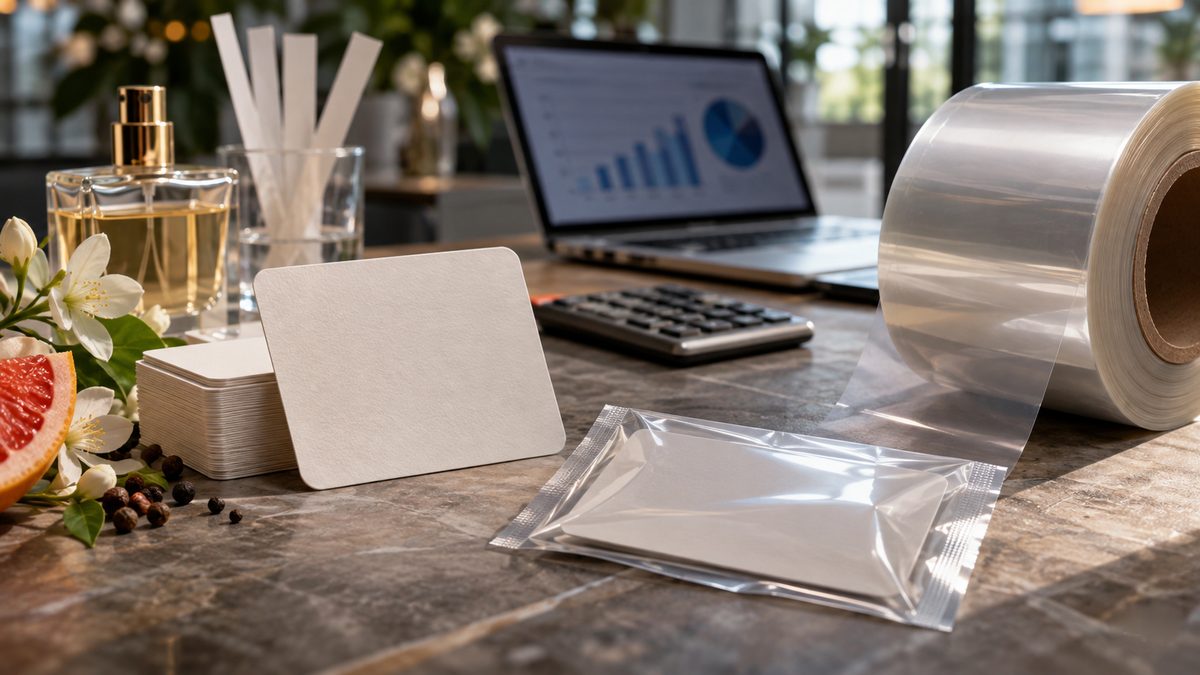
This article explains the barrier films used on scent cards, what each one blocks, how the costs are moving in 2026, and how to judge whether the extra spend buys real scent retention. It is written for private label buyers of scent cards who need to make the barrier decision on economics, not habit.
Table of Contents
- Why the barrier film became the cost question
- Film options and what they block
- The cost drivers in 2026
- The trade-off: retention versus unit cost
- Reading a quote, and cost per complaint
- Practical guide: choosing the right barrier at the right cost
- Frequently asked questions
- Conclusion
Why the barrier film became the cost question
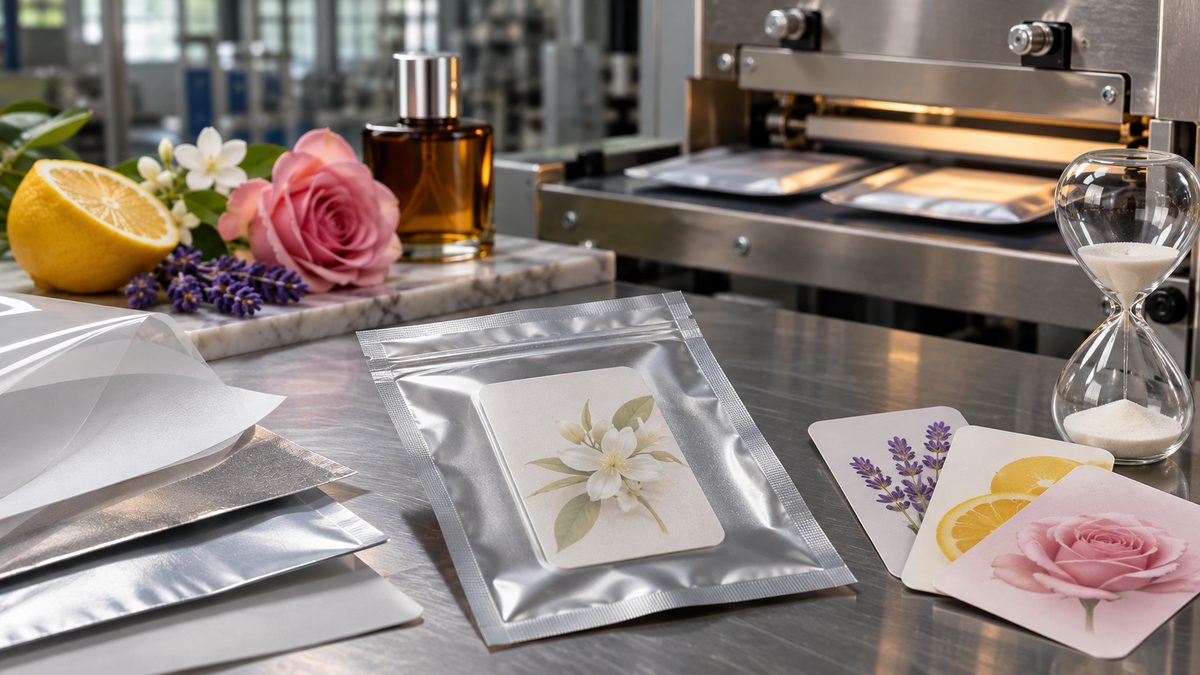
Scent cards are essentially fragrance printed or coated onto a substrate and then sealed to hold the scent until the customer opens them. The seal is what preserves the product between manufacture and use, and that seal is where the cost conversation now concentrates.
The film is the working part of the package
Unlike a box that only protects against damage, the barrier film on a scent card is what keeps the volatile fragrance molecules from escaping. A cheaper film that lets scent through defeats the purpose of the product. Material prices have moved, so the film that was once an invisible fraction of the price has become visible in quotes, and buyers are now asking what it actually does.
Film options and what they block
The common barrier films differ in what they stop and what they cost, and the choice should follow what the scent actually needs protection from.
Metallised films and polymer films
Metallised PET and aluminium foil provide a strong barrier against light and oxygen, which matters for fragrances sensitive to oxidation, and are the higher-cost end. Films such as EVOH-based structures and coated BOPP offer a moisture and oxygen barrier at a lower cost, and are often sufficient where light exposure is controlled and the main threat is scent diffusion through the film.
Why the barrier is about scent loss, not just spoilage
For a scent card, the film's main job is to stop the fragrance from migrating out, not only to stop oxygen or moisture getting in. A film that is a good oxygen barrier can still let volatile aroma molecules pass through, so the scent-retention property must be specified separately from a food-style barrier rating.
Thickness and seal integrity
Increasing film thickness slows scent loss, but it also raises material cost and can change the feel and the sealing behaviour of the card, so the gauge should be treated as a costed variable. A premium film with a weak seal still leaks scent at the edges, so the economics must account for both the film and the seal, not the film alone.
The cost drivers in 2026
The price of a barrier film is driven by the material, the coating, the gauge and the order quantity, and each has moved differently.
| Cost driver | How it moves the price | Buyer lever |
|---|---|---|
| Film material | Foil and metalised cost more than coated polymer | Choose the minimum barrier that works |
| Gauge or thickness | Thicker film uses more material | Specify a gauge, not "the thickest" |
| Coating or metallisation | Added barrier layers raise cost | Confirm the layer is actually needed |
| Order quantity | Larger runs lower per-unit film cost | Consolidate volumes where possible |
Watch the unit of the quote, not just the number
Film prices are quoted per square metre, per kilogram or per finished card depending on the supplier, and comparing quotes without normalising the unit leads to wrong conclusions. Ask for the cost on a common basis before comparing, and request the film structure and gauge rather than a trade name, because two films with the same brand name can differ in thickness and barrier.
The trade-off: retention versus unit cost
The economics is a trade between how long the card must hold its scent and what the buyer can afford to pay per unit.
Match the barrier to the claimed shelf life
The barrier only needs to hold the scent for the product's stated shelf life. Over-specifying the film to protect a card for years when it is sold and opened within months wastes money, while under-specifying produces a card that arrives weak. A short-lived promotional drop can use a lighter barrier because it is opened quickly, while a retail card that sits on a shelf for months needs a stronger one.
Where the barrier earns its cost
Fragrances built on citrus and light top notes lose their character fastest, so cards carrying those scents benefit most from a stronger barrier, while heavier base-note fragrances are more forgiving. Cards destined for warm retail environments or long distribution chains face faster scent loss, so the better barrier is more justified there, and the retention claim depends on the packaging structure covered in our scent card packaging guide.
Reading a quote, and cost per complaint
A supplier quote should let the buyer see the film structure, the gauge and the unit basis, and the decision should be judged on total cost rather than film cost alone.
Separate the film from the lamination and finishing
The total package cost includes the film, the lamination and the finishing, and the buyer should see these separately so an increase can be attributed to the right line. This also matters for the packaging-rule questions covered in our EU packaging rules guide.
The complaint is the hidden cost of a cheap film
A card that arrives with a faded scent generates returns, negative reviews and rework that dwarf the per-unit saving on a cheaper film. The honest comparison is film cost against the cost of the complaints it prevents, so run a retention check on the actual card with the actual fragrance before switching to a lighter barrier.
| Decision view | What it counts | Risk if ignored |
|---|---|---|
| Film cost only | Per-unit film price | Weak scent in the field |
| Total cost | Film plus returns and rework | Over- or under-specification |
| Validated saving | Retention check on the final card | Saving assumed, not measured |
Trace weak-scent reports back to the packaging
Our complaint triage guide covers how weak-scent reports are traced back to the packaging, closing the loop between the film choice and the customer outcome.
Practical guide: choosing the right barrier at the right cost
Step 1 — Fix the claimed shelf life and channel
Decide how long the card must hold its scent and whether it is a short promotional drop or a long retail shelf item, because that sets the barrier requirement.
Step 2 — Identify the fragrance's volatility
Confirm whether the scent is built on volatile top notes or heavier base notes, since that determines how much protection the film must provide.
Step 3 — Request quotes on a common unit basis
Ask suppliers for the film structure, gauge and cost on the same per-card or per-square-metre basis so the options can actually be compared.
Step 4 — Match the film to the requirement, not the maximum
Choose the lightest film structure that holds the scent for the stated shelf life in the target channel, rather than defaulting to the strongest and most expensive option.
Step 5 — Validate with a retention check
Run a scent retention check on the actual card with the actual fragrance before committing, so the saving from a lighter film is confirmed by measurement.
Step 6 — Price the complaint, not just the film
Compare the film saving against the cost of weak-scent complaints and returns, and decide the barrier on total cost rather than the line item alone.
Frequently asked questions
What is a scent card barrier film?
It is the sealing film that stops the fragrance from escaping the card before the customer opens it, protecting scent retention during storage and distribution.
What are the common barrier film materials?
Metallised PET, aluminium foil, EVOH-based structures and coated BOPP are common, and they differ in how well they block light, oxygen and scent diffusion.
Why have scent card film costs risen?
Polymer and metalised material input costs have moved, and the film has become a visible line item in quotes where it was previously a small fraction of the price.
Is a thicker film always better for scent retention?
Not automatically. Thicker film slows scent loss but costs more and changes the card's feel and sealing, so the gauge should match the stated shelf life rather than being maximised.
Do promotional cards and retail cards need the same film?
No. A promotional card opened quickly can use a lighter barrier, while a retail card that sits on a shelf for months needs a stronger one, so the barrier can vary by channel.
How do I compare film quotes fairly?
Ask for the film structure and gauge on a common unit basis, and separate the film from the lamination and finishing so the cost can be attributed correctly.
What happens if I choose too cheap a film?
The card can arrive with a faded scent, producing returns and negative reviews that cost more than the saving, so the film should be validated with a retention check first.
Where should I spend more on the barrier?
On volatile top-note fragrances, long shelf lives and hot distribution chains, where scent loss is fastest and the better film earns its cost.
Conclusion
The scent card barrier is a costed variable, not a fixed line item, and the right decision matches the film to the fragrance's volatility and the channel's shelf life. Over-specifying wastes money; under-specifying buys complaints that cost more than the film saved.
Fix the shelf life and channel, confirm the fragrance's volatility, compare quotes on a common basis, and validate the cheaper option with a retention check before committing. Judged on total cost rather than film cost, the barrier decision becomes a measurable economics question instead of a supplier's line item to accept.
Discuss your fragrance programme with our team:
WhatsApp: +86 17324762943
Email: adon@customperfumeoem.com
Website: customperfumeoem.com