
Air Freshener Rules Compared: EU, US and Gulf Requirements for Vent Clips
A buyer clears a vent clip for Europe, assumes the same file works everywhere, and the shipment stalls in the Gulf because a conformity mark is missing while a US state's VOC rule was never checked. Air freshener regulation is three overlap
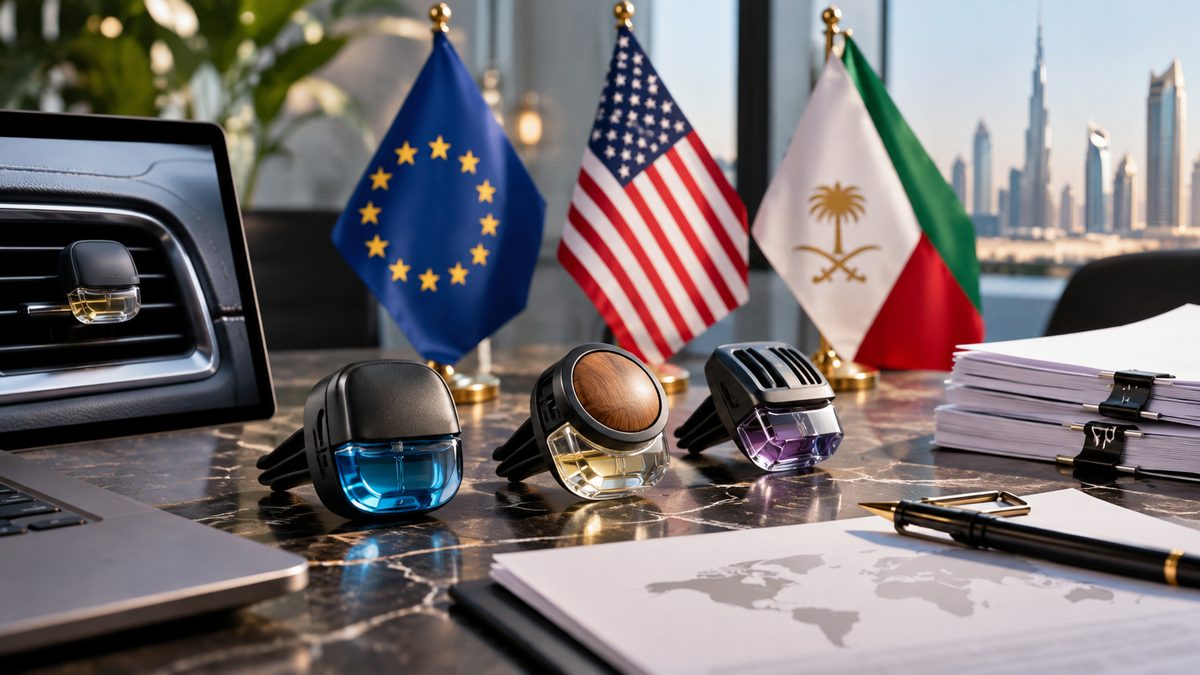
A buyer clears a vent clip for Europe, assumes the same file works everywhere, and the shipment stalls in the Gulf because a conformity mark is missing while a US state's VOC rule was never checked. Air freshener regulation is three overlapping regimes that ask similar questions in different documents, and a vent clip that crosses borders must satisfy all of them.
This article compares the EU, US, and Gulf requirements for car air fresheners, shows where the regimes agree and where they diverge, and explains how to build one dossier that clears all three.
Table of Contents
- Why a vent clip is an air freshener in every market
- The EU route: CLP and mixture classification
- The US route: CPSC, FHSA and state VOC limits
- The Gulf route: GSO standards and conformity marks
- What the three regimes have in common
- Where the regimes diverge
- Failure modes when the rules are applied piecemeal
- Building one dossier that clears all three
- Practical guide: clear a vent clip for three markets
- Frequently asked questions
- Conclusion
Why a vent clip is an air freshener in every market
A vent clip is an air freshener because it releases fragrance into an enclosed space, and every major regime regulates air fresheners as a consumer product with chemical content, labelling, and sometimes emission obligations. The enclosed cabin concentrates both the scent and the regulator's attention on what the product releases.
A buyer cannot treat a car fragrance as a novelty accessory. It is a chemical-containing consumer product, and the classification, labelling, and documentation rules attach to it in every market.
The EU route: CLP and mixture classification
In the European framework, a vent clip's fragrance liquid is a chemical mixture governed by the Classification, Labelling and Packaging rules. If the liquid is classified — a skin sensitiser or eye irritant, for example — the product carries the corresponding hazard statements and pictograms, and a poison centre notification with a UFI code may be required.
The classification is the load-bearing decision, made from the SDS and ingredient data the supplier provides. An unclassified liquid carries a lighter burden, but the assessment still has to be done and documented.
The US route: CPSC, FHSA and state VOC limits
The United States regulates consumer products through the Consumer Product Safety Commission and, for hazardous substances in household products, the Federal Hazardous Substances Act, which requires cautionary labelling where a product presents a specified risk. Several states also impose volatile organic compound limits on air fresheners.
| Layer | Authority | What it covers |
|---|---|---|
| Household hazards | CPSC / FHSA | Cautionary labelling for hazardous substances |
| State VOC limits | State agencies (e.g. CARB) | Caps on VOC content in air fresheners |
| State warnings | California Prop 65 | Warnings for listed chemicals |
The US route is layered rather than unified, which means a buyer must check the federal labelling rules and the state VOC caps and warning requirements separately. A product that passes one layer can still trip the next, and the exact limits should be confirmed against the current official text for each state the product is sold into.
How a state VOC cap is applied
A state VOC cap limits the volatile organic compound content of an air freshener, expressed as a percentage of the product. The cap is enforced at the formulation level, which is why a buyer needs the VOC figure for the finished liquid, not the fragrance concentrate alone.
Why the cap applies to the content, not the product weight
The limit is a concentration, not an absolute amount, so a small vent clip can still exceed it if the liquid it holds is high in volatile solvents. This is why the same VOC question follows the product regardless of how small the package is.
The Gulf route: GSO standards and conformity marks
The Gulf Cooperation Council market regulates consumer products through GSO standards, which set safety, labelling, and often a conformity mark requirement for products entering the region. Importers commonly require a conformity certificate tied to the product or batch before the goods clear customs.
The Gulf regime is less about hazard classification and more about demonstrating conformity to a named standard, which is why the missing-mark failure is so common. The requirement is procedural — the right certificate, in the right format, from the right body — and it is easy to overlook when the focus has been on the EU or US documentation.
What the three regimes have in common
Despite the different documents, the regimes ask the same underlying questions: what is in the product, is it hazardous, how is it labelled, and who is responsible. A product with a complete ingredient list, correct classification, and accurate cautionary labelling is most of the way to compliant in all three markets.
This is the leverage point for a buyer: invest once in the underlying data — the formula, the SDS, the classification, the label content — and the market-specific packaging becomes a matter of format rather than of substance. The ingredient documentation a supplier should provide is exactly this shared foundation.
Where the regimes diverge
The divergence is in emphasis and paperwork. The EU leads with hazard classification and poison centre notification; the US adds state-by-state VOC and warning layers; the Gulf leads with conformity marks and certificates. The same product may need a CLP label for one market, a Prop 65 warning for another, and a GSO conformity certificate for a third.
| Dimension | EU | US | Gulf |
|---|---|---|---|
| Core logic | Mixture classification | Consumer product + state rules | Standard conformity |
| Key document | SDS, CLP label | FHSA label, VOC data | Conformity certificate |
| Notification | Poison centre / UFI | Generally not required | Certification body |
The divergence means a single label rarely works for all three, but a single dossier — the underlying data — does. The labels are derivatives; the data is the asset worth getting right once.
Failure modes when the rules are applied piecemeal
The failures come from treating one market as the whole. A product cleared for the EU ships to California without the required warning. A product cleared for the US reaches the Gulf without a conformity mark and is held at customs. A buyer patches each market reactively and ends up with three incomplete files instead of one complete one.
Each failure is a timing problem: the gap is discovered after production, when labels are printed and freight is booked. The fix is to map all three regimes at the quoting stage, so the market-specific requirements are built into the product rather than bolted on at the port.
Building one dossier that clears all three
A single dossier starts with the shared foundation — the full ingredient list, the SDS, the classification, and the cautionary label content — and then layers the market-specific outputs: the CLP label and any poison centre notification for the EU, the state VOC and warning checks for the US, and the conformity certificate for the Gulf. The foundation is built once; the layers are generated per market.
For a buyer selling car fragrance across borders, the pack formats sold into accessory shops and dealers should be planned with the market layers in mind from the first SKU, and the labelling obligations that travel with the product reviewed per destination. Our customisation process builds the market layers into the label and documentation rather than leaving them to the buyer.
Practical guide: clear a vent clip for three markets
Step 1 — Build the shared foundation once
Assemble the full ingredient list, SDS, and classification. This single foundation supports every market layer that follows.
Step 2 — Map the three regimes for your SKU
List what the EU, US, and Gulf each require for this specific product, before any label is printed.
Step 3 — Generate the EU layer
Confirm the CLP classification and label, and file any poison centre notification with the UFI where required.
Step 4 — Check the US layers by state
Verify federal cautionary labelling and the state VOC limits and warning requirements for each state you sell into.
Step 5 — Secure the Gulf conformity route
Confirm the applicable GSO standard and arrange the conformity certificate tied to the product or batch.
Step 6 — Re-derive the labels from the dossier
Produce each market's label from the shared data, and re-check all three whenever the formula changes.
Frequently asked questions
What is a private label car fragrance?
A private label car fragrance is manufactured by a supplier and sold under a buyer's own brand; the buyer selects the scent, format, and packaging, and the supplier fills it under the buyer's name.
What is an air freshener under the regulations?
An air freshener is a consumer product that releases fragrance into an enclosed space, and it is regulated for chemical content, labelling, and sometimes emissions in most markets.
What is the FHSA?
The Federal Hazardous Substances Act is a US law requiring cautionary labelling on household products that present a specified hazard, enforced through the Consumer Product Safety Commission.
Do EU and US rules apply to a vent clip in the same way?
Not exactly. The EU treats the fragrance liquid as a chemical mixture under CLP; the US treats it as a consumer product under CPSC and FHSA, plus state VOC and warning rules.
What is a GSO conformity certificate?
It is a certificate issued against the applicable Gulf standard, demonstrating that a product meets the region's safety and labelling requirements before it clears customs.
Why did my shipment stall at Gulf customs?
Usually because the required conformity mark or certificate was missing. The Gulf regime is procedural, and the certificate must be in place before the goods arrive.
Can I use one label for all three markets?
Rarely. The labels are derivatives of the same data but differ per market — a CLP label, a state warning, a Gulf mark. One dossier, but separate labels.
What should I build first when entering multiple markets?
The shared foundation: the full ingredient list, the SDS, and the classification. Everything market-specific is generated from that single source.
Conclusion
Air freshener regulation across the EU, US, and Gulf is three ways of asking the same question, and the products that clear all three are the ones that answer it once, at the data level, rather than three times at the border. The classification, the ingredient list, and the cautionary content are the shared asset; the labels and certificates are its market-specific outputs.
Map the three regimes before production and re-derive the labels from a single dossier. A vent clip built that way crosses borders as a documented product, not as a shipment hoping no one asks.
Discuss your fragrance programme with our team:
WhatsApp: +86 17324762943
Email: adon@customperfumeoem.com
Website: customperfumeoem.com


