
Why Scent Cards Smell Different After a Month in the Pouch
A scent card is approved fresh off the line, sealed into pouches, and shipped — then a customer opens it a month later and the top notes are gone, the scent has turned slightly sour, or the card smells faintly of the pouch it was sealed in.
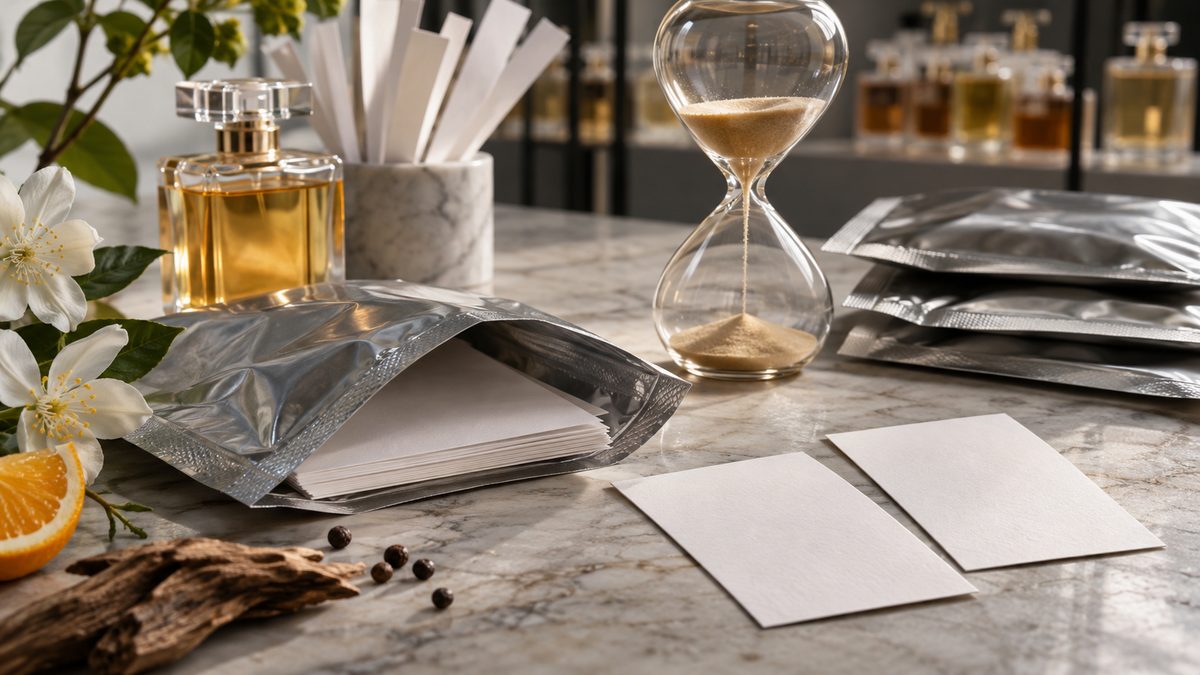
A scent card is approved fresh off the line, sealed into pouches, and shipped — then a customer opens it a month later and the top notes are gone, the scent has turned slightly sour, or the card smells faintly of the pouch it was sealed in. The card that passed QC at day zero no longer matches the approved sample, and nobody can say why.
This article explains why a scent card smells different after a month in its pouch. It covers the chemical and physical changes that happen inside the sealed pack — top-note loss, oxidation, and the interaction between the fragrance, the paper, and the film — and how to test a card so its scent survives to the shelf.
Table of Contents
- What changes in a month
- Top note evaporation
- Oxidation in the sealed pouch
- Paper and coating interaction
- Pouch barrier
- How to test a scent card
- Practical guide: keeping a scent card stable in the pouch
- Frequently asked questions
- Conclusion
What changes in a month
A sealed pouch is not a time capsule. Inside it, three processes run at once. The most volatile fragrance components migrate into the pouch headspace and can be absorbed by the film or lost through it; oxygen and light slowly oxidise the fragrance; and the fragrance interacts with the paper and any coating, changing both the card and the scent. The card you smell at day thirty is the product of all three, not the card you sealed at day zero.
The direction of the change is usually predictable: the bright top notes thin out, the base becomes relatively more prominent, and a slight off note can appear if oxidation has started. The magnitude depends on the fragrance, the paper, and the film, which is why two cards that smell identical at sealing can diverge within weeks if their substrates differ.
Top note evaporation
Top notes are the small, volatile molecules that give a scent its first impression, and they are the first to leave a sealed card. Even inside a pouch, they migrate from the card into the headspace, where they either stay or pass through the film. A film with poor barrier properties lets them escape entirely, so the card opens smelling flatter and less "fresh" than it did at sealing.
The loss is partly unavoidable — some volatiles will always redistribute — but the rate is controlled by the barrier. A high-barrier film keeps the top notes in the headspace so they can re-adsorb onto the card, while a poor barrier bleeds them to the outside. This is the single largest driver of the "it smelled stronger when I approved it" complaint.
Oxidation in the sealed pouch
Oxidation needs oxygen, and a sealed pouch contains a fixed but real amount of it. Fragrance components, especially unsaturated ones such as citrus terpenes, react with that trapped oxygen over time, producing off notes that read as stale or sour. The reaction is slow at room temperature but accelerates in a warm warehouse or a delivery van in summer.
The oxygen comes from three places: the air trapped when the pouch was sealed, oxygen that permeates through a low-barrier film, and oxygen already dissolved in the fragrance or absorbed in the paper. A good barrier film controls the permeation, but it does nothing about the oxygen sealed inside, which is why some card programs add an oxygen absorber or a nitrogen flush for sensitive scents.
Paper and coating interaction
The paper is not inert. Cellulose absorbs fragrance, and the coating applied to make the card printable can react with or retain certain components. Acidic or uncoated papers can catalyse reactions that alter the scent, and a heavy coating can act as a reservoir that releases the fragrance at a different rate than the card's body. The substrate, not just the scent, shapes what comes out of the pouch.
| Substrate choice | Effect on scent | Consideration |
|---|---|---|
| Uncoated paper | Fast absorption, possible catalysis | Cheap, but can alter delicate scents |
| Coated paper | Slower, more even release | Coating must not react with fragrance |
| Absorbent board | High load, fast release | Dries out faster |
| Synthetic substrate | Less reactive, controlled | Higher cost, different feel |
The practical rule is to test the fragrance on the exact paper and coating you will produce, not on a generic swatch. A scent that is stable on one stock can turn on another, and the only way to know is to seal the real card and wait.
Pouch barrier
The pouch film is the card's only defence against the outside, and its barrier properties set how much fragrance escapes and how much oxygen and moisture enter. A low-barrier film such as plain polyethylene is cheap but lets volatiles and oxygen pass; a metallised or aluminium-foil laminate blocks both but costs more and adds a metallic look.
| Film structure | Barrier level | Best for |
|---|---|---|
| Plain PE | Low | Short life, low-cost giveaways |
| Metallised PET | Moderate to high | Mid-range retail cards |
| Aluminium foil laminate | Very high | Long shelf life, sensitive scents |
Selecting the film
Matching barrier to shelf life
Choose the film against the shelf life the product must meet. A promotional card handed out in a week can survive a low-barrier pouch; a retail card that may sit on a shelf for months needs a foil laminate. The cost difference is real, so fix the required shelf life first and buy only as much barrier as that number demands.
How to test a scent card
The test is to seal the real card in the real pouch and smell it at intervals, against a retained reference kept in a genuinely inert container. Smell at day zero, then at one week, one month, and the end of the claimed shelf life, and score the card against the reference for top-note presence and any off note. A card that diverges from the reference early will only diverge further.
Run the test under the storage conditions the product will actually see, including a warm hold to simulate a summer warehouse or van, because temperature is the multiplier on both evaporation and oxidation. A card that only passes at room temperature has not been tested for its real journey. For how the sealing itself affects this, see our scent-card complaint guide. For the pack structure that protects the card, see our scent-card packaging guide and our starter-holder guide.
Practical guide: keeping a scent card stable in the pouch
Step 1 — Fix the shelf-life target
State how many months the card must keep its scent, because the barrier film and any oxygen control are chosen against that number.
Step 2 — Test the scent on the real paper
Seal the actual card stock and coating, not a swatch, and confirm the substrate does not react with the fragrance.
Step 3 — Choose the film against the shelf life
Match the pouch barrier to the required life: low barrier for short-life giveaways, foil laminate for months on a shelf.
Step 4 — Consider oxygen control for sensitive scents
Add an oxygen absorber or nitrogen flush for oxidation-prone fragrances, since the film alone cannot remove sealed-in oxygen.
Step 5 — Age the sealed card at intervals
Smell at day zero, one week, one month, and end of life against a retained reference, scoring top notes and off notes.
Step 6 — Include a warm hold in the test
Age a sample under a summer warehouse or van temperature, because heat multiplies both evaporation and oxidation.
Frequently asked questions
What is a scent card?
A scent card is a paper or board substrate impregnated with fragrance, used to sample or deliver a scent. It is usually sealed in a pouch to preserve the fragrance until the customer opens it.
What is a scent card pouch?
A scent card pouch is the sealed film package that protects the card from fragrance loss, oxygen, and moisture. Its barrier properties determine how well the scent survives to the shelf.
Why do top notes disappear from a sealed card?
Top notes are the most volatile components, and they migrate into the pouch headspace and can pass through a low-barrier film. A high-barrier film keeps them in the headspace so they can re-adsorb onto the card.
Can a scent card go stale in a sealed pouch?
Yes. The oxygen trapped at sealing, plus any that permeates through a low-barrier film, can oxidise unsaturated fragrance components into stale or sour notes, especially in warm storage.
Does the paper change how a card smells?
Yes. Cellulose absorbs fragrance and certain papers or coatings can react with components or release them at a different rate. Test the fragrance on the exact production paper and coating, not a generic swatch.
Which pouch film keeps a scent card fresh longest?
An aluminium foil laminate offers the highest barrier and longest life, followed by metallised PET, then plain PE. Choose the film against the shelf life the product must meet, not the highest barrier by default.
How do I test whether a card will last on the shelf?
Seal the real card in the real pouch, smell it at intervals against a retained reference, and score top-note presence and off notes. Include a warm hold to simulate a summer warehouse or van.
Does an oxygen absorber help a scent card?
For oxidation-prone scents, yes. The film controls oxygen permeation but not the oxygen already sealed inside, so an absorber or nitrogen flush can extend life for sensitive fragrances.
Conclusion
A scent card changes in its pouch because three processes never stop: top notes migrate and escape, oxygen oxidises the fragrance, and the paper and coating interact with what remains. The card you ship is not the card you approved, and the gap is set by the fragrance, the substrate, and the film together.
Test the real card in the real pouch, choose the barrier against a stated shelf life, and age samples under the warm conditions the product will actually meet. Do that, and the card the customer opens a month later is recognisably the same scent they were promised.
Discuss your fragrance programme with our team:
WhatsApp: +86 17324762943
Email: adon@customperfumeoem.com
Website: customperfumeoem.com


