Why Car Fragrance Smells Different in Winter
In summer your car fragrance fills the cabin within minutes of the door closing; in winter the same product sits on the vent and the driver can barely detect it. The customer assumes the refill went stale, but the real change is the cabin t
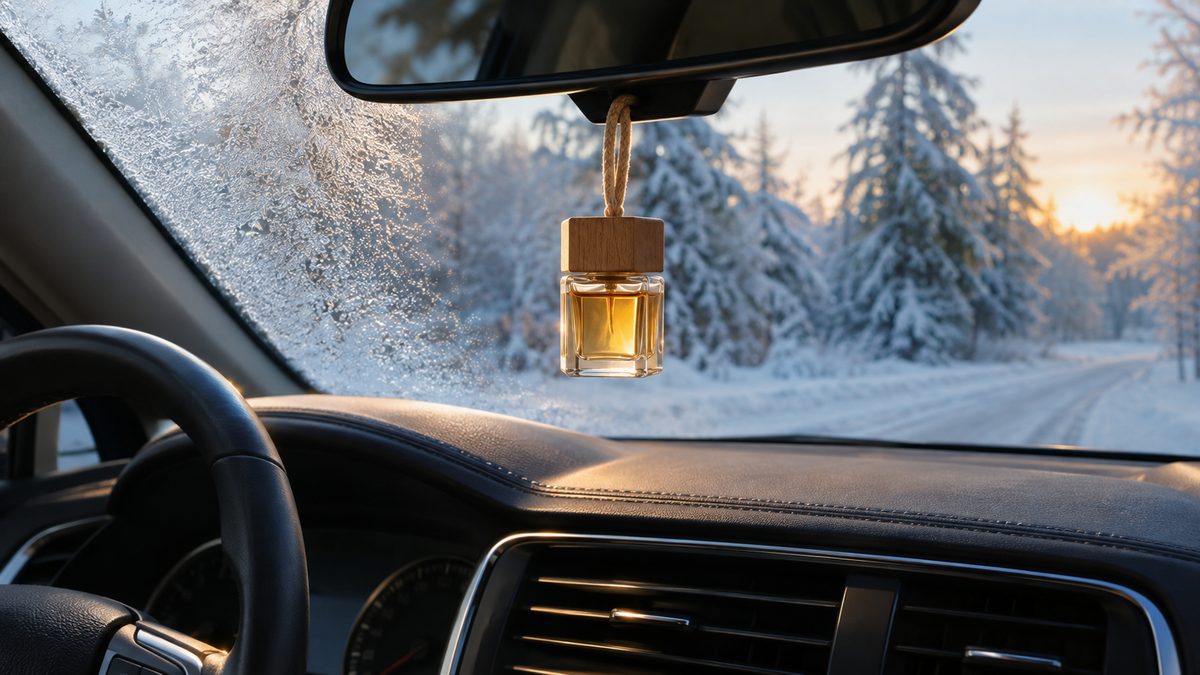
In summer your car fragrance fills the cabin within minutes of the door closing; in winter the same product sits on the vent and the driver can barely detect it. The customer assumes the refill went stale, but the real change is the cabin temperature, which governs how fast the fragrance leaves the carrier and reaches the nose.
This article explains why cold suppresses a car fragrance, how winter-specific factors like heater vents and closed windows change what you smell, and how the product format — liquid, pad or card — behaves differently in the cold. It gives you the design and test steps for a car fragrance that still performs when the cabin is at its coldest.
Table of Contents
- The cabin temperature range and evaporation
- Volatility and why cold suppresses throw
- Heater vents and winter surfaces
- How formats differ in winter
- Scent perception in a closed winter cabin
- Designing a winter-stable car fragrance
- Practical guide: making a car fragrance that works in winter
- Frequently asked questions
- Conclusion
The cabin temperature range and evaporation
A car cabin swings through a wider temperature range than almost any other fragrance environment: from below freezing on a parked morning to well above room temperature once the heater has run. The fragrance has to deliver across that whole swing, not at a single comfortable point.
Cold is the harder half
At the cold end, evaporation nearly stops, and the product seems dead. At the warm end, the same product can release too fast and smell overpowering. A winter car fragrance is therefore a balancing act between surviving the cold start and not flooding the cabin once warm.
Volatility and why cold suppresses throw
Evaporation is driven by temperature. As the cabin cools, the vapour pressure of every fragrance molecule falls, so fewer molecules leave the liquid or pad each minute, and the scent that does escape diffuses more slowly through the denser, cooler air.
The first ten minutes are the test
The customer forms their judgement in the first minutes after starting the car, when the cabin is still cold. A fragrance that only wakes up after twenty minutes of heating has already failed the winter user, however good it is at operating temperature.
Vapour pressure drops with temperature
A molecule's tendency to evaporate is its vapour pressure, and vapour pressure falls sharply as temperature drops. This is why a formula that opens easily on a warm day can sit almost motionless on a freezing one, and why the top notes are the first casualty of cold.
Heater vents and winter surfaces
In winter the airflow that carries scent comes from the heater, and the surfaces it passes are cold glass and plastic. A vent-mounted fragrance gets warm air blown through it, which accelerates release, while a hanging or dash-mounted product gets none of that assistance.
Position changes the effective temperature
The same refill performs differently depending on where it sits. A vent clip warmed by the heater will release far more than a card tucked in the door pocket, so winter instructions and winter design have to account for where the product will actually live.
How formats differ in winter
The carrier format sets how the fragrance responds to cold. A liquid relies on evaporation from a wick or membrane and slows sharply when cold; a gel or pad holds the fragrance in a matrix and releases it more gently; a printed card depends on diffusion from the paper surface.
Match the format to the cold start
A format with a large, exposed surface releases more at low temperature than a sealed liquid with a small vent. If the winter experience matters, choose a format that can still emit at the cold end rather than one that only performs once the heater has done its work.
| Format | Cold behaviour | Winter fit |
|---|---|---|
| Liquid with vent | Slows sharply, can thicken | Needs heater airflow |
| Pad or gel | Releases gently from matrix | Better cold-start emission |
| Printed card | Diffuses from surface | Depends on surface area |
Scent perception in a closed winter cabin
Winter also changes how the customer perceives the scent. Windows stay shut, the air is dry from the heater, and the nose adapts to a constant background fragrance within minutes, so a steady, subtle release can seem to disappear even when it is still present.
Habituation reads as failure
In a closed cabin the driver adapts to a constant scent and stops noticing it, which is easily mistaken for the product running out. This is a perception problem, not a delivery problem, and it means a winter product needs enough variation or intensity to break through adaptation.
Designing a winter-stable car fragrance
A winter-stable car fragrance is designed around the cold start. That means choosing a format and a formula that still emit at low temperature, positioning the product where the heater assists it, and setting the release so it does not overwhelm once the cabin warms.
| Factor | Winter effect | Design response |
|---|---|---|
| Cabin temperature | Evaporation slows sharply | Choose a format that emits cold |
| Heater airflow | Warms and accelerates release | Position on or near the vent |
| Closed windows | Scent accumulates, nose adapts | Allow intensity variation |
| Dry cabin air | Faster top-note loss | Rebalance toward persistent notes |
Practical guide: making a car fragrance that works in winter
Step 1 — Define the cold-start scenario
Write down the coldest cabin temperature the product must work in and the first-minute impression you want, because that is the moment the customer judges.
Step 2 — Pick the format for cold emission
Choose a liquid, pad or card format based on whether it can still release fragrance at the cold end, not just on how it performs in a warm car.
Step 3 — Raise the top-note volatility
Use lighter, more volatile top notes so the fragrance opens even at low temperature, while keeping enough base to last through the drive.
Step 4 — Test in a cold cabin
Evaluate the product in a real cold car, not a warm lab, and record the first ten minutes separately from the steady state after heating.
Step 5 — Set the venting and position
Specify where the product should be placed and how the airflow should pass over it, so the heater assists rather than overwhelms the release.
Step 6 — Write winter usage instructions
Tell the customer what to expect in cold weather and how position affects intensity, so a slow cold start reads as expected behaviour rather than a fault.
Frequently asked questions
What is a car fragrance?
A car fragrance is a scent product designed to scent the enclosed cabin of a vehicle, usually mounted on a vent, hung from the mirror or placed on the dash. It works by releasing volatile fragrance molecules into the cabin air.
What is evaporation in fragrance?
Evaporation is the process by which fragrance molecules leave a liquid, gel or solid carrier and enter the air as vapour. It is driven by temperature, so it slows in the cold and speeds up in the heat.
What is a vent clip car fragrance?
A vent clip is a car fragrance holder that attaches to an air vent so that airflow from the heater or air conditioning passes over it. The airflow accelerates release, which is especially useful in winter.
Why does my car scent disappear in winter?
Cold lowers the vapour pressure of the fragrance, so fewer molecules evaporate into the cabin, and the cool, dense air carries them more slowly. The product has not run out; it is simply releasing far less at low temperature.
Does a vent clip work when the heater is on?
Yes, and the heater is what makes it work in winter. Warm air blowing over the fragrance raises its temperature locally and accelerates release, which is why a vent-mounted product performs better in cold weather than one tucked away.
Is a liquid or a pad better in cold weather?
It depends on the design, but a format with a larger exposed surface, such as a pad, can often release more at low temperature than a sealed liquid with a small vent. Choose the format by testing the cold-start performance, not by a general rule.
How do I test a car fragrance for winter?
Test it in a real cold car and record the first ten minutes separately from the steady state after the heater has run. A warm-lab test misses the cold start, which is exactly where winter products fail.
Does the fragrance freeze in winter?
A liquid car fragrance can thicken or partially solidify in extreme cold, which stops it releasing until it warms. Check the freezing behaviour of your formula and choose a format that still emits at the lowest expected temperature.
Conclusion
Winter changes a car fragrance not because the product fails but because temperature governs evaporation. The fix is to design for the cold start: a format that emits at low temperature, a formula weighted toward volatile top notes, and a position where the heater can assist the release.
Test in a real cold cabin and set expectations on the packaging, because a slow first ten minutes is the moment a winter customer decides the product works. For the pack and assortment side of the decision, see our guide on planning car fragrance packs, and for the ingredient checks behind a winter formula, read supplier ingredient checks. Browse the car fragrances we produce or ask about custom formulation.
Discuss your fragrance programme with our team:
WhatsApp: +86 17324762943
Email: adon@customperfumeoem.com
Website: customperfumeoem.com