Why Candle Vessel Sourcing Moved From Stock Moulds to Custom Tooling
Candle vessel sourcing for years meant building a range on whatever vessels a glassworks already had in its mould library, decorating them, and being on shelf in a season. That route has narrowed: the popular stock shapes are contended, the
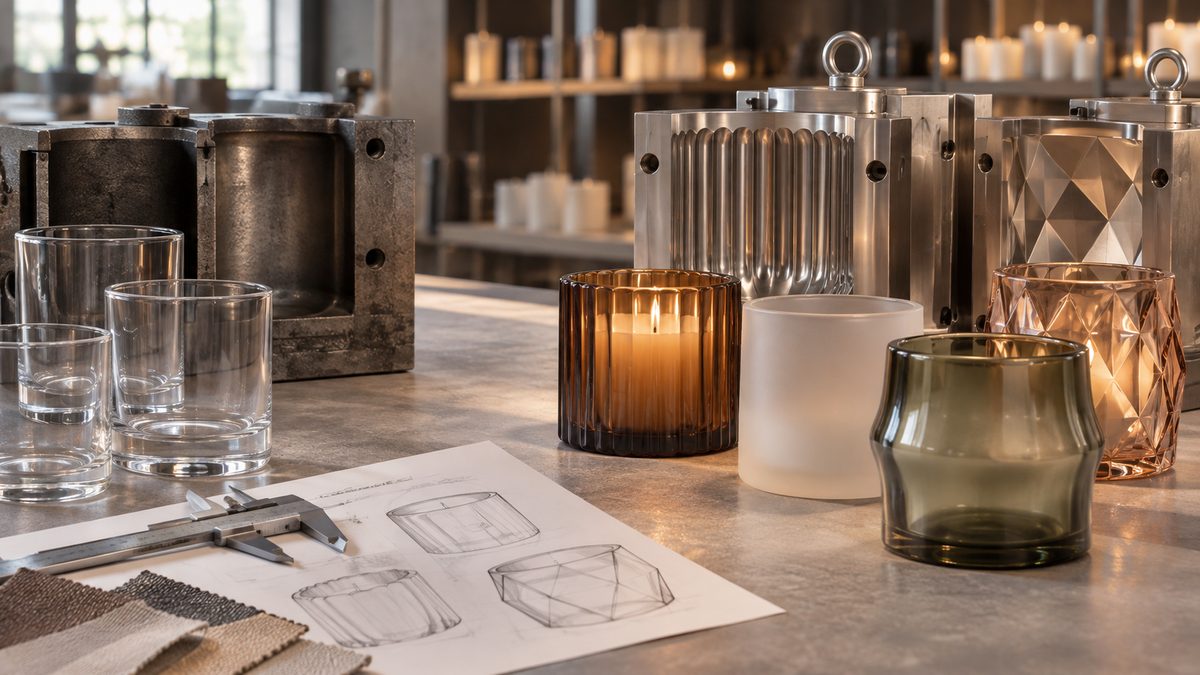
Candle vessel sourcing for years meant building a range on whatever vessels a glassworks already had in its mould library, decorating them, and being on shelf in a season. That route has narrowed: the popular stock shapes are contended, the decoration capacity behind them is booked, and retailers increasingly ask for a vessel that does not appear in three competing ranges.
This article explains why candle vessel sourcing has moved toward custom tooling, what the volume threshold actually looks like once freight and breakage are counted, which tooling terms decide whether the investment is portable, and how the main vessel materials fail in production.
Table of Contents
- Why sourcing moved off the stock shelf
- The volume threshold behind a custom mould
- Sourcing routes compared
- Glass, ceramic, concrete and tin
- Tooling terms that decide the outcome
- Practical guide: candle vessel sourcing, from stock to custom
- Frequently asked questions
- Conclusion
Why sourcing moved off the stock shelf
Two pressures met at once. On the supply side, stock moulds became a scheduling problem: the shapes everyone wanted were already running for larger customers, and a small brand asking for 6,000 pieces of a popular 8 oz jar was competing for machine hours it could not win. On the demand side, differentiation became a listing requirement. A retailer comparing two candle ranges in the same category wants a vessel it can describe, and a stock jar with a different label does not give it one.
What changed on the supply side
Glass capacity is finite and campaigns are long. A mould that is already in the library is cheap to use but shared, and shared capacity is allocated to volume and forecast reliability. When a stock shape is unavailable, the alternatives are to wait, to accept a different shape, or to hold a mould of your own. The third option converts a scheduling risk into a capital decision, which is easier to plan around.
What changed on the demand side
Refill and reuse changed the vessel's job. A jar designed to be refilled needs a thicker wall, a clean interior, a lid that survives repeated opening and an opening wide enough for a refill insert. Stock moulds were designed for single use, and many of them cannot meet that brief. Once the vessel has to be an object the customer keeps, the case for tooling it specifically becomes a product argument rather than a marketing one.
The volume threshold behind a custom mould
A mould is a fixed cost, so the question is not whether it is expensive but how many units carry it. Divide the tooling cost by the planned volume and add the result to the unit price; compare that figure with the stock option, then add the costs the stock option hides: the decoration queue, the substitution risk and the price the market pays for a shape it has seen before.
Cavity count changes the shape of the deal
More cavities cost more up front and produce more per machine hour, which lowers unit cost at volume. Fewer cavities reduce the capital and raise the unit price. The right number depends on annual demand and on how much of the tooling cost the brand can carry before the first reorder, not on the launch quantity.
Cavity count is a cash-flow decision
A single-cavity tool on a 20,000-piece programme may be the rational choice even though the unit price is higher, because the cash stays in the launch budget. A four-cavity tool only pays if the programme sustains volume across several seasons. Model both against your own cash position; the cheapest unit price is not the cheapest programme.
Where the hidden costs sit
Custom vessels change freight, packaging and breakage. A heavier or larger vessel raises volumetric weight and can turn a full container into a partial one. A new shape needs a new insert, and the insert is tooling too. Breakage depends on wall thickness, annealing quality and how the vessel sits in the carton, so the first run should ship with a damage allowance rather than an assumption.
Sourcing routes compared
| Route | Upfront cost | Minimum order | Differentiation | Supply risk |
|---|---|---|---|---|
| Stock mould | None | Low | Low — shape is shared | High — capacity is allocated |
| Stock mould with custom decoration | Decoration setup only | Low to mid | Medium — colour and print | Medium — coater queue |
| Custom mould, glass | Capital, one-off | High | High — shape is yours | Low after tooling |
| Custom ceramic | Capital plus moulds | Highest | Highest | Medium — firing yield |
The middle route is often the right first step: a stock shape with a distinctive coating and a good label buys most of the differentiation for a fraction of the tooling cost.
Glass, ceramic, concrete and tin
Material choice decides tooling cost, minimum order, weight and how the vessel behaves when the candle burns down. Each has a failure mode that shows up late if it is not designed for.
| Material | Tooling | Weight and freight | Characteristic failure | Refill suitability |
|---|---|---|---|---|
| Glass | Mould per shape, cavities scalable | Heavy, volumetric pressure | Annealing stress, seam lines, chipping | Good if wall and opening allow |
| Ceramic | Case moulds plus glaze development | Heaviest | Firing shrinkage, warpage, glaze variation | Good, but lid fit drifts |
| Concrete | Simple moulds, long cure | Very heavy | Efflorescence, thermal shock, chipping | Poor — porous and heavy |
| Tin or aluminium | Deep-draw tool and print plates | Light | Dent on seam, print wear | Limited — dents end reuse |
Glass is the default because it tolerates heat and its tooling scales predictably with cavity count. Ceramic earns a premium but adds a firing step: the lid is fitted to a fired body, and glaze batches vary enough that a reorder can look different under retail lighting. Concrete is a styling choice with a freight penalty; tin is the cheapest coloured vessel and the least convincing refill object.
Tooling terms that decide the outcome
The commercial terms matter as much as the drawing. Three clauses separate a good tooling deal from an expensive lesson.
Ownership and transfer
Ask who owns the mould and get a certificate naming your company. Ownership without transfer rights is a hostage: if the relationship ends you need the right to move the mould, which requires compatibility with the new plant's machines and a full drawing file. Negotiate it at the start, while you still have leverage.
First article and tolerances
Approve a first article from the production cavity, measured against a drawing that states height, diameter, weight, lid fit and wall thickness with tolerances. A sample that looks right is not an approval; a measured sample is. Keep the approved article as the reference for later disputes.
Refurbishment and life
Moulds wear. Seam lines become visible, dimensions drift and the surface finish dulls. Ask for the expected life in drops, the refurbishment interval and who pays, because a tool that needs replacing after two seasons changes the amortisation in your business case.
Practical guide: candle vessel sourcing, from stock to custom
Step 1 — Define the differentiation that tooling actually buys
Write down what the customer will notice: silhouette, wall thickness, lid fit, surface texture. If the answer is a colour, decoration will do it for less.
Step 2 — Model the threshold on landed cost
Compare stock and custom on unit price plus freight, breakage allowance, insert cost and the price premium the shape supports. Tooling divided by volume is only one line in that comparison.
Step 3 — Brief the drawing, not the reference photo
Supply a dimensioned drawing with tolerances and a lid or neck specification. A photo transfers a look; a drawing transfers a product you can inspect against.
Step 4 — Contract ownership, transfer and refurbishment
Name the owner, secure the transfer right, agree the life expectation and the refurbishment cost. Do this before the tool is cut.
Step 5 — Approve a measured first article
Check dimensions, weight distribution, lid fit and annealing. Commission a polariscope check if the plant offers one, because internal stress is invisible until the vessel cracks in transit.
Step 6 — Plan decoration and the insert in parallel
Coating, printing and the packaging insert have their own lead times. A vessel without decoration or without an insert is not a shippable product. The pack side is covered in packaging formats.
Step 7 — Run the transition stock deliberately
Hold enough of the old vessel to cover the new tool's ramp-up and the first decoration run. Retailers will not accept a gap, and a partial rollout with two vessels on shelf looks like a mistake. Assortment planning around that transition is covered in planning candle starter assortments and repeat singles.
Frequently asked questions
How is a private label candle programme structured?
A candle made under the buyer's brand, with the buyer setting vessel, wax, fragrance and label while the manufacturer handles pouring, wicking, testing and packing.
What is a stock mould vessel?
A vessel shape whose mould already exists at the factory and is shared across customers. It avoids tooling but offers no exclusivity and no guaranteed capacity.
What is the minimum order for a custom candle vessel?
Set by the mould, the cavity count and the plant's run length, and usually far above a stock minimum. Confirm the glass, decoration and filling minimums separately.
How much does a candle vessel mould cost?
It depends on material, size, cavity count and complexity, and the range is wide enough that only a quoted drawing is meaningful. Compare it against volume, not against the unit price.
How long does custom tooling take?
Tooling, first-article approval, decoration trials and a first production run sit in series. Plan it as a season, not as a purchase order lead time.
Can I move my mould to another factory?
Only if the contract grants transfer and the mould suits the new plant's machines. Negotiate that right before the tool is cut.
Is ceramic better than glass for premium candles?
It reads as more crafted and costs more to tool and ship. Firing shrinkage and glaze variation mean lid fit and colour need approval per batch.
Why do custom vessels break more in transit?
Usually because the insert was designed for the old shape, or because annealing stress was not checked. Test a full carton, not a single unit.
Conclusion
Custom tooling is not a status purchase. It converts a shared, allocated supply into capacity you control, and it only makes sense when the vessel does a job a stock shape cannot: carrying a refill, holding a silhouette the brand can own, or meeting a retailer's demand for something not already on three other shelves.
In candle vessel sourcing, the discipline is in the sequence. Model the threshold on landed cost, brief a drawing rather than a photograph, contract the ownership and transfer rights before the tool is cut, and approve a measured first article. Our scented candle programmes run vessel, wax and wick as one specification for that reason.
Discuss your fragrance programme with our team:
WhatsApp: +86 17324762943
Email: adon@customperfumeoem.com
Website: customperfumeoem.com