
Viscosity and Wicking: Why a Thick Base Starves the Reeds
Your diffuser base is full, the reeds are fresh and the fragrance concentrate is the same one that worked before, yet the room never smells as strong as the sample did. The most common cause is hidden in the base itself: a liquid that is to
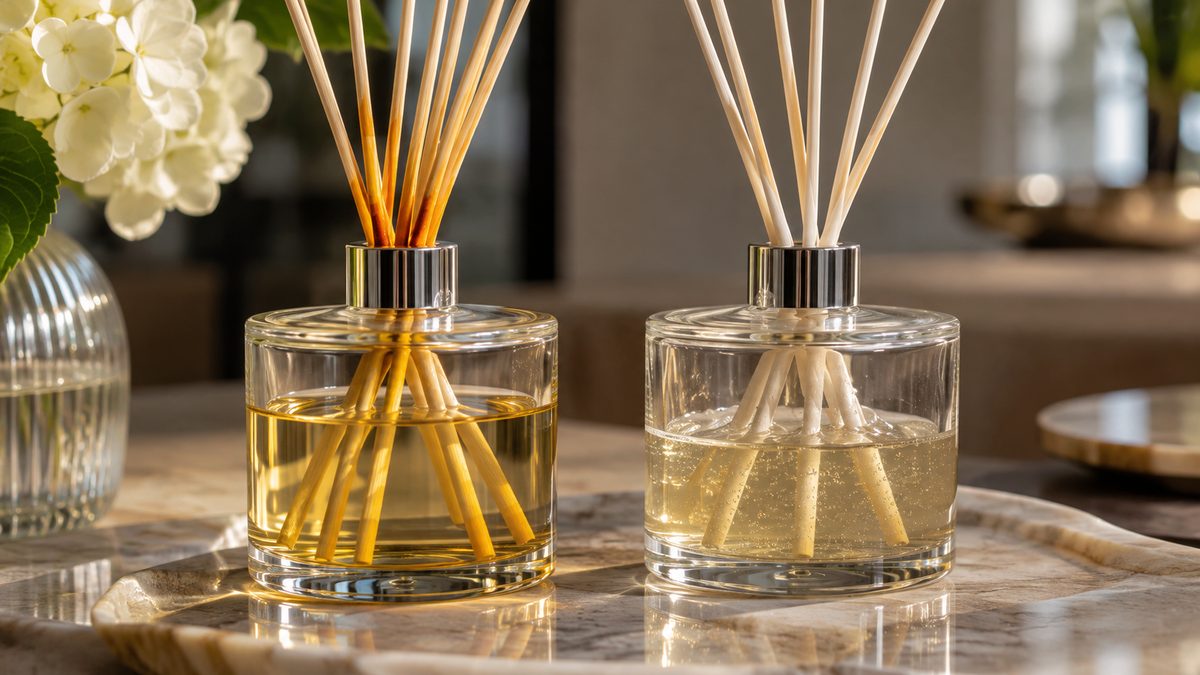
Your diffuser base is full, the reeds are fresh and the fragrance concentrate is the same one that worked before, yet the room never smells as strong as the sample did. The most common cause is hidden in the base itself: a liquid that is too viscous climbs the reeds slowly, and a slow climb is a weak scent no matter how good the oil is.
This article explains how viscosity controls capillary wicking, why a thick base starves the reeds even when it looks full, and how to choose a base that moves up the reeds at the rate your fragrance needs. It compares the common base solvents and gives you a test method for wicking height you can run before you commit to a formula.
Table of Contents
- How reeds actually pull liquid
- What viscosity does to wicking
- Common base solvents and their viscosity
- Why a thick base gives weak throw
- Temperature and viscosity drift
- Picking a base for the evaporation window
- Practical guide: choosing a base that wicks
- Frequently asked questions
- Conclusion
How reeds actually pull liquid
A reed is a bundle of fine, open channels running along its length. Liquid rises up those channels by capillary action — the same force that lifts water into a paper towel — because the attraction between the liquid and the channel walls pulls the liquid upward against gravity.
The climb is a balance of forces
Capillary action stops rising when the pull of the walls is balanced by the weight of the column of liquid. A shorter climb is easier, which is why a reed wicks faster when the liquid level is high and slows as the level falls.
What viscosity does to wicking
Viscosity is the liquid's resistance to flow. The thicker the liquid, the more friction it meets inside the reed's channels, and the slower it rises. Two bases with identical fragrance can therefore deliver very different amounts of scent per hour purely because one is thicker.
Thickness multiplies with the climb height
The effect is not linear. A modest increase in viscosity produces a larger slowdown when the reed has to lift the liquid a long way, which is exactly the situation late in a bottle's life. A base that is barely acceptable when full can stall almost completely when the level is low.
Capillary rise scales with surface tension over viscosity
The rate at which a liquid climbs a thin channel is set by a balance of surface tension, channel size and viscosity. Higher surface tension pulls harder, but higher viscosity resists more, so a base with good surface tension can still wick poorly if it is too thick.
Common base solvents and their viscosity
Diffuser bases are built from glycol ethers, glycols and occasionally esters or alcohol, each with a different viscosity and evaporation rate. The choice is a trade between how freely the liquid wicks and how slowly it evaporates.
Thin wicks fast, thick evaporates slowly
A low-viscosity base climbs quickly and gives strong throw but evaporates sooner, while a high-viscosity base lasts longer but delivers less scent. The usable range for reeds sits between these two, and the fragrance concentrate you add shifts the final viscosity of the blend.
| Base family | Relative viscosity | Wicking behaviour | Trade-off |
|---|---|---|---|
| Glycol ethers | Low | Fast, strong throw | Shorter life |
| Glycols (e.g. DPG) | Moderate | Steady, even | Balanced |
| Heavy esters | Higher | Slow, weak throw | Long life |
Why a thick base gives weak throw
When the base is too thick, the reeds deliver less liquid to the evaporation surface each hour, so less fragrance reaches the air. The bottle looks full and the reeds look wet, but the scent never reaches the corners of the room.
Wet reeds are not proof of delivery
A reed can be saturated and still be releasing little scent, because saturation is about what the reed holds, while throw is about how fast new liquid arrives at the surface to replace what evaporates. A thick base keeps the reed wet but replenishes it too slowly.
Temperature and viscosity drift
Viscosity falls as temperature rises and climbs as it drops. A diffuser that performs well in a warm showroom can wick sluggishly on a customer's cool hallway, so the base must be chosen for the temperature range the product will actually meet.
Cold is the risk case
In a cold room the base thickens and the wicking slows, which is why winter is when weak-throw complaints cluster. Test the base at the low end of the expected range, not just at a comfortable lab temperature.
| Symptom | Likely cause | Check |
|---|---|---|
| Reeds wet but room faint | Base too viscous | Measure blend viscosity |
| Strong when full, stalls when low | Climb height rises | Wick-height test |
| Fades in cold rooms | Viscosity rises in cold | Test at low temperature |
Picking a base for the evaporation window
The right base wicks freely enough to deliver the fragrance throughout the bottle's life and evaporates slowly enough to last the promised weeks. Start from the intended lifespan and work back to a viscosity that sustains the climb as the level falls.
Practical guide: choosing a base that wicks
Step 1 — Measure the concentrate's own viscosity
Before choosing a base, know how thick the fragrance concentrate is, because it shifts the final blend. A heavy concentrate can thicken a thin base into the unusable range.
Step 2 — Select a base family for the lifespan
Match the base's evaporation rate to the weeks you promise, then check its viscosity against the reed type you intend to use.
Step 3 — Set the blend ratio
Blend the concentrate into the base at the target ratio and measure the finished viscosity, because the blend is what the reeds actually have to lift.
Step 4 — Run a wick-height test
Stand reeds in the finished blend and measure how high and how fast the liquid climbs over a set time, comparing the result against a base you know performs well.
Step 5 — Check evaporation over the full life
Weigh the filled diffuser weekly for the intended lifespan and confirm both mass loss and scent strength hold up as the level falls.
Step 6 — Lock a viscosity specification
Record the acceptable viscosity range for the finished base and test each incoming batch against it so a supplier change does not silently thicken the product.
Frequently asked questions
What is a diffuser base?
A diffuser base is the solvent that carries the fragrance up the reeds and releases it by evaporation. It must wick freely and evaporate at a controlled rate, and its viscosity largely decides how well the reeds deliver scent.
What is viscosity?
Viscosity is a liquid's resistance to flow. A high-viscosity liquid is thick and moves slowly, while a low-viscosity liquid is thin and moves freely.
What is capillary action?
Capillary action is the force that draws a liquid up a narrow channel against gravity. It is what carries diffuser base up the fine channels inside a reed to the surface where it evaporates.
Why does a thick base reduce throw?
A thick base climbs the reeds slowly, so it replenishes the evaporation surface too slowly to keep scent in the air. The bottle stays full and the reeds stay wet, but little fragrance actually leaves the product each hour.
Which base wicks fastest?
Low-viscosity bases such as glycol ethers wick fastest and give the strongest throw, but they evaporate sooner. The fastest base is not always the right one, because the lifespan you promise also has to hold.
Does warming the base help wicking?
Warming lowers viscosity and speeds wicking, but a diffuser runs at room temperature, so you cannot rely on heat. Choose a base that wicks at the coldest temperature the product will actually meet.
How do I test viscosity for a diffuser base?
Measure the finished blend's viscosity with a viscometer and, more usefully, run a wick-height test that shows how high and how fast the liquid climbs the reeds you intend to use.
Can I dilute a base that is too thick?
You can often thin a thick base with a compatible low-viscosity solvent, but the change also alters evaporation and flash point. Reformulate and re-test rather than adding solvent blindly, and confirm any regulatory implication against the current official text.
Conclusion
Viscosity is the invisible governor of a reed diffuser. A base that is too thick starves the reeds of fresh liquid, and no amount of fragrance concentrate can fix a delivery system that is not moving.
Choose the base against the promised lifespan and the coldest room the product will meet, and lock a viscosity specification so every batch wicks like the sample. For the evaporation and loss checks that sit alongside this decision, see our guide on reed diffuser mass loss and leak checks, and for the ingredient checks that protect the blend, read supplier ingredient checks. Browse the reed diffusers we produce or ask about custom formulation.
Discuss your fragrance programme with our team:
WhatsApp: +86 17324762943
Email: adon@customperfumeoem.com
Website: customperfumeoem.com


