Viscosity and Dropper Behaviour: Why Fill Weight Drifts
A brand fills 10 ml dropper bottles with a fragrance oil and records the fill weight on the same scale each morning. The number moves by a few percent between batches, the operator blames the machine, and the lab insists the formulation has
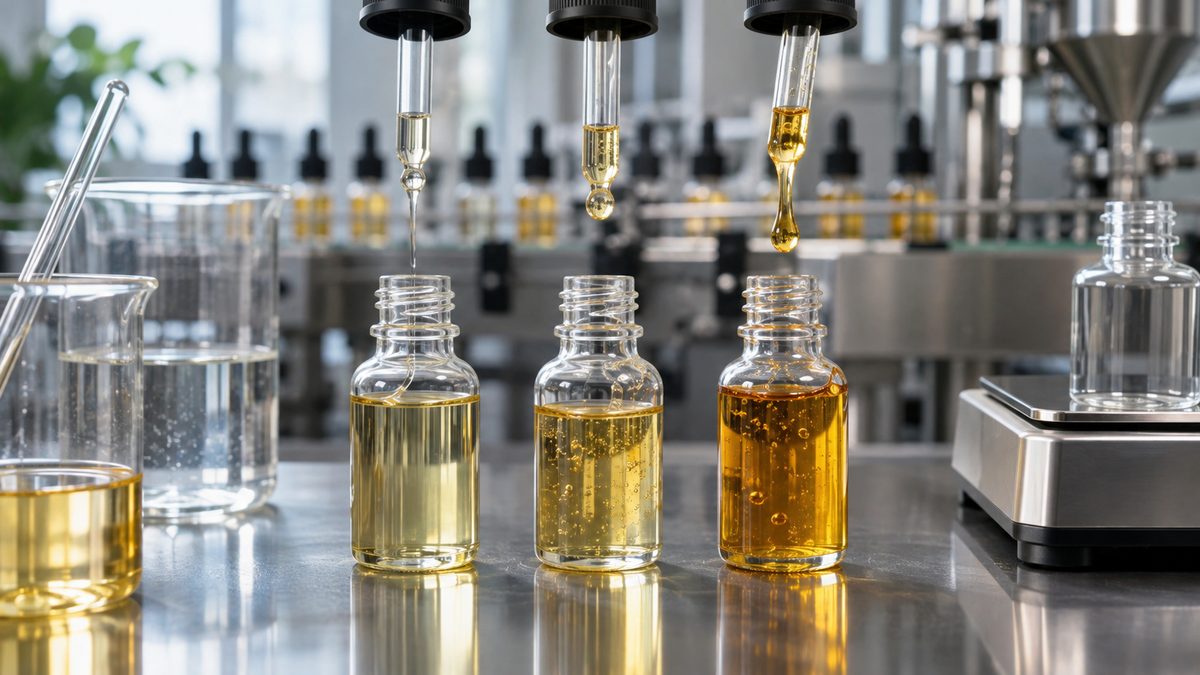
A brand fills 10 ml dropper bottles with a fragrance oil and records the fill weight on the same scale each morning. The number moves by a few percent between batches, the operator blames the machine, and the lab insists the formulation has not changed. In most cases neither is at fault: the viscosity of the oil drifted with room temperature, and the dropper dispensed a different volume while the declared fill stayed fixed.
This article explains how viscosity, temperature and dropper geometry interact to move fill weight, and how to spec a fill that survives a seasonal swing. It is written for buyers who need to stop chasing a number that is a physical property, not a calibration error.
Table of Contents
- Why viscosity matters in a dropper fill
- Temperature dependence of fragrance oil viscosity
- Fill by weight versus fill by volume
- Dropper orifice, pipette and glass geometry
- Failure modes that read as a "fill problem"
- Specification controls that hold the fill stable
- Measuring viscosity without a full lab
- Practical guide: stabilising your dropper fill
- Frequently asked questions
- Conclusion
Why viscosity matters in a dropper fill
A dropper bottle is filled one of two ways: the liquid is metered by volume, or it is dosed by weight. Both interact with viscosity through different mechanisms. In a volumetric fill, the flow speed through the nozzle changes with thickness; in a weight fill, the amount that leaves the nozzle cleanly — rather than clinging to it — shifts the result.
What viscosity actually is here
For fragrance oils, viscosity is set mainly by the carrier base and the heavy fixatives and resins in the blend, so two blends can share a scent character and have very different viscosities.
Newtonian versus slightly non-Newtonian oils
Most simple fragrance oils behave close to Newtonian — viscosity roughly constant under shear — but blends with thickeners, waxes or suspended materials can thin or thicken under flow. If your oil behaves differently at the pump than in a beaker, ask the chemist whether anything in the blend is shear-sensitive before adjusting the machine.
Temperature dependence of fragrance oil viscosity
Viscosity falls as temperature rises, and the effect is much stronger than most production teams expect. A blend that is thin and easy to dose in a warm warehouse is noticeably thicker in a cold one, and the same fill setting delivers a different volume. This is the largest single source of fill-weight drift in products bottled in one season and sold in another.
Hold one fact, not a formula
A change of a few degrees Celsius can move the viscosity of many carrier systems by a double-digit percentage. If the filling room is not temperature-controlled, the fill will wander even with a calibrated machine — which is why the first diagnostic is a thermometer, not a technician. Keep the area within a stated band — many facilities target around 20–25°C — and let the oil and bottles equilibrate before filling, because cold glass pulls heat out of the oil at contact.
Fill by weight versus fill by volume
The declared net content is almost always a volume — millilitres — but the machine may be dosing by weight. The conversion needs the density of the blend, which is itself temperature-dependent, though more weakly than viscosity. A stale density figure makes a weight-based fill drift even when the scale is accurate.
| Property | What it is | Main drivers in a fragrance oil | Effect on dropper fill |
|---|---|---|---|
| Viscosity | Resistance to flow | Carrier, fixatives, resins, temperature | Changes metered volume and drainage |
| Density | Mass per unit volume | Composition, temperature | Changes weight-to-volume conversion |
| Surface tension | Cohesion at the surface | Composition, contaminants | Changes drop size and bottle cling |
Density and viscosity are easily confused: density is mass per unit volume, viscosity is resistance to flow. A buyer who says "the oil is thicker so it must weigh more" has conflated the two and will chase a phantom error.
Dropper orifice, pipette and glass geometry
The dropper itself is part of the dosing system: orifice diameter, pipette length and tip shape set how much a squeeze delivers and how much drains back. A visually similar "upgrade" can shift the fill without any change to the blend.
Drop size is not a fixed quantity
A drop is roughly 0.05 ml for water, but for a fragrance oil the drop size depends on the orifice, surface tension and viscosity. Counting drops is therefore a poor way to set a fill — a dropper delivering 0.04 ml per drop in summer may deliver 0.03 ml in winter. Treat the dropper assembly as a controlled component, like the bottle itself; the closure options on our packaging page show how a small closure change ripples through the fill.
Failure modes that read as a "fill problem"
Not every fill-weight drift is viscosity. Several other failures present with the same symptom, and treating them as a viscosity issue wastes time. The table separates them and how to tell them apart.
| Symptom | Most likely cause | How to distinguish |
|---|---|---|
| Fill drifts with room temperature | Viscosity and density shift | Correlates with the thermometer, not the machine |
| Fill drifts after a dropper change | Orifice or pipette geometry changed | Compare dropper batch and first-article sample |
| Fill drifts with stable temperature | Scale calibration or nozzle wear | Check calibration and inspect the nozzle |
| Fill drifts only for one blend | Formulation variance or heavy component | Compare viscosity across blends |
Running through this list before touching the blend saves the most expensive mistake in the whole process: reformulating a stable product to fix a problem that lives in the dropper or the room temperature.
Specification controls that hold the fill stable
The durable fix is a specification that pins the variables down: the viscosity target and its allowed range at a defined temperature, the density used for conversion, the dropper orifice, and the filling-room temperature band.
Write a range, not a single point
A single viscosity number is unrealistic because raw materials vary. Agree a tolerance band and a test temperature, so the supplier has a clear pass/fail line. This discipline carries directly into repeat orders; the reasoning is laid out in our note on specifying a reorderable blend.
Measuring viscosity without a full lab
You do not need a research rheometer to catch a drift. A flow cup or a falling-ball device gives a relative number that is enough for production control, as long as you measure at the same temperature and against the same reference. The point is consistency of method, not absolute accuracy.
Make the measurement repeatable
Record the instrument, temperature and operator, and measure the reference oil first each day to confirm the setup has not drifted. A relative reading that is stable across batches tells you the oil is consistent; an absolute value that matches a textbook tells you little about whether today's fill matches last month's. When a blend behaves oddly at the dropper, the checklist in this dispensing-complaint triage separates a fill fault from a formulation fault.
Practical guide: stabilising your dropper fill
Step 1 — Log temperature with every run
Record room temperature at the start, middle and end of the run, and let oil and bottles equilibrate overnight in the filling area.
Step 2 — Confirm the density figure on the line
Check the density the machine uses for weight-to-volume conversion against the current blend, and update it whenever the formula changes.
Step 3 — Fix the dropper as a controlled component
Lock orifice diameter and material in the specification, and run a first-article fill check whenever the dropper source changes.
Step 4 — Set a viscosity band, not a point
Agree a target viscosity with a tolerance at a stated test temperature, so the supplier has a pass/fail line instead of an argument.
Step 5 — Measure a reference oil before each shift
Run the reference first to confirm the method has not drifted, then measure the batch at the same temperature.
Step 6 — Distinguish the failure before reformulating
Check the thermometer, the dropper, the scale and the nozzle in that order before touching the blend.
Frequently asked questions
What is private label fragrance oil manufacturing?
It is when a supplier blends and bottles fragrance oils to your specification and brand, while you own the label and sell the product, with the supplier handling formulation, blending and filling.
What is a typical minimum order quantity for fragrance oils?
Minimums depend on the blend and packaging, often from a few hundred to a few thousand bottles per SKU, with stock blends lower and fully custom formulations higher.
How is fragrance oil viscosity specified?
As a value at a defined temperature, usually with a tolerance band, measured with a consistent method such as a flow cup or falling-ball device.
Why does my fill weight change between summer and winter?
The oil's viscosity and density both move with temperature, so the same setting delivers a different volume in a cold room than a warm one. The fix is temperature control and a viscosity band in the spec.
Should I fill by weight or by volume?
For a label that declares millilitres, fill by volume or use an accurate, current density to convert weight to volume. Filling by weight is fine for control, but only with the correct density figure.
Does changing the dropper affect the fill?
Yes. Orifice diameter, pipette length and tip shape all change how much a squeeze delivers and how much drains back, so a visually similar dropper can shift the fill by several percent.
Can I reformulate to make the oil less temperature-sensitive?
Partially. A different carrier base changes the sensitivity, but no oil is immune to the viscosity-temperature relationship. Aim for drift that stays inside your tolerance band.
How do I tell a fill fault from a formulation fault?
Correlate the drift with the thermometer, dropper, scale and nozzle. If it tracks temperature, it is physical; if it appears only after a component change, it is the dropper; if it tracks one blend, it is formulation.
Conclusion
Fill-weight drift in a dropper product is usually a physics problem wearing a calibration costume. The oil's viscosity and density move with temperature, the dropper geometry sets the delivered volume, and any of these can masquerade as a machine fault. Chasing the scale when the real variable is the room temperature burns time and tempts a team into reformulating a blend that was never the problem.
The durable answer is a specification that pins viscosity, density, dropper geometry and filling-room temperature to stated ranges, backed by a reference measurement at the start of every shift. That turns a drifting number into a controlled variable — and gives you a fill that holds from the first bottle to the last.
Discuss your fragrance programme with our team:
WhatsApp: +86 17324762943
Email: adon@customperfumeoem.com
Website: customperfumeoem.com