Running a Car Fragrance Trial With Dealers: A Practical Protocol
A brand sends a box of car fragrances to a dozen dealers, waits for the reorder, and gets back silence — no clear winner, no data, and a vague "they liked them". The trial produced enthusiasm and no information, because it was run as a give
A brand sends a box of car fragrances to a dozen dealers, waits for the reorder, and gets back silence — no clear winner, no data, and a vague "they liked them". The trial produced enthusiasm and no information, because it was run as a giveaway rather than a structured experiment.
This article lays out a protocol for running a car fragrance trial with dealers: what to test, what to record, how long to run it, and how to read the results so the decision to scale is based on evidence rather than politeness.
Table of Contents
- Define the question before you ship anything
- Designing the sample set for a clean read
- Selecting dealers and briefing them
- What to capture: the feedback form that matters
- Duration, cadence and placement
- Reading results: separating signal from politeness
- Failure modes that corrupt a trial
- Practical guide: running a dealer car-fragrance trial
- Frequently asked questions
- Conclusion
Define the question before you ship anything
A trial without a question is a giveaway with extra steps. Write down the one decision it must inform — which scent to lead with, which price holds, or whether a format sells in this channel — because the sample set, form and duration all follow from it.
One decision, stated as a comparison
Frame the question as a comparison rather than a rating — "which of these three scents earns the strongest reorder intent" rather than "do people like the product". A comparison forces a choice and produces rankable data; a rating produces a wall of sevens and eights that tells you nothing.
Success criteria set in advance
Decide before the trial what a pass looks like: a reorder-intent score above a threshold, a sell-through rate, or a dealer willingness to stock. Setting the bar after you see the results is how trials get retrofitted into whatever conclusion the team already wanted. The dealer-facing formats themselves are covered in our car fragrance pack planning note.
Designing the sample set for a clean read
The samples should vary only the thing you are testing. If the question is scent selection, vary the scent and hold format, size and price constant; if it is format, vary the format and hold the scent constant.
Keep the set small enough to compare
Three to five options is the working range; more than that and dealers rank by memory. Give each dealer the same set, in the same order, with a clear identifier. If the scent is the question, label the samples neutrally so the brand name does not carry the vote.
Selecting dealers and briefing them
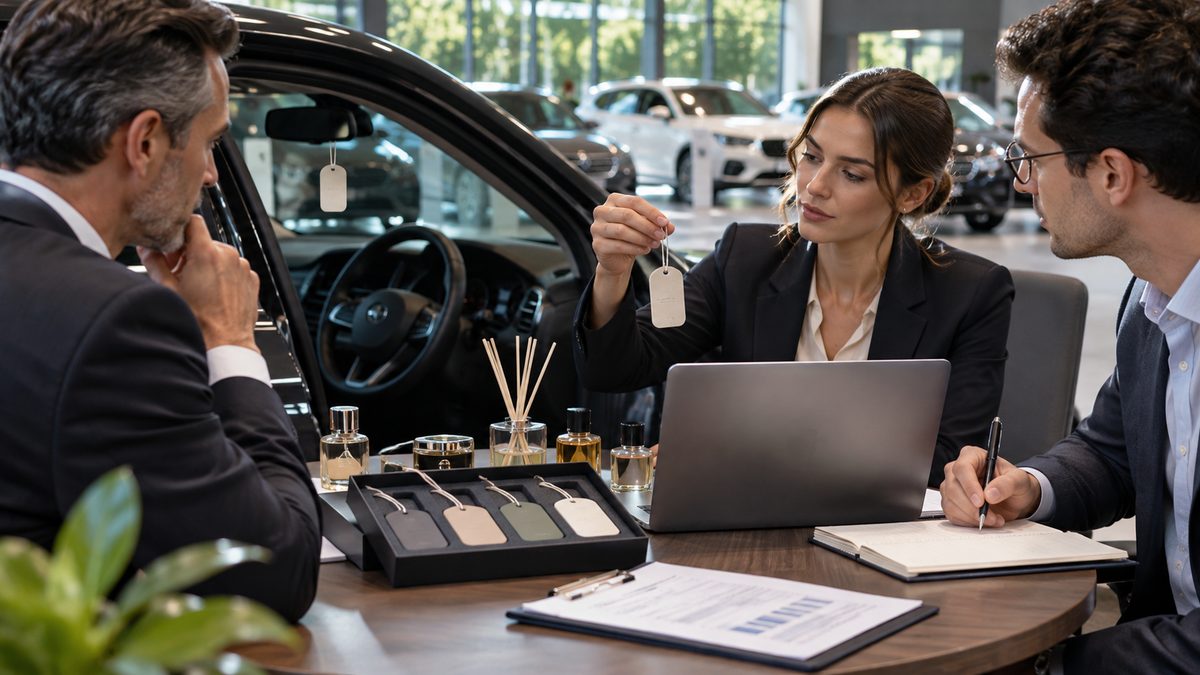
The dealers you trial with should resemble the channel you will sell into, not the most convenient or friendly. A mixed group gives a read across the channel, but the trial is only as clean as the brief.
Tell dealers exactly what to place, where, for how long and what to record, and make the recording a fixed part of the deal rather than a favour. A dealer briefed to "try these and tell us what you think" will tell you what they think of you; one briefed to record placement, duration and reorder intent will give you data. Offer a reason to complete the form — a discount on the first stock order or credit against the trial — that rewards the completed form, not the positive answer. If the set includes scent cards for promotional drops, brief them the same way.
Tell dealers exactly what to place, where, for how long and what to record, and make the recording a fixed part of the deal rather than a favour. A dealer briefed to "try these and tell us what you think" will tell you what they think of you; one briefed to record placement, duration and reorder intent will give you data. Offer a reason to complete the form — a discount on the first stock order or credit against the trial — that rewards the completed form, not the positive answer.
What to capture: the feedback form that matters
The feedback form is where most trials fail. It should capture observable facts and a small number of ratings, not a single "overall score" and a comments box. The table separates what is worth recording from what is noise.
| Field | What it captures | Why it matters |
|---|---|---|
| Placement and duration | Where the product sat and for how long | Separates real use from a quick sniff |
| Ranking, not rating | Forced order of the sample set | Produces comparable, decision-ready data |
| Customer reaction | What buyers said or asked unprompted | Captures demand, not opinion |
| Reorder intent | Would the dealer stock at a stated price | The number that predicts the launch |
Keep the form short — a page at most — because a long form gets skipped. Its job is to turn a dealer's week into a few comparable numbers and one line of context.
Duration, cadence and placement
A car fragrance must be lived with, not sniffed, so the trial needs a real duration — at least a couple of weeks, ideally spanning a change in weather, because temperature drives the product's behaviour. A one-day sniff test measures the top note, not the product, and the whole point of the trial is to catch the mid- and late-life behaviour the customer actually experiences.
Instruct dealers to place the product where the end customer will use it — the vent, the mirror, the cup holder — and to leave it there. A product moved to the counter for display is being smelled by staff, not used by customers. Set a check-in schedule — initial confirmation, midpoint check, final collection — so the trial does not drift into silence, and the final collection is where the form gets completed and the data lands. Questions on trial scope can go to our contact page.
Instruct dealers to place the product where the end customer will use it — the vent, the mirror, the cup holder — and to leave it there. A product moved to the counter for display is being smelled by staff, not used by customers. Set a check-in schedule — initial confirmation, midpoint check, final collection — so the trial does not drift into silence, and the final collection is where the form gets completed and the data lands.
Reading results: separating signal from politeness
Dealers are polite, and politeness inflates scores. The most reliable signal is reorder intent — whether the dealer will actually stock the product at a stated price — because it is a commitment, not a compliment.
Look for the spread, not the average
A set of samples all rated seven has told you nothing; one where a sample is ranked first by most dealers and another last is a decision. Rankings and reorder intent preserve the signal that averages compress. Report results by dealer type, and let the channel you want to serve set the direction.
Failure modes that corrupt a trial
Most dealer trials fail for predictable reasons, and nearly all of them are design errors made before the first box ships. Recognising them in advance is cheaper than discovering them in the data.
| Failure | What it looks like | How to prevent it |
|---|---|---|
| No defined question | Vague "they liked it" feedback | Fix one decision before shipping |
| Too many variables | Cannot tell what drove the result | Vary one thing at a time |
| Too short a duration | Only the top note was judged | Run at least a couple of weeks |
| Politeness inflation | Everything scores seven | Rank, and weight reorder intent |
| Incentive for the wrong answer | Dealers flatter to win the prize | Reward the completed form, not the positive result |
The common thread is that a trial is an experiment, and experiments fail when they are not designed. Treat the trial with the same rigour as a production run, and the data will be worth the weeks it took to collect.
Practical guide: running a dealer car-fragrance trial
Step 1 — Write the single decision and its success criteria
State the one comparison the trial must answer and the pass threshold, in writing, before any sample is assembled.
Step 2 — Build a three-to-five option sample set, one variable
Vary only the thing you are testing, label the samples clearly, and blind them where the scent itself is the question.
Step 3 — Select dealers that match the target channel
Choose a mixed group that resembles where you will sell, and brief them on placement, duration and recording, not on enthusiasm.
Step 4 — Use a one-page feedback form with a forced ranking
Capture placement, duration, a ranking, customer reaction and reorder intent at a stated price — and nothing more.
Step 5 — Run at least a couple of weeks with fixed check-ins
Span a weather change, instruct placement where the customer uses it, and check in at the start, midpoint and finish.
Step 6 — Read reorder intent and the spread, not the average
Rank reorder intent above ratings, report by dealer type, and distrust a trial where everything scores the same.
Frequently asked questions
What is a private label car fragrance?
A car air freshener produced to your brand's specification — your fragrance, format and packaging — by a supplier, while you own the brand and sell under your own name.
What is a typical minimum order quantity for car fragrances?
Minimums depend on the format and packaging, commonly from a few hundred to a few thousand units per SKU, with custom formats carrying higher minimums than stock options.
What is a dealer trial for a car fragrance?
A structured test where dealers place sample products in real customer-facing use and report structured feedback, so a brand can decide which scent, format or price to launch.
How many samples should a dealer trial include?
Three to five options. Fewer limits the comparison; more overwhelms the dealer. Give every dealer the same set in the same order.
How long should a car fragrance trial run?
At least a couple of weeks, ideally spanning a change in weather, because a short trial only measures the top note.
What is the most reliable measure in a dealer trial?
Reorder intent — whether a dealer will stock the product at a stated price — because it is a commitment, not a compliment.
Why do my trials always come back with everything rated the same?
Politeness inflates ratings, and averages compress the signal away. Use a forced ranking and weight reorder intent instead of an overall score.
Should samples be blind-labelled?
When the scent itself is the question, yes. Blind labelling removes brand loyalty so the dealer judges the fragrance, not your name.
Conclusion
A dealer trial is only as good as the question it was built to answer, and most fail before the first box ships because they were built to generate enthusiasm rather than information. The fix is discipline: one decision, one variable, and a short form that records reorder intent.
Run the trial like the experiment it is, and the weeks return a decision you can defend — which scent to lead with, which price holds, which channel to scale. Run it like a giveaway, and you get back what a giveaway produces: goodwill, and silence.
Discuss your fragrance programme with our team:
WhatsApp: +86 17324762943
Email: adon@customperfumeoem.com
Website: customperfumeoem.com