
Retention and Drop Testing Evidence for a Car Fragrance Mount
A car fragrance mount is sold on a promise that it will stay put, and then a customer reports the clip dropped off the vent on a rough road, or the adhesive pad let go on the first hot afternoon. The buyer has no retention or drop test reco
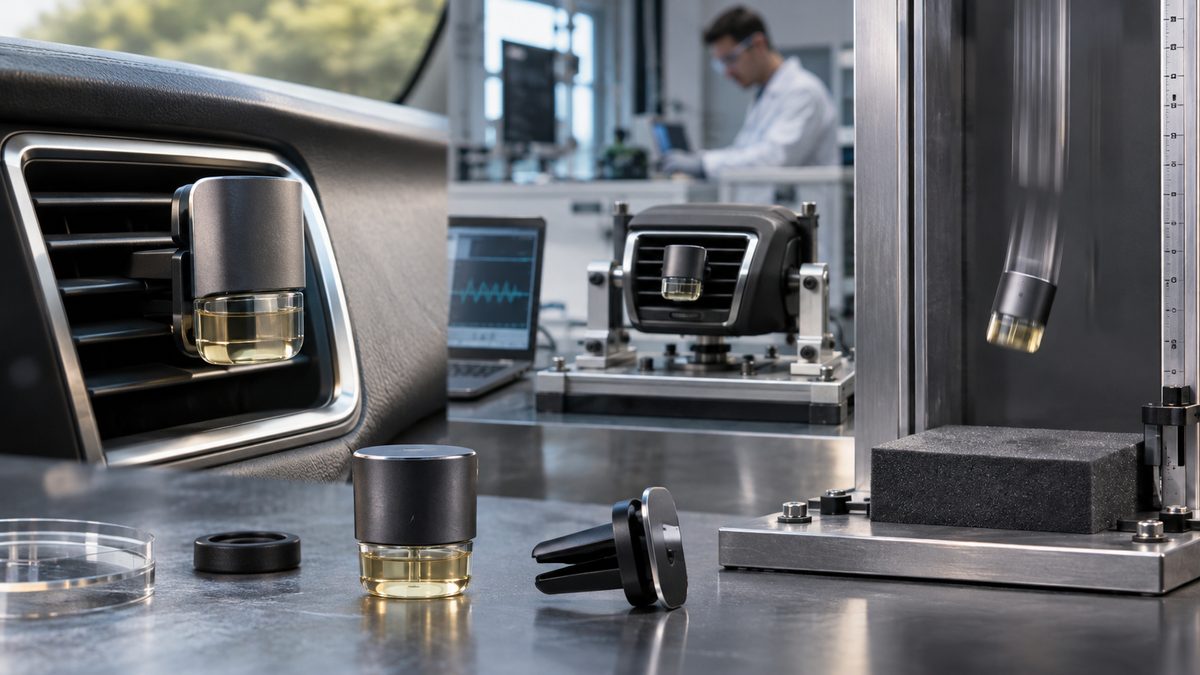
A car fragrance mount is sold on a promise that it will stay put, and then a customer reports the clip dropped off the vent on a rough road, or the adhesive pad let go on the first hot afternoon. The buyer has no retention or drop test record, so the complaint becomes a product defect with no counter-evidence.
This article explains the retention and drop testing evidence buyers now request for car fragrance mounts, covering the mount types, what to measure, and how to specify a test that produces a defensible file. It is written for private label buyers who need to prove their product stays mounted in real use.
Table of Contents
- Why mount retention evidence is requested
- Mount types and retention force
- Drop testing and vibration
- Temperature cycling and the evidence file
- Specifying the tests in the order
- Practical guide: building mount evidence that holds up
- Frequently asked questions
- Conclusion
Why mount retention evidence is requested
The mount is the part of a car fragrance most exposed to mechanical and thermal stress, yet it is the part least often documented. A retailer or platform asks for retention and drop evidence because a fallen product is a distraction hazard and a repeat-return driver.
The mount is a safety and quality issue at once
A fragrance that detaches while driving can roll under pedals or distract the driver, so the retention question is not cosmetic. At the same time, a mount that fails quickly produces returns that erode the listing's reputation, and with a test record the buyer can show the design holds a stated force and survives a stated drop, isolating a complaint to a single defective unit or a misuse condition.
Mount types and retention force
Car fragrance mounts fall into a few families, and each fails in its own way. Retention is quantified as the force required to pull the mount free, measured in the direction it would actually be loaded.
| Mount type | Failure mode | Measurement |
|---|---|---|
| Vent clip | Slips off the fin | Pull force before release |
| Adhesive pad | Peels or shears off | Peel and shear force on the surface |
| Visor clip | Opens or slides off | Clamp force and slip resistance |
| Hanging mount | Detaches under swing | Load at detachment under motion |
Measure in the direction of real loading
Pull force must be applied the way the load is actually applied: downward for a hanging mount, rearward for a vent clip under acceleration, and outward for an adhesive pad being peeled. Testing the wrong direction gives a number that flatters the design, and the test should use representative vent fins and the actual dashboard or trim surface rather than a generic fixture.
Drop testing and vibration
A drop test confirms the product and its mount survive an accidental fall, and the parameters must be stated for the result to mean anything.
Height, surface and orientation
The drop height should reflect the distance from a hand or a vent to the floor, and it should be stated in the protocol. Dropping onto concrete is harsher than onto carpet, and the product should be dropped in the orientations it is likely to fall, including on its clip and on its face. After the drop, check that the product still functions, that no part has cracked or detached, and that the mount still holds.
Why static pull alone overstates security
A static pull measures the mount at a single instant, but real failure usually comes from thousands of small movements that gradually loosen a clip or peel an adhesive. Vibration and temperature cycling, not a one-off pull, are what reveal that cumulative loosening, so a vibration test that shakes the mounted product at road-like frequencies for a stated duration is the test that catches the slow failures a static pull misses.
Temperature cycling and the evidence file
The mount's materials expand and contract with temperature, and cycling stresses the interface between clip and fin, or pad and surface.
Heat is the silent loosener
A clip that grips tightly at room temperature can relax in the heat of a parked car and stay loose even after cooling, because the plastic has taken a set. The test should check retention after a temperature cycle, and combine vibration with an elevated temperature where possible, reproducing a hot car on a rough road rather than the two conditions in isolation. This ties to the packaging and placement choices covered in our scent card packaging guide.
The three parts of a defensible file
Keep the written protocol with its stated heights, forces, surfaces and durations; the results with photos and measurements; and the pass/fail criteria the results were judged against. The tested unit should be identified by SKU and production batch, so the evidence describes the product actually sold rather than an early prototype.
Specifying the tests in the order
The buyer's leverage is to put the test requirements into the order so the factory produces the evidence as part of production rather than after a complaint arrives.
State the forces, heights and surfaces in the spec
Write the required retention force, the drop height and surface, the vibration duration, and the temperature cycle into the purchase specification, so the supplier tests against a defined standard rather than an informal check.
| Test parameter | What to specify | Failure if left open |
|---|---|---|
| Retention force | Value and loading direction | Wrong direction flatters the design |
| Drop height | Height, surface, orientations | Result not reproducible |
| Vibration | Frequency range and duration | No cumulative failure data |
| Temperature cycle | Peak and cycle count | Heat loosening not captured |
Request the report on production samples
Ask for the retention, drop and vibration report on production-representative samples, with photos and the pass/fail criteria, and file it against the SKU. Our car fragrance pack planning guide and packaging range can help fix the mount design and the test brief together from the start.
Practical guide: building mount evidence that holds up
Step 1 — Identify the mount type and its failure mode
Confirm whether the product uses a vent clip, adhesive pad, visor clip or hanging mount, and name the specific way it would detach in use.
Step 2 — Set the retention force in the real direction
Specify the pull force and the direction of loading that matches how the mount is actually stressed, using the real fin or surface geometry.
Step 3 — Define the drop height, surface and orientations
State the drop height, the landing surface and the orientations to be tested, and require a post-drop function and grip check.
Step 4 — Add vibration and temperature cycling
Include a vibration phase and a temperature cycle, and combine them where possible so the test reproduces a hot car on a rough road.
Step 5 — Write the pass/fail criteria first
Set the acceptable retention force, the allowed post-drop condition and the grip requirement before testing, so the result is judged against a fixed standard.
Step 6 — File the protocol, results and criteria together
Store the protocol, photos, measurements and pass/fail criteria against the SKU and batch, so the evidence describes the product actually sold.
Frequently asked questions
What is a car fragrance mount retention test?
It is a measurement of the force required to pull the mount free in the direction it is actually loaded, used to confirm the product stays attached in real use.
Why do car fragrance mounts fail?
Vent clips lose grip when plastic relaxes, adhesive pads let go when heat softens the bond, and hanging mounts detach under vibration and swing loads.
What should a drop test specify?
It should state the drop height, the landing surface and the orientations tested, and require a check that the product still functions and the mount still holds afterward.
Is a static pull force enough to prove the mount is secure?
No. Real failure usually comes from vibration and temperature cycling that gradually loosen the mount, so those tests must accompany a static pull.
Why does temperature matter for the mount?
Heat softens plastic and adhesive, so a clip or pad that grips at room temperature can relax in a hot car and stay loose, which is why retention is checked after a temperature cycle.
What should the mount be tested on?
On representative vent fins and the actual dashboard or trim surface, not a generic fixture, because retention depends on the real geometry and material.
What makes the test evidence defensible?
A complete file with the written protocol, the results with photos and measurements, and the pass/fail criteria, tied to the specific SKU and production batch.
How do I get the supplier to produce this evidence?
Write the required forces, heights, surfaces, vibration and temperature cycle into the purchase specification and request the report on production samples.
Conclusion
Mount retention and drop testing turn a subjective promise — "it stays put" — into a measurable claim. The buyer who specifies the forces, heights, surfaces, vibration and temperature cycle, and files the protocol with the results and criteria, can answer a complaint with evidence instead of accepting a defect finding.
The key is to test the mount the way it is actually loaded, on the real fin and surface, and to treat vibration and heat as the real loosening forces rather than a single static pull. Built that way, the evidence survives a review and the product survives the road.
Discuss your fragrance programme with our team:
WhatsApp: +86 17324762943
Email: adon@customperfumeoem.com
Website: customperfumeoem.com


