Proving 'Lasts 90 Days': Evidence Behind Diffuser Performance Claims
A buyer prints "lasts 90 days" on a diffuser because the supplier said so in an email, and six weeks later the returns start — the liquid is gone, the scent has faded, and the claim has no test behind it. A longevity claim is a measurable s
A buyer prints "lasts 90 days" on a diffuser because the supplier said so in an email, and six weeks later the returns start — the liquid is gone, the scent has faded, and the claim has no test behind it. A longevity claim is a measurable statement about evaporation, and it either has evidence or it does not. The gap between those two states is where diffuser performance claims fail.
This article explains what a "lasts 90 days" claim really asserts, which variables move the number, how mass-loss testing supplies the evidence, and how to write a claim that survives a challenge rather than a refund request.
Table of Contents
- What "lasts 90 days" actually means
- The variables that change how long a diffuser lasts
- Mass-loss testing as the core evidence
- Why test conditions decide the number
- From a single measurement to a defensible claim
- What "lasts" does not promise — intensity over time
- Failure modes when the claim is unsubstantiated
- Specifying the test into the development process
- Practical guide: substantiate a longevity claim
- Frequently asked questions
- Conclusion
What "lasts 90 days" actually means
The claim asserts that the filled diffuser will continue to release fragrance for a stated period under stated conditions. It is a promise about two things at once: that liquid remains in the bottle long enough, and that the scent stays perceptible as the liquid evaporates. Most claims collapse on the second point — the bottle may still hold liquid at day 90 while the scent dropped below notice weeks earlier.
This is why a single number is not enough. A defensible claim states the period, the conditions, and the number of reeds it assumes, because all three together define what the number means. A bare "90 days" with no conditions is a claim waiting to be tested against whatever room a customer happens to live in.
The variables that change how long a diffuser lasts
Longevity is set by the solvent's evaporation rate, the number and type of reeds, the bottle's neck opening, and the environment — temperature, airflow, and humidity. A diffuser that lasts 90 days in a cool, still room can empty in half that time in a warm, draughty one, because evaporation accelerates with heat and moving air.
| Variable | Effect on life | Direction |
|---|---|---|
| Solvent volatility | Sets baseline evaporation | Faster solvent, shorter life |
| Reed count and type | Sets exposed surface area | More reeds, faster loss |
| Temperature | Accelerates evaporation | Warmer, shorter life |
| Airflow / ventilation | Carries vapour away | More airflow, shorter life |
| Bottle neck opening | Limits exposed liquid | Wider neck, faster loss |
The point of the table is not to memorise values but to see that the number is a system property, not a fragrance property.
Mass-loss testing as the core evidence
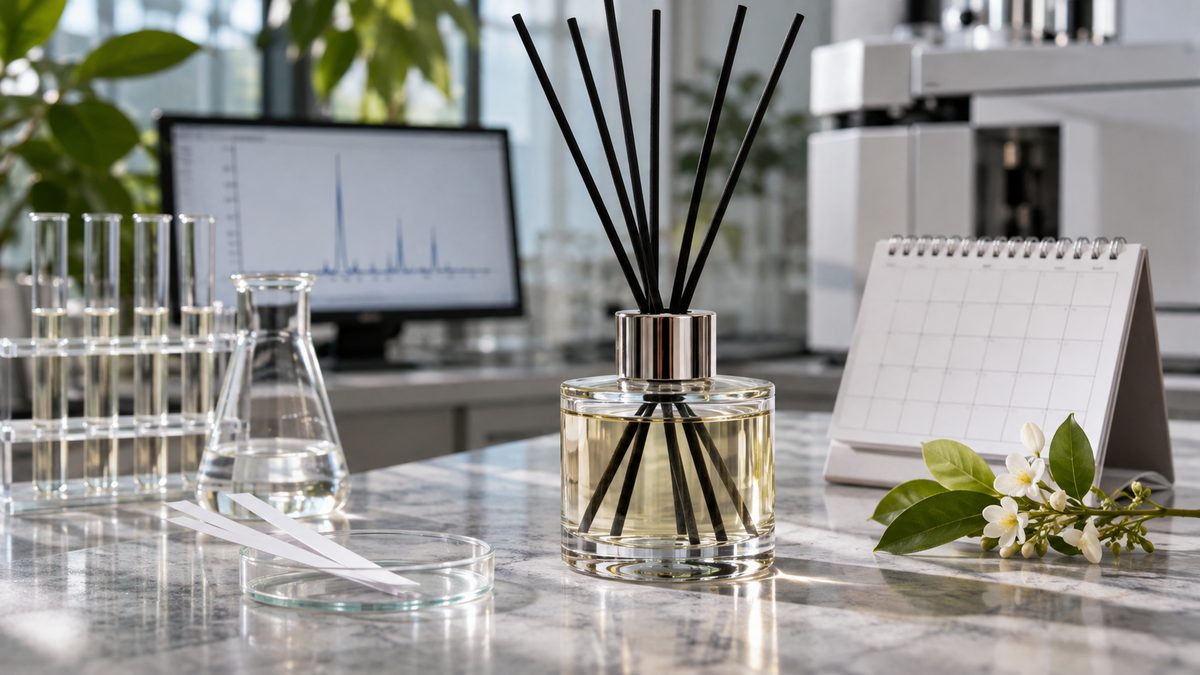
Mass-loss testing measures how much liquid leaves the diffuser over time, by weighing the bottle at intervals under controlled conditions. The result is an evaporation curve — typically fast at first as the reeds saturate, then steadier — that can be projected to the point where the liquid is exhausted or the release rate drops below usefulness.
The test answers the mechanical half of the question: how long the liquid lasts. It does not, by itself, answer whether the scent stays perceptible, which needs an olfactive check at the same intervals. A full substantiation runs the two together, so the claim covers both the physical liquid and the perceived scent.
Why test conditions decide the number
The same diffuser tested at 20 degrees and still air will show a different life than at 28 degrees with a fan, because evaporation is temperature- and airflow-driven. This is why a claim without a defined condition is meaningless — the number can be made to say almost anything by choosing the room.
Choosing a representative condition
The practical approach is to test at a condition that represents the typical use case, state it on the technical file, and keep the consumer-facing wording modest — "up to 90 days" or "approximately 90 days under normal indoor conditions" rather than an absolute. The mass-loss and evaporation checks that back the number belong in the same file.
Why a single "real-world" number is a trap
There is no single real world; a customer's bedroom, bathroom, and hallway are three different environments. A credible claim picks a defined, reproducible condition — stated temperature, airflow, and reed count — and is honest that real-world life will vary around it. Pretending the number is universal is what turns a reasonable estimate into a misleading claim.
From a single measurement to a defensible claim
A single bottle measured once is a data point, not evidence. A defensible claim rests on a defined test protocol — the fill volume, the reed count, the environment, and the measurement intervals — run across enough samples that the result is reproducible, with the olfactive check confirming the scent holds at each interval. That chain is what a retailer or a challenger can be shown.
| Evidence element | What it establishes | Why it is needed |
|---|---|---|
| Fill volume and reed count | The system under test | Defines what the claim applies to |
| Controlled environment | Temperature, airflow, humidity | Makes the result reproducible |
| Mass-loss curve | Physical liquid life | Shows the liquid lasts |
| Olfactive check | Perceptible scent over time | Shows the scent lasts too |
When the evidence chain is complete, the claim becomes a statement about a defined system under defined conditions. When it is missing any link, the claim is an opinion, and opinions do not survive a refund or a review.
What "lasts" does not promise — intensity over time
A diffuser that "lasts 90 days" may still fade to near nothing well before day 90, because the release rate is not constant. The top notes leave first, and the scent character shifts as the base notes dominate. A longevity claim that ignores intensity is technically true and practically useless — the customer smells the product for two weeks and stares at an inert bottle for ten more.
The honest framing treats life and intensity as one curve. The claim should reflect the period over which the scent remains at an acceptable strength, not merely the period until the bottle is empty. This is where the olfactive check earns its place in the protocol.
Failure modes when the claim is unsubstantiated
The failures follow a pattern. A claim is copied from a competitor without its own test. A number is taken from a solvent data sheet rather than the finished product. A test is run at a flattering condition that no customer's room matches. A reformulation changes the solvent or the reeds but the old claim is left on the label.
Each failure is a claim that will be tested against reality by the customer, and reality is a harsher auditor than any regulator. The fix is to make the claim a product of the test, not the other way around.
Specifying the test into the development process
The longevity test should be part of development, not a post-hoc exercise. When the base, reeds, and fragrance are being selected, the mass-loss and olfactive checks run in parallel, so the claim and the product mature together. Any later change to the solvent or the reeds re-runs the test, because the number belongs to the system, not the fragrance.
For a full programme, the claim ties into the reed bundles sold as replacements, which must match the tested system, and into the packaging that carries the claim. Our diffuser range is developed with the test protocol built in, so the number on the box has a file behind it.
Practical guide: substantiate a longevity claim
Step 1 — Define the system under test
Fix the fill volume, the base, the fragrance dose, the reed count and type, and the bottle neck, so the test describes a real product.
Step 2 — Set a controlled environment
Choose a stated temperature, airflow, and humidity that represent typical use, and record them as part of the protocol.
Step 3 — Run mass-loss at intervals
Weigh the diffuser at fixed intervals to build the evaporation curve, and project it to the point of exhaustion.
Step 4 — Add the olfactive check
At the same intervals, confirm the scent is still perceptible at an acceptable strength, so life and intensity are measured together.
Step 5 — Write the claim modestly
Use "up to" or "approximately" with the stated conditions, rather than an absolute number with no qualifier.
Step 6 — Re-test on any system change
Re-run the protocol whenever the solvent, reeds, or fragrance change, and update the claim to match the new system.
Frequently asked questions
What is a private label reed diffuser?
A private label reed diffuser is manufactured by a supplier and sold under a buyer's own brand; the buyer selects the fragrance, base, bottle, and reeds, and the supplier fills it under the buyer's name.
What is a diffuser performance claim?
A diffuser performance claim is a statement about how long or how strongly the product releases fragrance, such as "lasts 90 days", which must be backed by test evidence.
What is mass-loss testing?
Mass-loss testing measures how much liquid leaves a diffuser over time by weighing it at intervals under controlled conditions, producing an evaporation curve.
Why does my diffuser not last as long as the label says?
Because real-world life depends on temperature, airflow, and reed count, which can be very different from the test condition. A warmer or draughtier room shortens the life substantially.
Does the bottle still holding liquid mean it is still working?
Not necessarily. The scent can fade below perceptible strength while liquid remains, because the top notes evaporate first. Life and intensity must be measured together.
How many samples should I test?
Enough that the result is reproducible rather than a single lucky bottle. A defensible claim rests on a defined protocol run across multiple samples.
Can I change the reeds without re-testing the claim?
No. The reed count and type set the evaporation surface, so a change alters the life. Re-run the protocol whenever the system changes.
What wording should I use for a longevity claim?
Use qualified wording such as "up to 90 days" or "approximately 90 days under normal indoor conditions", and keep the defined test condition in the technical file.
Conclusion
A longevity claim is a measurement dressed up as a marketing promise, and it is only as good as the test behind it. The claims that survive are the ones that name the system, state the conditions, and measure both the liquid and the scent, rather than borrowing a number from a supplier's email.
Build the test into development and re-run it on every change. A diffuser whose "90 days" is backed by an evaporation curve and an olfactive check earns the claim the way a competitor's copied number never will.
Discuss your fragrance programme with our team:
WhatsApp: +86 17324762943
Email: adon@customperfumeoem.com
Website: customperfumeoem.com