Perfume Filling Options: Cold Fill, Vacuum Crimp and Lead Time
A fifty-millilitre spray looks like a simple assembly: glass, liquid, pump, cap. Filling is where those four meet, and where most failures that reach the customer are created — the seep at the crimp, the spray that weakens after a week. Col
A fifty-millilitre spray looks like a simple assembly: glass, liquid, pump, cap. Filling is where those four meet, and where most failures that reach the customer are created — the seep at the crimp, the spray that weakens after a week. Cold fill and vacuum crimp differ in how much oxygen stays in the headspace, what the seal must do, and which formulas a line can run.
This article follows the perfume filling process from route selection through formulation limits and lead time to the defects that appear after dispatch rather than at the end of the line.
Table of Contents
- How each filling route seals
- Formulation limits that choose the route
- Filling routes compared
- Where the lead time actually sits
- Defects that appear after dispatch
- Practical guide: specifying a perfume filling run
- Frequently asked questions
- Conclusion
How each filling route seals
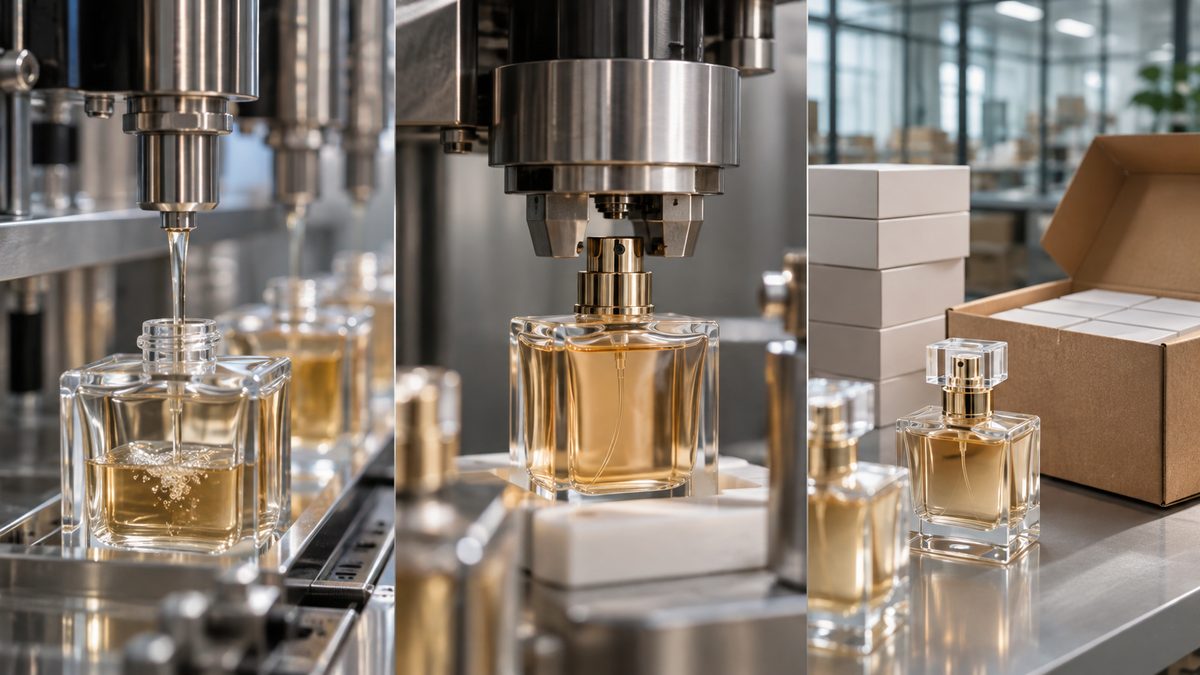
A perfume filling process for a pump spray ends with a pump crimped onto a glass neck. What differs is what happens to the air before the crimp closes.
Cold fill
Liquid is filled at ambient temperature, the pump is placed, and a crimping head folds the aluminium ferrule over the neck finish. It is the default for alcoholic fragrance because heating a flammable, volatile liquid is undesirable on every count. The bottle keeps air in the headspace, roughly one-fifth oxygen, and the ethanol surface is open to the room between fill and crimp — seconds on a rotary line, longer on a semi-automatic one.
Vacuum crimp
The head draws a vacuum through the pump stem or around the neck before the ferrule closes, so the sealed bottle starts with a reduced-pressure headspace. The seal is checked by vacuum decay: the unit is placed under vacuum and the pressure rise monitored, a rate above a set limit indicating a leak path. Cycle time is longer, and the pump must pass vacuum through the stem without the valve being pulled shut.
Why vacuum crimp is not automatically better
Removing headspace oxygen slows oxidation of citrus terpenes and some aldehydes, which genuinely helps a high-limonene formula. But it does nothing for a seal that is dimensionally wrong, and it adds a step some fillers run badly. A vacuum crimp made with a worn die is worse than a clean cold fill, because the fault stays hidden until the vacuum test is done properly.
Formulation limits that choose the route
The formula decides how a perfume filling process runs: whether the line can fill it cleanly, quickly and lawfully. Three properties decide most of the selection.
Ethanol, flashpoint and the filling room
An eau de parfum is typically 60–80% ethanol, a flammable liquid with a flashpoint below room temperature. The filling room is therefore a hazardous area: solvent-rated equipment, bonding and grounding of every conductive part, local extraction, no ignition source. A filler that runs food-grade alcohol under another classification may not be equipped for fragrance.
Foaming, viscosity and fill accuracy
Fragrance foams less than a surfactant solution but enough to matter at speed. Nozzle turbulence, a high fill rate and a cold bulk increase entrained air, which shows up as weight variation and a bubble at the shoulder. Bottom-up filling, a degassed bulk and a stable temperature solve most of it. A heavy formula also draws slowly through a fine dip tube, so fill time is set by the slowest SKU.
Pump gasket compatibility
The gasket and concentrate stay in contact, and terpenes attack some elastomers. Nitrile and EPDM can swell and take a compression set, producing a leak weeks later; polyethylene and PTFE are more inert but less elastic, so the seal leans harder on crimp force. Immerse the gasket in the concentrate for four weeks at elevated temperature, then measure swell and hardness change against agreed limits. Bottle and closure options are set out under packaging formats.
Filling routes compared
| Route | How the seal is made | Headspace oxygen | Throughput | Main constraint | Best for |
|---|---|---|---|---|---|
| Cold fill | Ambient fill, pump placed, ferrule crimped | Near ambient, about one-fifth | High | Ethanol loss and oxidation risk | Most alcohol sprays, short runs |
| Vacuum crimp | Vacuum drawn, then ferrule crimped | Reduced | Moderate | Needs vacuum-capable pump and crimper | Citrus-heavy or oxidation-sensitive formulas |
| Pressure fill | Propellant forced into a sealed can | Set by propellant | High | Separate product category and rules | Aerosol formats only |
Take throughput from the filler's validated rate for the pack, not from a catalogue. A line rated at tens of thousands a day may run a small bottle at half that once changeover and QC stops are counted.
Where the lead time actually sits
Buyers count the filling days and forget the weeks before them. The perfume filling process is rarely the constraint; the constraint is whatever must be made, matured or decorated first.
Bulk maturation
A freshly blended dilution is not at its final odour. Maceration — holding the bulk before filling — lets reactive components equilibrate, softens the alcohol edge and reduces the chance the scent shifts in the bottle. Two to six weeks is common, longer with heavy resins. Skipping it saves calendar time and costs consistency.
Components, decoration and the booking block
Stock bottles and pumps take days; custom moulds and decoration do not. A custom bottle can run months from tooling to first article, and coating, printing and hot stamping queue after the glass arrives. Ordering the pump after the bottle is approved is the classic sequencing error: neck finish, dip tube and crimp dimension must be specified as a set. Filling capacity is booked in blocks, and a slot holds only if bulk and components arrive by the cut-off.
| Stage | Typical duration | What compresses it | What does not |
|---|---|---|---|
| Bulk maceration | 2–6 weeks | Accelerated maturation, with evidence | Formula complexity |
| Bottle and pump | Days to 8 weeks | Stock components, early deposit | Custom tooling, decoration queue |
| Filling and crimping | 1–2 weeks for 30,000 units | Second line, longer shifts | Changeover and cleaning |
| QC and release | 2–5 days | Pre-agreed acceptance criteria | Leak testing time |
Defects that appear after dispatch
The failures that matter pass the end-of-line check and surface in the customer's hands. Three account for most of them.
Crimp leaks
A crimp has three dimensions that matter: diameter, height and pull-up over the neck. All three drift with die wear and with variation in the neck finish. Too loose and the gasket leaks; too tight and the gasket is crushed and splits. Either can pass a visual check and fail a vacuum decay test. Measure with a crimp gauge on a fixed sample every hour and at each shift end, and read the trend rather than the single value.
Weak spray
A spray that fades in the first week usually has air in the pump chamber, a dip tube that misses the bottom, or a concentrate that has thickened. Dip tube length is a specification: too short and the bottle stops spraying with liquid left inside, too long and the tube curls and blocks. The diagnostic sequence is in this guide to weak sprays and leaks.
Fill weight drift
Volumetric filling assumes a density, and ethanol density changes with temperature: a bulk that warms through the shift delivers less mass for the same volume. Under an average-quantity system, a few grams per unit can push a lot outside tolerance while every bottle still looks full. Confirm the destination's metrology rules and control bulk temperature.
Practical guide: specifying a perfume filling run
Step 1 — Fix the ethanol and water ratio first
Flashpoint, viscosity and density follow from it, and all three feed the specification. Quoting before the ratio is fixed produces a price that will change.
Step 2 — Specify bottle finish, pump and crimp as one system
Neck finish, ferrule size and crimp dimensions are a mated set. Approve them on one drawing, not on three samples that happen to fit.
Step 3 — Run a pilot on the actual line
Five hundred to a thousand units on the machine that will run the order, with real bulk and components. A lab fill proves the formula; a line pilot proves the process.
Step 4 — Set the QC gates before the run
Fill weight, crimp dimensions, leak or vacuum decay, spray rate and actuation force. Agree sample size and limits in writing; a gate added afterwards is a negotiation.
Step 5 — Retain first, middle and last
Keep units from the start, middle and end of the run plus a bulk retain. When a complaint cluster arrives later, these separate a line problem from a formula problem.
Step 6 — Book freight against release, not the fill date
QC release and documentation add days after the last bottle is packed. Plan backwards from the retail date using the release date.
Frequently asked questions
What is private label perfume filling?
Filling a buyer's fragrance into the buyer's bottle and closure under the buyer's brand. The filler owns the line, crimp specification and batch record; the buyer owns formula and pack design.
What does minimum order quantity mean here?
The smallest run a line accepts without changing over at a loss. It is driven by component minimums, cleaning time and the booking block, so it moves with bottle choice.
How long does perfume production take?
From approved formula to released goods, commonly eight to sixteen weeks, with maceration, custom glass and decoration as the long poles.
Cold fill or vacuum crimp — which should I choose?
Cold fill unless the formula is oxidation-sensitive or the market requires a reduced-pressure headspace. Vacuum crimp costs cycle time and demands a compatible pump.
Does vacuum crimping make a fragrance last longer?
It slows oxidation, protecting the top and the colour over shelf life. It does not change performance on skin or rescue a thin base.
Why do crimps leak after shipping but not at the factory?
Pressure and temperature changes in transit, plus vibration, open a marginal seal. A crimp at the loose end of tolerance can hold at sea level and fail in an air-freight hold.
What fill weight tolerance should I ask for?
One that satisfies the destination's net-content rules and is achievable at line speed. Ask for the capability study, then set the tolerance inside it.
Can an alcohol-based perfume be air freighted?
Yes, as a regulated flammable liquid, subject to quantity limits, packaging and documentation. Confirm the carrier's current dangerous-goods requirements first.
Conclusion
The perfume filling process is a sealing process that happens to involve liquid. The route, the crimp dimensions and the gasket decide whether the bottle leaving the line is the same product six months later, and none can be inspected into the product at the end. Specifying them as one system, on the real line, is cheaper than downstream sorting.
Treat lead time as a chain of releases rather than a single number: compound, maceration, components, slot, QC, freight. The longest link is usually the one nobody booked. Our customisation process sequences these releases so the filling slot is confirmed against materials rather than against hope.
Discuss your fragrance programme with our team:
WhatsApp: +86 17324762943
Email: adon@customperfumeoem.com
Website: customperfumeoem.com