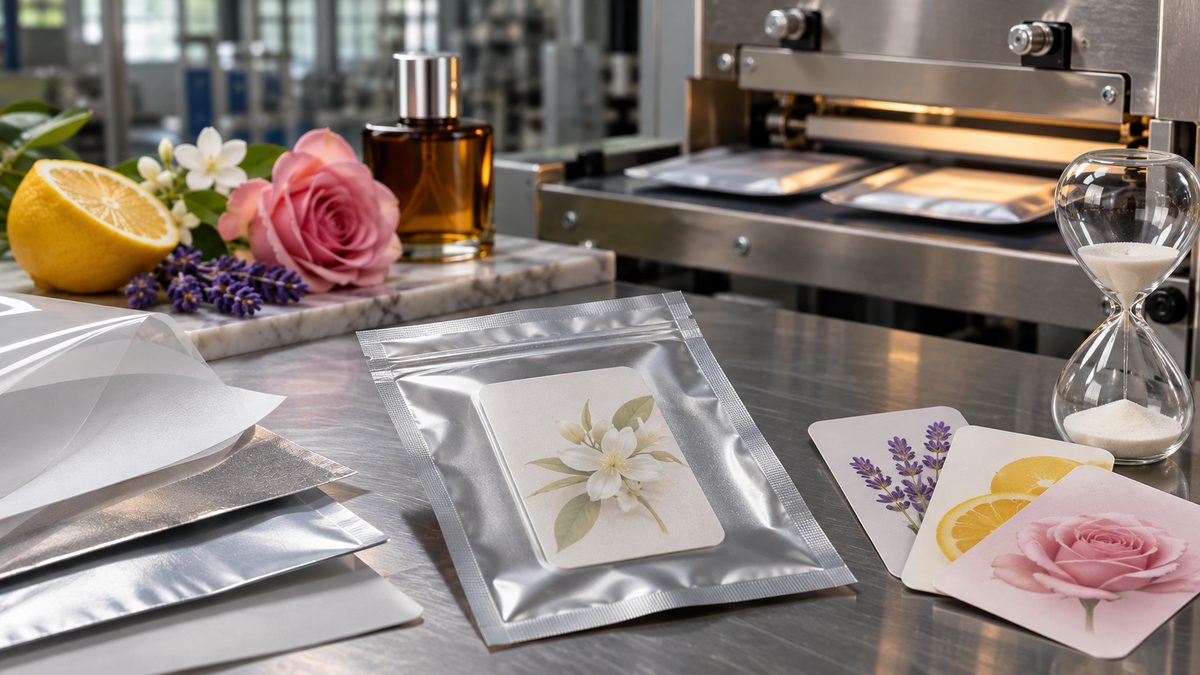
Ink, Coating and Fragrance: Three-Way Compatibility on a Printed Card
The ink looks right on the proof and the fragrance smells right on its own, but on the finished card the print smears, the scent is weak, or the cards bond into a block in the box. The failure is a three-way problem: the ink, the coating an

The ink looks right on the proof and the fragrance smells right on its own, but on the finished card the print smears, the scent is weak, or the cards bond into a block in the box. The failure is a three-way problem: the ink, the coating and the fragrance each react with the other two, and testing any pair in isolation misses the interaction that ruins the product.
This article explains how ink, coating and fragrance interact on a printed scent card, where the conflicts arise — solvents attacking ink, coatings trapping or sealing the scent, and blocking in the stack — and how to run a compatibility test that catches the failure before the full run. It gives you the test sequence and the specification format that keeps all three materials working together.
Table of Contents
- Three materials on one card
- Ink chemistry and fragrance attack
- Coatings: barrier or trap
- Blocking and set-off in the stack
- Testing the three-way compatibility
- Building a compatibility specification
- Practical guide: running a three-way compatibility test
- Frequently asked questions
- Conclusion
Three materials on one card
A finished scent card carries ink that forms the design, a coating that protects the print, and a fragrance that must survive both. Each pair interacts: the fragrance can dissolve or smear the ink, the coating can seal the fragrance in or the ink in, and the stack pressure can transfer any of them between cards.
Pairwise tests are not enough
An ink that survives the fragrance and a coating that survives the ink can still fail together, because the coating changes how the fragrance contacts the ink and how the stack releases. The only valid test applies all three materials on the real stock and observes the finished card.
Ink chemistry and fragrance attack
Fragrance oils and their carriers are solvents, and some of them will soften, dissolve or discolour certain inks. A fragrance heavy in esters or glycol ethers is more likely to attack an ink film than a light, dry fragrance, so the fragrance's own chemistry is the first thing to check.
The carrier is usually the aggressor
Often it is not the fragrance oil but its carrier — DPG, IPM or a solvent blend — that attacks the ink. When a card smears, check whether the carrier, not the aromatic, is what is dissolving the print, because the fix may be as simple as changing the carrier.
Coatings: barrier or trap
A coating is applied over the ink to protect it, and it sits between the print and the fragrance. Whether that coating helps or hurts depends on what it is: an aqueous or UV coating can act as a barrier that keeps the fragrance off the ink, or as a film that blocks the fragrance from absorbing into the paper at all.
The coating decides where the scent sits
If the coating seals the paper surface, the fragrance sits on top and is free to evaporate or smear the coating. If the coating is porous, the fragrance can pass through into the paper. Where the scent ends up — on the surface or in the fibre — changes both its strength and its life.
| Coating type | Porosity | Effect on scent |
|---|---|---|
| Aqueous | Moderate | Anchors or blocks by formulation |
| UV varnish | Low, dense | Protects ink, shortens release |
| Laminate | None | Blocks scent entirely |
Coating as barrier versus trap
A dense, closed coating keeps the fragrance from reaching the ink, which protects the print but can also stop the fragrance from anchoring to the card, so it evaporates quickly. A porous coating lets the fragrance anchor but offers the ink less protection. The coating is a deliberate trade, not a default.
Blocking and set-off in the stack
Blocking is the tendency of stacked cards to stick together, and set-off is the transfer of ink or fragrance from one card to the back of the next. Both are driven by residual solvent, an incompletely dried coating, or a fragrance that has softened the ink or coating film.
Pressure and time make it worse
A card that is fine when handled alone can block once it has sat under the weight of a full stack for days. The compatibility test must therefore include a stacked, weighted sample, because the failure only appears under pressure over time.
Testing the three-way compatibility
The test applies the fragrance to a fully printed and coated card and observes the result over time and under stack pressure. It looks for four outcomes: ink smear or bleed, coating failure, blocking, and an unacceptable odour change.
| Check | What to look for | Why it matters |
|---|---|---|
| Ink integrity | Smear, bleed, colour shift | Fragrance or carrier attacking ink |
| Coating integrity | Cracking, tack, haze | Coating breaking down or trapping scent |
| Blocking | Cards sticking, set-off | Residual solvent under stack pressure |
| Odour | Off-notes, ink smell | Fragrance reacting with materials |
Building a compatibility specification
Once the three materials pass together, the result is written down as a locked combination: a named ink, a named coating, and a named fragrance at a defined load on a named stock. Any change to one of the three invalidates the test and requires a re-run.
Practical guide: running a three-way compatibility test
Step 1 — Shortlist the ink and coating
Pick the ink and coating candidates for the design before introducing the fragrance, so you test the real print system, not a placeholder.
Step 2 — Get a printed and coated blank
Print and coat the actual stock exactly as production will, because a proof on different paper does not predict the behaviour of the real card.
Step 3 — Apply the fragrance at the target load
Dose the fragrance at the production load, not a stronger bench dose, so the test reflects what will actually ship.
Step 4 — Observe for a defined period
Hold the samples for at least several days and check ink, coating and odour at intervals, because solvent attack and colour shift are often slow.
Step 5 — Check blocking under weight
Stack a representative pack under a realistic weight for the same period and confirm the cards separate cleanly with no set-off.
Step 6 — Confirm the odour is acceptable
Have the panel smell the finished card, not just the fragrance, to catch the off-notes that arise when the three materials meet.
Step 7 — Lock the materials
Record the ink, coating, fragrance, load and stock as a single locked combination so any later substitution triggers a re-test.
Frequently asked questions
What is an aqueous coating?
An aqueous coating is a water-based protective film applied over printed paper. It can act as a barrier between the ink and the fragrance, and its porosity decides whether the scent anchors into the paper or sits on the surface.
What is UV varnish?
UV varnish is a coating cured by ultraviolet light to a hard, glossy film. It is dense and protective but can seal the paper surface and change how a fragrance absorbs or evaporates.
What is blocking on printed cards?
Blocking is when stacked cards stick together, usually because residual solvent or a softened coating has not fully dried. It appears under stack pressure and is a common failure when fragrance is applied before the card is dry.
Does fragrance dissolve ink?
It can, because fragrance oils and their carriers are solvents. Often it is the carrier rather than the aromatic that attacks the ink, so when a card smears, check whether the carrier is the aggressor.
Which coating protects ink from fragrance?
A dense, closed coating keeps the fragrance off the ink and protects the print, but it can also stop the fragrance from anchoring and shorten its life. The right coating is a trade between print protection and scent retention, tested on the real stock.
Why do cards stick in the stack?
Cards stick when residual solvent or a softened ink or coating has not dried before the cards are stacked under weight. Allow a drying window and test a weighted stack, because the failure only shows under pressure over time.
Does laminate block the scent?
A laminate is a solid film that will block most fragrance from passing through, so it is generally unsuitable where the scent must release. Reserve lamination for areas that need no scent, and test any partial laminate carefully.
How long should a compatibility test run?
Run it for at least several days, because solvent attack, colour shift and blocking are slow. Include a weighted stack for the full period, since a single handled card will not reveal the failures that appear under pressure.
Conclusion
Ink, coating and fragrance are a single system on a printed scent card, and any one of them can be undone by the other two. Test all three together on the real stock, under weight and over time, and treat the passing combination as locked.
Change any material and the test is void. For the complaints that surface when this step is skipped, see our guide on triaging scent card complaints, review the scent cards we produce and our packaging options, or ask about custom scent card development.
Discuss your fragrance programme with our team:
WhatsApp: +86 17324762943
Email: adon@customperfumeoem.com
Website: customperfumeoem.com