Ethanol Denaturation and Odour: Why Two 96% Alcohols Smell Different
Two drums of ethanol arrive with the same certificate: 96% v/v, pharmacopoeia grade, water within limit. One opens clean; the other carries a flat, glue-like note that survives filtration and later collapses the top note within seconds of s
Two drums of ethanol arrive with the same certificate: 96% v/v, pharmacopoeia grade, water within limit. One opens clean; the other carries a flat, glue-like note that survives filtration and later collapses the top note within seconds of spraying.
This article separates the 96% headline into the fractions that reach a finished perfume: the congener fingerprint from feedstock and distillation cut, the denaturant package, oxidation in storage, and the remaining water. It then sets out a testing sequence for approving a drum and holding later deliveries to it.
Table of Contents
- What a 96% figure conceals
- Feedstock and distillation cut
- Denaturants: the deliberate contaminant
- Oxidation between drum and bottle
- Water, the other six percent
- Testing before approval
- Practical guide: specifying perfume ethanol quality
- Frequently asked questions
- Conclusion
What a 96% figure conceals
96% v/v is measured by volume at a stated temperature; at 20 °C it is roughly 94% ethanol by weight, with about 6% water and a small organic residue. The assay says how much ethanol is present, not which traces remain, and traces are what the nose detects.
Pharmacopoeia monographs control assay, water, methanol, benzene, aldehydes and fusel oil. Those limits protect a process rather than guarantee olfactory neutrality: an alcohol can sit inside every limit and still carry an earthy character below the test thresholds.
Why certificates pass while the nose rejects
A total-aldehyde limit expressed as acetaldehyde does not distinguish it from other carbonyls that smell different, and a fusel limit says nothing about which alcohol dominates. Two batches can report identical numbers and perform differently, so perfume ethanol quality needs a retained sensory reference and a congener profile.
Feedstock and distillation cut
Beet, cane, corn and synthetic routes
Cane molasses alcohol carries more congeners and can show a rum-like edge; beet alcohol may develop earthy notes; grain alcohol is relatively neutral; synthetic ethylene alcohol is the most reproducible. What matters is whether one supplier holds a single route and plant across batches, since opportunistic sourcing makes the fragrance drift.
Heads, hearts and tails
Distillation splits a run into fractions: heads carry aldehydes and esters, hearts are the clean ethanol, tails concentrate fusel alcohols and acids. A producer chasing yield widens the cut, a decision invisible on a certificate but audible to a perfumer.
Why the cut matters more than the proof
Proof measures concentration; the cut measures how carefully everything else was excluded. A poorly cut alcohol can be redistilled to 96% without removing compounds that co-distil with ethanol, so ask for a tighter cut evidenced by a congener profile.
Denaturants: the deliberate contaminant
Most ethanol sold for industrial and cosmetic use is denatured to make it undrinkable and route it through a lower-duty channel. The denaturant is added on purpose, is part of what you smell, and its permitted formulation differs between markets, so perfume ethanol quality depends on confirming the current official schedule for each destination before fixing a formula.
Which denaturants affect odour
A bittering agent at parts-per-million is essentially odourless. A solvent-type denaturant at one or two percent can add a rubbing-alcohol edge that fights the opening, so the same base can suit a room spray and fail in a fine fragrance.
| Denaturant family | Odour contribution | Where it causes problems | What to ask |
|---|---|---|---|
| Bittering agents such as denatonium benzoate | Low volatility, usually negligible at use level | Lip-adjacent products where bitterness carries | Concentration and carrier solvent |
| Alcohols such as isopropanol | Sharp, medicinal, visible in the opening | Fine fragrance, delicate florals, citrus tops | Percentage added and assay treatment |
| Ketones and esters | Solvent-like, fruity or nail-polish | Any product claiming a clean opening | Full formulation, not the family name |
| Fuel-type schedules | Strong, persistent, unsuitable for skin | Not usable in cosmetic fragrance | Written confirmation of cosmetic suitability |
Oxidation between drum and bottle
Ethanol oxidises slowly, and the first products smell more strongly than ethanol. Acetaldehyde gives a green, fruity sharpness; further oxidation produces acetic acid and ethyl acetate. A drum clean at the distillery can be dull by filling time after months in a warm warehouse.
Headspace oxygen drives the reaction, so a part-used drum ages faster than a full one. Heat and light accelerate it, copper catalyses it, and a liner that is not ethanol-resistant can swell, admit air and add its own smell.
How it presents in the finished perfume
A top note that opens sharp and vanishes early, staleness through the drydown, and colour drift ahead of schedule. In a citrus accord this reads as a weak concentrate, so split the sample: dilute the concentrate in fresh reference alcohol and compare it with the production fill. Our note on triaging weak-spray complaints sets out the logic.
Water, the other six percent
What water quality changes
The water in a 96% alcohol carries dissolved ions and gases, and it sits against the concentrate, pump and glass for the life of the product. Hardness ions can produce haze, chloride accelerates corrosion of pump metal, and organic matter creates off-notes, so deionised water with controlled conductivity is the normal specification.
Contraction, density and fill volume
Ethanol and water contract on mixing, so a fill volume calculated by adding the two components separately will not match the volume after equilibration, and density shifts with temperature. Fill by weight against a density curve, or let the batch equilibrate and fill by volume.
Add water slowly with agitation and check clarity at each stage, since a concentrate with limited water tolerance can fall out of solution and leave a batch-wide haze.
Testing before approval
Sensory screening at use dilution
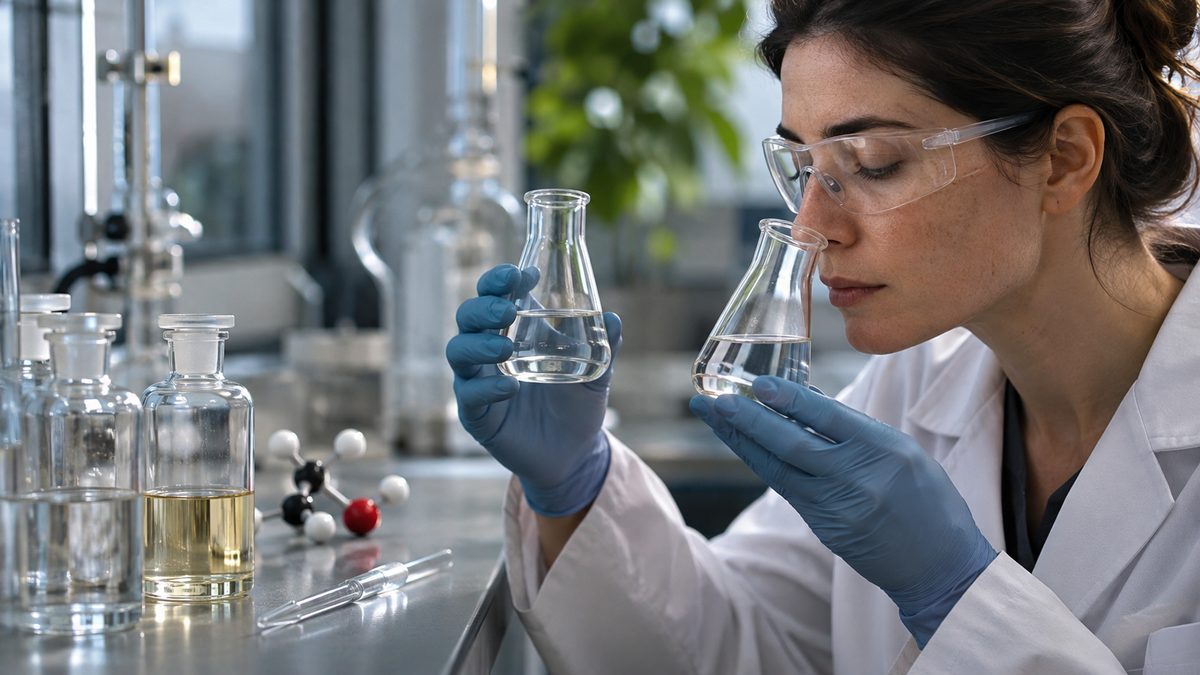
Dilute to the formula's alcohol level and evaluate on smelling strips against a retained reference at one minute and thirty minutes. A blind triangle test, two samples of one alcohol and one of the other, gives a defensible result from a small panel, provided panel, dilution and timing are recorded.
Analytical confirmation
Gas chromatography quantifies acetaldehyde, ethyl acetate, methanol and the main fusel alcohols. Gas chromatography-olfactometry, splitting effluent to a sniffing port, links peaks to smells and is the most direct route to the compound behind an off-note; the useful output is a marker list and a reference chromatogram.
| Check | Detects | Misses | When to run |
|---|---|---|---|
| Certificate review | Out-of-limit assay, water, methanol, benzene | Odour-active traces below stated limits | Every delivery, before unloading |
| GC screen for aldehydes and esters | Oxidation and congener markers | Compounds without a calibrated method | When sensory flags a difference |
| GC-olfactometry | Which peak carries the off-note | Nothing about the fix | Root-cause work on a reject |
| Conductivity and hardness | Ion load that risks haze or corrosion | Microbial contamination | At the point of use, per batch |
Practical guide: specifying perfume ethanol quality
Step 1 — Write the specification around performance
State assay, water limit, denaturant formulation, feedstock and the sensory match to a named reference; 96% v/v alone leaves the important variables to the supplier.
Step 2 — Require the denaturant schedule in writing
Ask for formulation, carrier solvent and concentration, and confirm it is permitted for the category in each destination. Vague answers become a compliance problem after artwork is printed.
Step 3 — Retain a sealed reference from the approved batch
Store several bottles under controlled conditions and log the date. Later deliveries are compared with this material, not with a memory of the last drum.
Step 4 — Screen sensorially, then confirm analytically
Run the triangle test at use dilution first. If it passes, certificate checks may be enough; if it fails, the GC work has a defined question and a better chance of being worth its cost.
Step 5 — Test water and mixing on your own line
Check conductivity and hardness at point of use, then run a small batch through the actual mixing and filling sequence. Clarity, contraction and fill weight should be observed in your equipment, not inferred from a data sheet.
Step 6 — Re-qualify on any change of plant or feedstock
Suppliers change plants and feedstock more often than buyers expect. A change-notification clause plus a re-test on the first affected batch is cheap insurance; our supplier ingredient check note covers the supporting documents.
Frequently asked questions
What is private label perfume manufacturing?
The manufacturer compounds the liquid to your formula and fills it under your label in packaging you choose. Responsibility for claims, artwork and the customer relationship stays with the brand owner.
What is a typical minimum order?
The bottle and pump usually set it, not the concentrate, because those parts carry setup and tooling that must be amortised.
How long does fragrance development take?
Weeks rather than days: brief, revisions, stability, then filling. The bottle often arrives after the concentrate is ready.
Does a higher-proof alcohol make perfume last longer?
Not in any simple way. Longevity depends on material volatility and how it binds to skin; percentage alone is not a lever.
Can one ethanol serve a perfume and a room spray?
Often the base can, but denaturant and safety assessment may not transfer. A household-grade denaturant may be restricted for skin.
Why does my perfume change three months after filling?
Usually oxidation in the alcohol plus reactions among materials, accelerated by air, light and warmth. Compare a stored sample with a fresh reference.
Is denatured alcohol allowed in cosmetics?
Many markets permit a specific denatured grade, but rules differ by jurisdiction and are revised. Confirm the current official text for each destination.
How do I compare two ethanol suppliers fairly?
Give both the same specification and disclosure, then test against one retained reference at the same dilution. Price means little before that gate.
Conclusion
Two 96% alcohols smell different because the number describes only the ethanol. Perfume ethanol quality is decided by what survived distillation, what was added as a denaturant, what oxidised in storage and what the water carried. A process that treats the certificate as the whole specification will keep discovering this in a bottle a customer has already opened.
The workable approach is unglamorous: specify sensory performance, retain a sealed reference, screen every batch at use dilution, and confirm with analysis only when the nose raises a question. That costs less than a reformulation round triggered by a solvent problem, and it leaves a record that this batch matches the one approved.
Discuss your fragrance programme with our team:
WhatsApp: +86 17324762943
Email: adon@customperfumeoem.com
Website: customperfumeoem.com