Droppers, Orifice Reducers and Leak Paths in Fragrance Oil Packs
A fragrance oil that arrives with a wet carton and a bulb that has gone soft in transit has already cost you the order, whatever the oil inside smells like. Leaks in dropper packs rarely come from the bottle itself; they come from the joint
A fragrance oil that arrives with a wet carton and a bulb that has gone soft in transit has already cost you the order, whatever the oil inside smells like. Leaks in dropper packs rarely come from the bottle itself; they come from the joints between the closure, the reducer and the neck, and from the wrong material meeting a solvent it was never meant to touch.
This article maps the real leak paths in a fragrance oil dropper pack — the neck finish, the orifice reducer, the pipette and the bulb — and explains how each component fails and how to spec it so it survives shipping. It also covers dosing precision and the tests you should run before you commit to a closure supplier.
Table of Contents
- The three components that control dispensing
- Where fragrance oil packs actually leak
- Bulb materials and chemical compatibility
- Orifice reducers and dosing precision
- Torque, liners and the shipping test
- Matching the closure to fill line and shelf life
- Practical guide: spec'ing a leak-proof dropper pack
- Frequently asked questions
- Conclusion
The three components that control dispensing
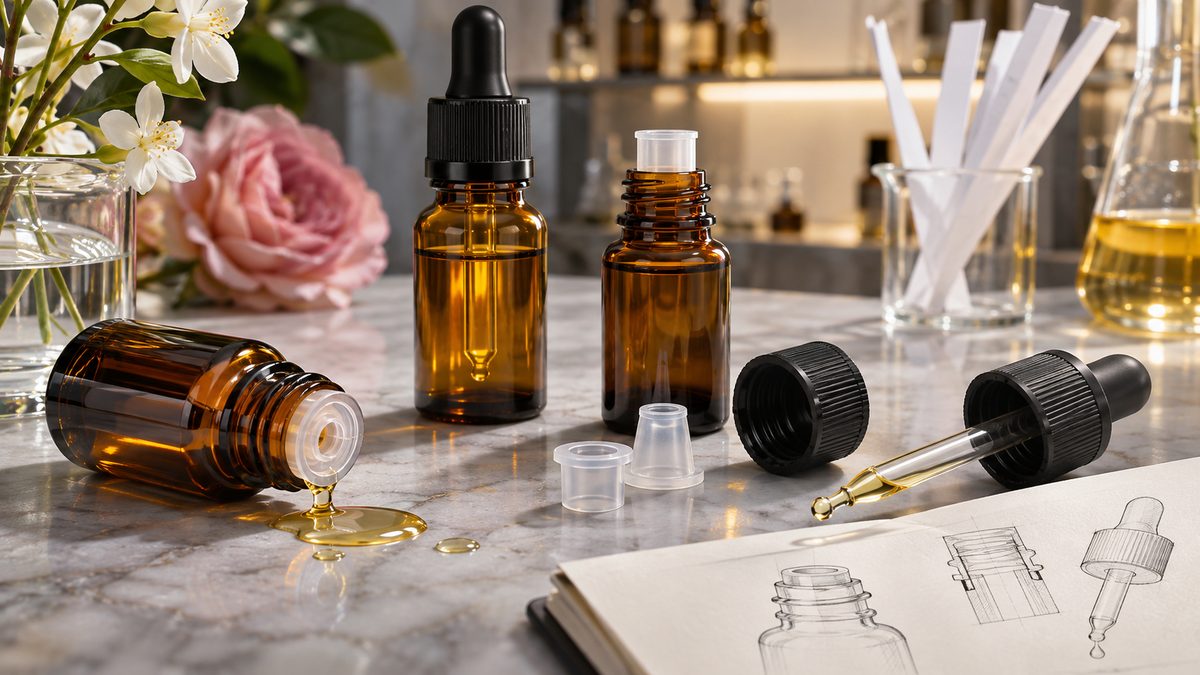
A dropper pack is not one part. It is a bottle neck, an orifice reducer seated in that neck, and a closure carrying a glass or plastic pipette with a rubber bulb on top. Each of these has its own tolerance, and a leak is usually a mismatch between two of them rather than a failure of any single piece.
Neck finish sets the rules
The neck finish — the thread profile and inner diameter at the bottle mouth — determines which reducer and cap will seat properly. A reducer specified for one finish will sit too high or too low in another, and a fraction of a millimetre is enough to break the seal or make the cap cross-thread.
Where fragrance oil packs actually leak
Fragrance oil finds the weakest joint and follows it. The three classic paths are the neck-to-reducer seat, the bulb-to-pipette joint, and the cap-to-neck thread when the liner is missing or the torque is wrong.
The seat is the first suspect
If the reducer does not seat flush against the bottle land, oil creeps between the reducer and the neck on its way out. The fix is dimensional, not a matter of tightening harder: the reducer must be specified for the exact finish and inspected for flash or distortion on the sealing face.
Bulb materials and chemical compatibility
The bulb is the component most likely to be destroyed by the product inside it. Fragrance oils and their carriers attack some rubbers, so a bulb that works with water can soften, swell or crack against DPG or a high-solvent fragrance.
EPDM, silicone and natural rubber
EPDM and silicone generally resist fragrance solvents better than natural rubber, which swells and turns tacky. The safe approach is to test the exact bulb compound against the exact oil, because a plasticiser in the fragrance can attack one grade of EPDM while another survives.
Swelling is the warning sign
A bulb that swells is absorbing the oil, which means it is both losing its grip on the pipette and leaching material back into the product. If the bulb changes dimension or feels soft after a soak test, change the compound before you ship a single unit.
Orifice reducers and dosing precision
The orifice reducer does two jobs: it plugs the bottle neck to limit the liquid to what the pipette holds, and it wipes the pipette as you withdraw it so the dose is consistent drop to drop. Its hole diameter sets the drop size and the fill level of the pipette.
Drop size is a spec, not an accident
A larger orifice lets the pipette overfill and gives bigger, less controlled drops; a smaller one slows dispensing and can trap air. Specify the orifice diameter against the viscosity of your oil and the dose the customer is told to use, then verify it with a count of drops per millilitre.
| Orifice size | Dose behaviour | Best fit |
|---|---|---|
| Small | Fewer, smaller drops, slower fill | High-value, precise dosing |
| Medium | Balanced drop size | General fragrance oil packs |
| Large | Bigger drops, faster fill | Thicker oils, larger doses |
Torque, liners and the shipping test
The cap holds everything together, and its effectiveness depends on the liner and the applied torque. Too little torque and the cap backs off in transit; too much and the thread strips or the liner deforms and stops sealing.
Liners and induction seals
A pressure-sensitive liner or an induction seal adds a second barrier at the neck. For oils that creep, an induction seal is often the difference between a dry carton and a returned pallet, but it must be compatible with the finish and the fill line that applies it.
Matching the closure to fill line and shelf life
The closure choice is constrained by how the pack is filled and how long it sits on a shelf. A dropper that is perfect in the lab can be the wrong choice on a line that fills hot or a product that ships to a hot climate.
| Component | Common failure | What to specify or test |
|---|---|---|
| Neck finish | Reducer seated off-flat | Exact finish code, land flatness |
| Bulb | Swelling, softening | Compound soak test in the real oil |
| Orifice reducer | Wrong drop size, trapped air | Hole diameter, drops per millilitre |
| Cap and liner | Back-off, thread strip, creep | Torque range, induction seal |
Practical guide: spec'ing a leak-proof dropper pack
Step 1 — Choose the neck finish first
Pick the bottle finish and write down its exact code, because every other component is selected against it. Changing the finish later forces a redesign of the reducer and cap.
Step 2 — Select a bulb compound for your oil
Soak candidate bulbs in the actual fragrance oil for the intended shelf life and measure dimension and hardness. Reject any compound that swells or softens.
Step 3 — Set the orifice by target dose
Define the dose the label promises, then choose an orifice diameter and verify it by counting drops per millilitre with your oil, not with water.
Step 4 — Specify the liner and torque
Decide between a pressure-sensitive liner and an induction seal, and set an applied torque range the fill line can hold consistently.
Step 5 — Run leak and drop tests
Fill sample packs, close them at production torque, then invert, drop and heat-cycle them to confirm no creep reaches the carton.
Step 6 — Validate with the real fragrance oil
Never qualify a closure with water or a placeholder. The oil's solvent character is what attacks the materials, so the qualification must use the product that will actually ship.
Step 7 — Set receiving inspection
Check reducer seating, bulb fit and cap torque on every incoming closure lot so a supplier change does not silently reintroduce a leak.
Frequently asked questions
What is an orifice reducer?
An orifice reducer is a plastic insert seated in a bottle neck that limits how much liquid enters the pipette and wipes the pipette as it is withdrawn. It controls drop size and helps keep the dose consistent.
What is a dropper insert?
A dropper insert, or reducer, is the neck-fitting piece that holds the pipette and restricts flow. It is specified against the bottle's neck finish so it seals flush and gives the intended drop size.
What is a bottle neck finish?
The neck finish is the standardised thread profile and mouth dimension at the top of a bottle. It determines which closures and reducers fit and seal, so it is the first thing to specify in any pack.
Why does my dropper bulb turn cloudy?
Clouding usually means the bulb material is absorbing the fragrance oil, a sign of chemical incompatibility. Switch to a solvent-resistant compound such as a suitable EPDM or silicone and re-run the soak test.
Does the glass pipette crack with fragrance oils?
The pipette itself is normally resistant to the oil; cracks are more often mechanical, from an over-tight cap or a pipette that is too long for the bottle. Confirm the pipette length matches the bottle's internal height.
How do I test for leaks before shipping?
Close filled samples at production torque, then invert them, subject them to a drop test and a heat cycle, and check the carton for oil creep. Test with the real oil, not water, so solvent attack is included.
What torque prevents seepage?
There is no single torque for every pack; it depends on the finish, liner and cap. Set a torque range that seals without stripping the thread, and hold that range constant on the line rather than chasing a higher number.
Should I use child-resistant dropper caps?
It depends on the product and market. Where a fragrance oil is classified as requiring child-resistant packaging, use a compliant closure and confirm the requirement against the current official text for that market.
Conclusion
A dropper pack leaks at its joints, and the way to stop it is to treat the neck, reducer, pipette and bulb as one system specified against each other and tested with the real oil. Material compatibility and torque do more to protect the carton than any amount of tightening.
Qualify the closure with the product that will actually ship, then hold that specification at receiving inspection. Our packaging team can help you spec the closure, and our notes on planning fragrance oil packs and triaging dispensing complaints cover the same system end to end. Contact us to review your pack.
Discuss your fragrance programme with our team:
WhatsApp: +86 17324762943
Email: adon@customperfumeoem.com
Website: customperfumeoem.com