Diffuser Assembly Labour: What Automation Changes at Volume
At five hundred diffusers a month, three people can fill, reed, cap and label the whole order by hand and nobody complains about the labour. At ten thousand a month, those same three people become the bottleneck, and the defects that manual
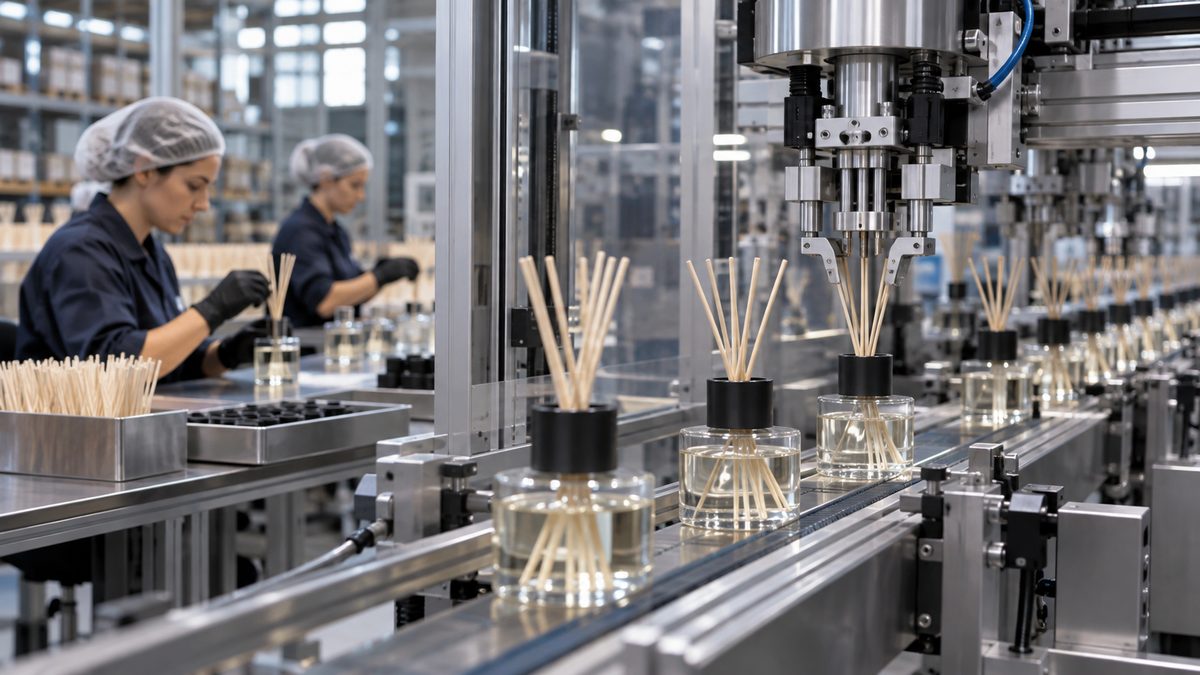
At five hundred diffusers a month, three people can fill, reed, cap and label the whole order by hand and nobody complains about the labour. At ten thousand a month, those same three people become the bottleneck, and the defects that manual speed introduces — mis-set reeds, under-filled bottles, skewed labels — start eating the margin the volume was supposed to create.
This article breaks a diffuser assembly line into its stations and shows what changes when each one is automated. It covers filling methods, reed insertion, capping and labelling, the volume at which automation usually pays, and the quality risks that high-speed assembly introduces if the process is not re-specified for it.
Table of Contents
- The manual sequence and where time goes
- Filling: pump versus piston versus overflow
- Reed insertion: bundling versus automation
- Capping, sealing and labelling
- When automation pays for itself
- Quality risk at high speed
- Practical guide: deciding when to automate diffuser assembly
- Frequently asked questions
- Conclusion
The manual sequence and where time goes
A hand-assembled diffuser passes through four or five stations: fill the bottle, insert the reeds, seat the collar or cap, and apply the label. The time is rarely spread evenly; one station — usually reed insertion or labelling — consumes most of the labour while the others wait.
Measure before you automate
Before buying any machine, time each station over a full shift and record the cycle time and the defect count. The station with the longest cycle and the most rework is the one where automation returns the most, and it is often not the station you expected.
Filling: pump versus piston versus overflow
Filling can stay manual for a long time, but the method you choose sets both speed and fill accuracy. A hand pump is cheap and slow; a piston filler delivers a precise volume per stroke; an overflow filler fills every bottle to the same visible level regardless of small bottle variations.
Pick the filler by fill spec
If your label promises a volume, use a piston filler for repeatability. If the sell is the visual fill height and bottles vary slightly, an overflow filler gives a consistent appearance. The two goals are different, and one machine does not serve both equally.
| Filler type | How it works | When to choose |
|---|---|---|
| Hand pump | Manual stroke per fill | Low volume, frequent changes |
| Piston | Fixed volume per stroke | Label promises a volume |
| Overflow | Fills to a set level | Visual fill height is the sell |
Reed insertion: bundling versus automation
Reed insertion is the classic bottleneck because it is fiddly: the right number of reeds, fanned evenly, seated to the bottom without snapping. A simple jig or a pre-bundled reed pack turns a slow, error-prone step into a single drop-in motion.
Pre-bundling is the cheap halfway house
Bundling reeds off-line — counting and tying or collaring them before the filling station — moves the skilled work to a slower, lower-pressure stage and lets the line drop a complete bundle in one move. This often removes the bottleneck without the cost of a full insertion machine.
Capping, sealing and labelling
Capping and sealing are about torque and liner placement, and both are easy to get wrong by hand at speed. Labelling is where a small misalignment becomes visible on every unit, so it is the station where automation buys the most cosmetic consistency.
Automate what the customer sees
An automatic label applicator or a simple alignment guide removes the skew and wrinkle that a rushed hand can introduce. Because labels are the first thing a buyer notices, the visual consistency of automation often justifies itself faster than a filling machine does.
When automation pays for itself
Automation is a fixed cost traded against variable labour. The crossover is where the machine's amortised cost per unit drops below the labour cost it replaces, and that point moves with wage rates, order size and how consistent your demand is.
The crossover is a number, not a feeling
Work out the cost per unit of the manual step, then the cost per unit of the machine including depreciation, operator time and changeover. Where the two lines cross is your volume threshold, and below it a jig or a fixture usually beats a machine.
Quality risk at high speed
Speeding up assembly without re-specifying the process creates new defects: a filler that splashes, reeds that go in crooked, caps that cross-thread. Automation does not remove quality risk; it moves it to the point where the machine meets the component.
Defect modes change with speed
At high speed the failures are different from the hand-assembly failures you know. A machine that is mis-set will repeat the same error on every unit, so a single bad adjustment becomes a whole pallet of defects. In-process checks matter more after automation, not less.
| Station | Manual approach | Automation or fixture | What improves |
|---|---|---|---|
| Filling | Hand pump | Piston or overflow filler | Fill accuracy, speed |
| Reed insertion | Count and place by hand | Pre-bundled pack or insertion jig | Speed, even fanning |
| Capping | Hand torque | Torque-controlled capper | Consistent seal |
| Labelling | Hand apply | Applicator or alignment guide | Visual consistency |
Practical guide: deciding when to automate diffuser assembly
Step 1 — Time every station
Record the cycle time and defect count at each station over a full shift so you know where the labour and the rework actually sit.
Step 2 — Price the manual labour per unit
Convert each station's time into a labour cost per unit, including the rework, so the automation decision is made on the real cost, not on a guess.
Step 3 — Map defects per station
List the failures each station produces and their frequency, because the station with the most defects may be a better automation target than the slowest one.
Step 4 — Compare machine payback
Add depreciation, operator time and changeover to the machine cost and find the volume where it beats the manual step.
Step 5 — Pilot a semi-automated step
Start with the single highest-return station, often reed bundling or labelling, and validate the improvement before committing to more equipment.
Step 6 — Re-lay out the line
Re-sequence the stations so material flows one way and the automated step feeds the next without buffering piles between them.
Step 7 — Set in-process checks
Add a check at the automated station so a machine mis-setting is caught in minutes rather than after a full pallet is built.
Frequently asked questions
What is diffuser assembly?
Diffuser assembly is the process of filling a bottle with scented base, inserting the reeds, seating the collar or cap and applying the label. It is usually manual at small scale and becomes a mix of manual and automated steps as volume grows.
What is a piston filler?
A piston filler draws a fixed volume of liquid into a cylinder and pushes it into the bottle with each stroke. It is chosen when the label promises a precise volume and repeatability matters.
What is an overflow filler?
An overflow filler fills every bottle to the same visible level by returning the excess above that level to the tank. It gives a consistent fill height even when bottle volumes vary slightly.
At what volume does diffuser automation pay?
There is no single threshold; the crossover is the volume where a machine's amortised cost per unit falls below the labour it replaces. Work it out from your own wage rates, order sizes and demand stability rather than borrowing a number.
Can I semi-automate reed insertion?
Yes. Pre-bundling reeds off-line and dropping a complete bundle in one move removes most of the bottleneck and the defect risk of hand counting, without the cost of a full insertion machine.
What defects come from manual capping?
Manual capping at speed produces inconsistent torque, cross-threaded caps and missed liners. A torque-controlled capper or a defined torque range removes the variance and protects the seal.
How do I cut labelling labour?
A label applicator or a simple alignment guide removes the skew and wrinkle of hand application. Because the label is what the customer sees first, this station often pays for automation faster than filling does.
Should I outsource diffuser assembly instead?
Outsourcing moves the labour and equipment burden to a manufacturer that already runs at volume. It makes sense when your demand is irregular or when a full line is not justified; the trade is less direct control over the process.
Conclusion
Diffuser assembly scales station by station, not all at once. Measure the cycle time and defects at each step, then automate the highest-return station first — often reed bundling or labelling — and add in-process checks so a machine error is caught before it becomes a pallet of returns.
The decision is a cost-per-unit comparison, not a preference for machines. If the volume does not justify a line of your own, handing assembly to a manufacturer that already runs one is often the cheaper route. See our notes on planning starter packs and reed bundles, review the diffusers we assemble and our packaging options, or contact us to cost your run.
Discuss your fragrance programme with our team:
WhatsApp: +86 17324762943
Email: adon@customperfumeoem.com
Website: customperfumeoem.com