
Dealer and Fleet Programs: How Car Fragrance Buying Moved to Replenishment
A dealership sells a car with a free fragrance card tucked in the glovebox, and the buyer never returns for a refill. A fleet manager buys a case of hanging cards for fifty vehicles, and six months later nobody can say which scent was reord
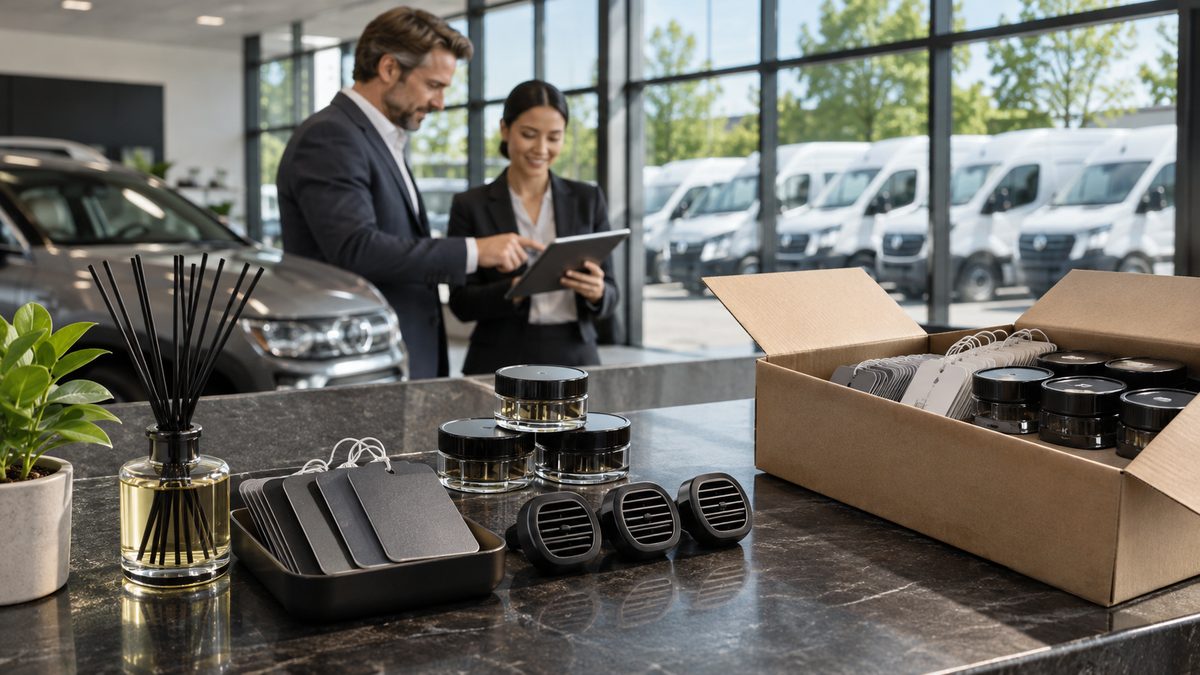
A dealership sells a car with a free fragrance card tucked in the glovebox, and the buyer never returns for a refill. A fleet manager buys a case of hanging cards for fifty vehicles, and six months later nobody can say which scent was reordered or why the order stopped.
This article explains how car fragrance buying shifted from single retail purchases to dealer and fleet replenishment programs, and what a program needs to actually hold together. It covers the program structures, the replenishment economics, scent-card and holder logistics, the attrition and scent-fatigue problems, and the operational checklist for running one profitably.
Table of Contents
- Why car fragrance buying moved to replenishment
- What a dealer or fleet program looks like
- The replenishment economics
- Scent-card and holder logic
- Fulfilment: bulk, kitting and service visits
- Attrition, scent fatigue and leakage
- Setting up a program with a supplier
- Practical guide: building a fleet replenishment program
- Frequently asked questions
- Conclusion
Why car fragrance buying moved to replenishment
A car fragrance is a consumable with a fixed life: a scent card or cartridge fades over weeks or months of cabin heat and airflow, and then the driver either replaces it or forgets it. The industry learned that the profit is not in the first card but in the habit of replacing it, and that habit is easiest to form where the car is already being serviced.
The dealership and fleet advantage
A dealer sees the vehicle at regular intervals for servicing, and a fleet operator already budgets consumables across its vehicles. Both are natural points to reinsert a fragrance refill into a recurring transaction.
What a dealer or fleet program looks like
Programs differ by who holds the inventory and who triggers the restock, and that division determines the packaging and the commercial terms. Three structures cover most real arrangements.
| Structure | Who holds stock | Restock trigger | Best for |
|---|---|---|---|
| Service-included | Dealer / fleet operator | Each service interval | Franchise dealers, lease fleets |
| Kit-at-delivery | Brand ships with vehicle | Follow-up refill offer | New-car handover |
| Direct-to-driver | Brand or distributor | Subscription / reminder | Ride-share, private fleets |
The service-included structure is the most durable because it ties the refill to a visit the vehicle will make anyway. The kit-at-delivery structure wins the first placement but has the weakest refill conversion.
The replenishment economics
A fleet program is sold on cost per vehicle per period, and that number must be low enough to survive a procurement review yet high enough to fund the product and the fulfilment. The unit is not the card but the vehicle-month.
Building the per-vehicle cost
Take the refill cost, add the amortised holder cost, and add fulfilment — kitting, shipping or service labour — then divide by the refill interval in months. The defensible figure depends on the fragrance's fade rate and the chosen interval, so measure the fade in a hot cabin before setting the schedule.
Why the fade rate drives everything
If a card fades in four weeks but the service interval is six months, the program promises more than it delivers and the driver stops noticing the scent long before the restock. Match the refill interval to the measured fade life, or the attrition problem becomes structural rather than incidental.
Scent-card and holder logic
The holder is the part the customer keeps and the card is the part they rebuy, and the two must be designed as a pair. A holder that is awkward to reload kills the replenishment habit even when the scent is good.
One holder, many scents
The holder should accept a standard card size across the range, so a fleet can switch scents without swapping hardware and a dealer can stock one holder SKU and several card SKUs. A proprietary holder shape that forces a single source is a short-term margin play that increases churn when the card is out of stock.
Why card standardisation protects the program
Standard card dimensions let a buyer reorder any scent into the same clip, which is what keeps a multi-scent fleet running. When a program depends on a bespoke card shape, every scent change becomes a hardware change, and the procurement friction that follows is usually where the program dies.
Fulfilment: bulk, kitting and service visits
Fleet fulfilment is not retail fulfilment. A fleet order is a case pack of the same scent or a pre-kitted multi-scent assortment, shipped to a parts desk or a service bay, and the packaging has to survive that route and make the restock fast.
Case packs and kitting
Design the case pack for the service-bay workflow: a tray that can sit on a parts shelf, labelled by scent on the end panel, with cards pre-sorted so a technician grabs one without reading small text. A multi-scent kit should be pre-kitted at the factory, not assembled by the dealer, because dealer-side kitting is exactly the labour a program is meant to remove.
Label and case marking
Bulk car fragrance shipments need scent identity readable at shelf distance, batch traceability for any quality issue, and the relevant transport and storage markings for a fragrance product that may sit in a hot parts room. These are packaging decisions covered on our packaging options page for fleet-scale orders.
Attrition, scent fatigue and leakage
Three failure modes decide whether a program survives its first year, and all three are observable early if someone is looking. They are driver attrition, scent fatigue, and leakage or damage in the hot-cabin environment.
Driver attrition
Attrition happens when the refill requires a step the driver will not take — a follow-up order, a separate payment, a reinstall that is fiddly. The structural fix is to bind the refill to something the driver already does, which is why the service-included structure outperforms the direct-to-driver reminder on retention.
Scent fatigue and leakage in heat
A single scent worn continuously becomes invisible to the driver within weeks, and a driver who cannot smell the product concludes it stopped working. Rotating scents by season or by visit keeps the benefit perceptible.
| Failure mode | Cause | Structural fix |
|---|---|---|
| Driver attrition | Refill requires a step the driver will not take | Bind refill to a service visit |
| Scent fatigue | One scent worn continuously | Seasonal rotation, small selection |
| Heat leakage | Card or cartridge in a hot cabin | Heat-cycle test before volume |
Setting up a program with a supplier
A replenishment program is a specification exercise as much as a sales exercise, and the supplier should be able to hold the product-side requirements: standard card dimensions, fade-tested fragrances, case packs for the service bay, and batch traceability.
The requirements a supplier should meet
Ask for standard card sizes that work across the scent range, a documented fade-life test, pre-kitted multi-scent cases, and the compliance documents for the fragrance and the holder. If the supplier cannot produce a fade-life figure or a standard card format, the program's replenishment interval and logistics are being guessed, not designed.
Where the product pages fit
The card dimensions, scent range and case configuration are settled at the product and customisation stages. Our product range covers the car fragrance formats we build programs around, and the customisation process page describes how a fleet-specific scent set or holder is specified.
Practical guide: building a fleet replenishment program
Step 1 — Choose the restock structure
Decide between service-included, kit-at-delivery or direct-to-driver before touching packaging, because case counts and holder formats follow from the structure.
Step 2 — Measure the fade life in a hot cabin
Test the card's scent life under a realistic temperature cycle and set the refill interval from the measured figure, not an estimate.
Step 3 — Standardise the card and holder
Fix one card dimension across the scent range so any scent reloads into the same clip and the fleet never needs a hardware change.
Step 4 — Design the case pack for the service bay
Build a shelf-ready tray labelled by scent on the end panel, with multi-scent kits pre-kitted at the factory.
Step 5 — Price per vehicle per month
Compute refill cost plus holder amortisation plus fulfilment over the refill interval, and present the program as a vehicle-month figure.
Step 6 — Plan the scent rotation
Rotate scents by season or service visit and offer a small selection to counter scent fatigue and keep the benefit perceptible.
Frequently asked questions
What is private label car fragrance manufacturing?
It is the production of car fragrance products under your brand by a factory that supplies the fragrance, holder and card or cartridge, and handles finishing so the range carries your identity.
What is a typical minimum order quantity for car fragrance?
Minimums vary by format and fragrance, but a common starting point is a few thousand units per scent, with smaller runs available at a higher unit cost.
Why did car fragrance buying shift to replenishment programs?
Because the product is a consumable with a fixed fade life, and the profit is in the repeat purchase rather than the first card.
What is the strongest restock structure for a fleet program?
The service-included structure, where the refill rides on a service visit the vehicle will make anyway, because it does not depend on the driver initiating a separate purchase.
Why does the fade rate determine the refill interval?
Because a card that fades in four weeks cannot honestly support a six-month interval.
How do I stop scent fatigue in a fleet?
Rotate scents by season or service visit and offer a small multi-scent selection, so the fragrance stays perceptible and the refill keeps its perceived value.
Should I standardise the scent card size?
Yes.
How should fleet case packs be designed?
As shelf-ready trays labelled by scent on the end panel, with multi-scent kits pre-kitted at the factory rather than assembled by the dealer.
Conclusion
Car fragrance stopped being a checkout purchase and became a service-bay consumable, and the brands that profit from the shift are the ones that designed for the repeat rather than the first sale. That means choosing the restock structure deliberately, matching the interval to the real fade life, and packaging for the bay rather than the retail peg.
A durable program is built from standardised cards, a measured fade rate, and a per-vehicle-month price a procurement team can defend. Get those three right, and the replenishment habit forms around the vehicle's existing schedule instead of depending on a driver's memory.
Discuss your fragrance programme with our team:
WhatsApp: +86 17324762943
Email: adon@customperfumeoem.com
Website: customperfumeoem.com


