Choosing Reeds: Diameter, Count and Length as a Specification
A buyer orders reeds by the one attribute the catalogue shows — a length and a colour — and discovers the finished diffusers all perform differently, some flooding the room and others doing nothing. The reeds looked identical in the photo,
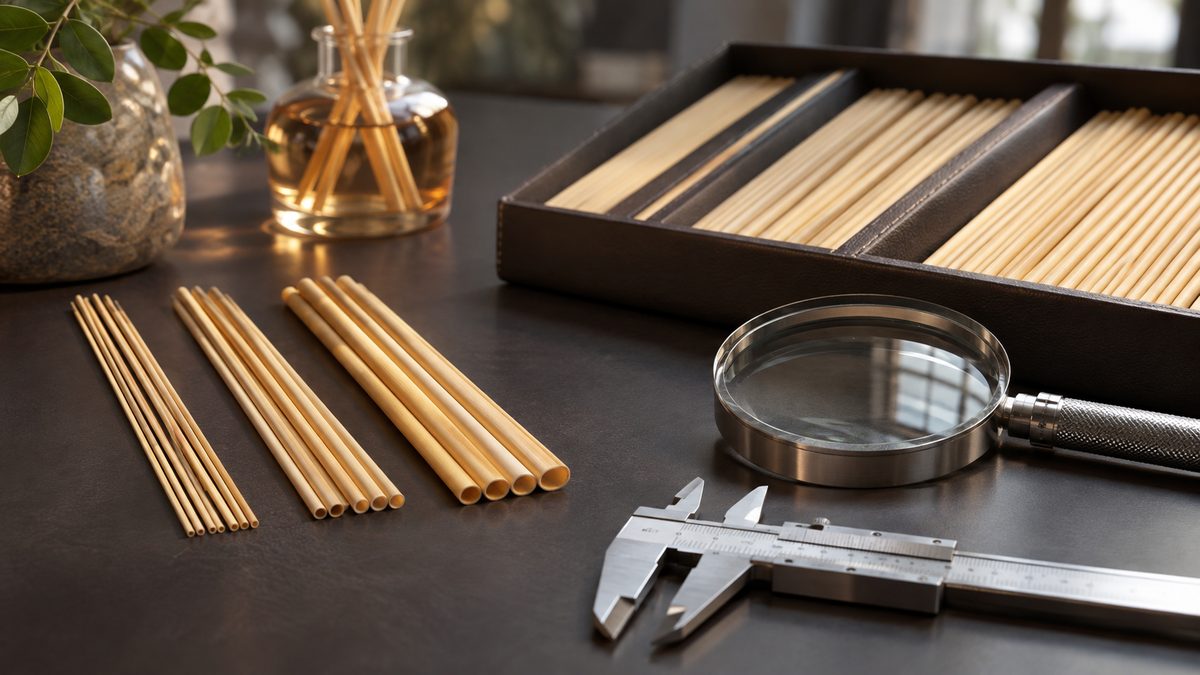
A buyer orders reeds by the one attribute the catalogue shows — a length and a colour — and discovers the finished diffusers all perform differently, some flooding the room and others doing nothing. The reeds looked identical in the photo, but diameter, count, and internal pore structure all differ, and the spec never captured them.
This article turns reed selection into a written specification. It covers the material options, how diameter, count, and length each affect output, how they interact with bottle geometry, and the exact fields to put in a purchase spec so the reeds you reorder are the reeds you tested.
Table of Contents
- Reed material types
- Diameter and evaporation area
- Count and bottle size
- Length and geometry
- Flipping and saturation
- Writing the specification
- Practical guide: writing a reed specification
- Frequently asked questions
- Conclusion
Reed material types
Reeds come as natural rattan, synthetic fibre, or a blend, and the material sets the baseline for consistency. Natural rattan has open longitudinal channels that wick well, but the pore size varies from stick to stick because it is a plant product. Synthetic fibre reeds are made to a controlled pore size, so their wicking is uniform but their look can read as less premium to some buyers.
What a reed actually does
A reed is a bundle of capillary channels, and its job is to lift liquid from the bottle to the air and expose it across a large surface. The material controls how fine and how uniform those channels are. A finer, more uniform pore structure saturates evenly; a coarse, variable one wicks unevenly and shows up as one reed drying out while its neighbour stays wet.
Choosing for the brand
Match the material to the claim the product makes. If the brand sells "natural," rattan supports the story but you accept more variance and should widen your tolerance. If the brand sells consistency, choose fibre and lean on the tighter spec. The two are rarely interchangeable without changing how the product feels.
Diameter and evaporation area
Diameter sets the exposed evaporation area of each reed. A thicker reed presents more surface at the tip and generally releases more scent per day, all else equal. But diameter also interacts with the bottle neck: a fat reed that barely fits the opening wicks differently from the same reed in a wide mouth, because the fit changes airflow around the exposed tip.
The common range is roughly 2 to 4 millimetres, with 3 millimetres a typical default. Thinner reeds give a softer, longer delivery; thicker reeds give a stronger, shorter one. Because diameter is fixed at purchase, it is the least flexible of the three geometry variables, so choose it deliberately rather than taking whatever the supplier stocks.
Count and bottle size
Reed count multiplies the surface area and is the easiest variable to change after the sale, which makes it the natural user-facing control. More reeds deliver more scent and empty the bottle faster; fewer reeds do the opposite. The design decision is where to set the shipped count so that a mid-range user gets the intended intensity without fiddling.
| Bottle size | Typical reed count | Resulting character |
|---|---|---|
| 50 ml | 5–6 reeds | Soft, longer life |
| 100 ml | 6–8 reeds | Balanced mid-range |
| 200 ml | 8–10 reeds | Strong, faster use |
Count must scale with bottle volume, not with the room. A small bottle packed with ten reeds empties in days and looks thirsty; a large bottle with five reeds under-delivers. Set the shipped count to match the liquid volume and the target life, then let the instructions tell the user how to tune it up or down.
Length and geometry
Length is mostly a visual and functional variable, not a major driver of output once the reeds are saturated. The reed must protrude enough above the bottle to look balanced and to expose evaporation surface, while staying short enough not to tip a narrow bottle. A reed that is too tall for a small bottle makes the product unstable, which is a safety and returns problem in itself.
The working rule is that the reed should extend roughly one and a half to two times the bottle height above the neck, but the precise ratio is an aesthetic choice. What matters for performance is that the reeds stay fully wetted: a reed that is too short relative to the bottle leaves the liquid surface far from the tip, slowing the climb.
Flipping and saturation
Over time the non-volatile part of the liquid coats the reed pores and slows wicking, which is why flipping the reeds gives a temporary revival — it re-wets the tips and exposes fresh surface. Flipping is a maintenance instruction, not a fix for a poorly specified reed, and the spec should assume the customer will flip at intervals.
| Symptom | Likely cause | Spec response |
|---|---|---|
| Uneven wetting across reeds | Variable pore structure | Tighter material grading |
| Weak throw from day one | Too few or too fine reeds | Raise count or diameter |
| Fast fade after a week | Pore coating, residue | Lower-residue base |
| Bottle tips over | Reeds too long or heavy | Shorten reeds or widen base |
Maintenance and its limits
Specifying the flip instruction
Decide whether the product tells the user to flip the reeds and how often, and put that into the on-pack copy and the spec together. A diffuser designed around weekly flipping needs reeds that tolerate re-wetting, while a no-flip promise needs a base and reed that hold performance without the intervention. The instruction and the specification are one decision, not two.
Writing the specification
A reed spec that only names a length and colour will not survive reordering, because a new batch from the same supplier can arrive with a different diameter or pore structure and nobody will have recorded what was actually tested. The spec must state material, diameter, length, count, pore or grading requirement, and the measured output on your liquid.
Add the performance number — the evaporation rate or wicking height measured on your actual liquid — so the supplier can re-verify against something objective. Tie reorders to the spec, and re-test whenever the reed source or the base solvent changes. For the measurement method and the liquid half of the system, see our mass-loss and leak-checks guide, and for how reeds fit the wider retail pack, review replacement-reed bundle planning. For how the reeds sit within the bottle and closure, see our diffuser packaging guide.
Practical guide: writing a reed specification
Step 1 — Fix the bottle first
Confirm bottle volume, neck diameter, and height, because reed diameter, count, and length are all specified against the bottle.
Step 2 — Choose the material against the claim
Select rattan, fibre, or a blend based on the brand promise, and write the material into the spec with any grading requirement.
Step 3 — Set diameter and count
Pick a diameter in the 2–4 mm range and a count matched to the bottle volume, then state both as fixed values.
Step 4 — Set length for balance and stability
Choose a length that protrudes correctly above the neck and keeps the bottle stable, and record it.
Step 5 — Add the performance number
Measure evaporation rate or wicking height on your actual liquid and attach the number to the spec so output is verifiable.
Step 6 — Lock the flip instruction with the spec
Decide the maintenance instruction, put it on pack, and re-test the whole system whenever the reed source or base changes.
Frequently asked questions
What are reed diffuser reeds made of?
Reeds are made from natural rattan, synthetic fibre, or a blend of the two. Natural rattan offers a natural look with more variance, while fibre reeds have a controlled pore structure for consistent wicking.
What is the standard diameter for diffuser reeds?
Reeds commonly run from about 2 to 4 millimetres in diameter, with 3 millimetres a typical default. Thinner reeds give softer, longer delivery; thicker reeds give stronger, shorter delivery.
How many reeds should a diffuser have?
The count should match the bottle volume: roughly five to six reeds for a 50 ml bottle, six to eight for 100 ml, and eight to ten for 200 ml. More reeds release faster and empty the bottle sooner.
Does reed length change how strong the diffuser smells?
Only modestly once the reeds are saturated. Length matters more for the visual balance and for keeping the bottle stable, but a reed that is too short relative to the bottle can slow the liquid climb.
Why do some reeds in the same bottle dry out faster than others?
Variable pore structure, most common in natural rattan, causes some reeds to wick faster than others. Grading the material or moving to fibre reeds tightens the consistency.
What does flipping the reeds do?
Flipping re-wets the tips and exposes fresh pore surface, temporarily reviving output as the non-volatile residue coats the old surface. It is a maintenance step, not a cure for a badly specified reed.
Should the reed spec include a performance number?
Yes. State the measured evaporation rate or wicking height on your actual liquid, not just the dimensions, so the supplier can re-verify each batch against an objective target.
Do I need to re-test reeds if I change the base solvent?
Yes. Reed performance only exists against a fixed liquid, so a solvent change invalidates the previous reed test. Re-test the reed and liquid as one system whenever either changes.
Conclusion
A reed is not a commodity stick; it is a capillary system whose diameter, count, length, and pore structure together set how the diffuser performs. Buyers who spec only a length and colour are buying the look and leaving the performance to chance, which is exactly where the "strong for a week, silent after" complaint comes from.
Write the full specification — material, diameter, count, length, grading, and a measured output number — and tie reorders to it. The spec is the only thing that makes the reeds you tested and the reeds you receive the same product, batch after batch.
Discuss your fragrance programme with our team:
WhatsApp: +86 17324762943
Email: adon@customperfumeoem.com
Website: customperfumeoem.com