Child-Resistant Closures: When a Diffuser Base Requires Them
A reed diffuser base ships to a market, and the buyer is told the closure must be child-resistant because the liquid is classified as hazardous — yet the existing bottle has a plain screw cap, and no one on the project can say which regulat
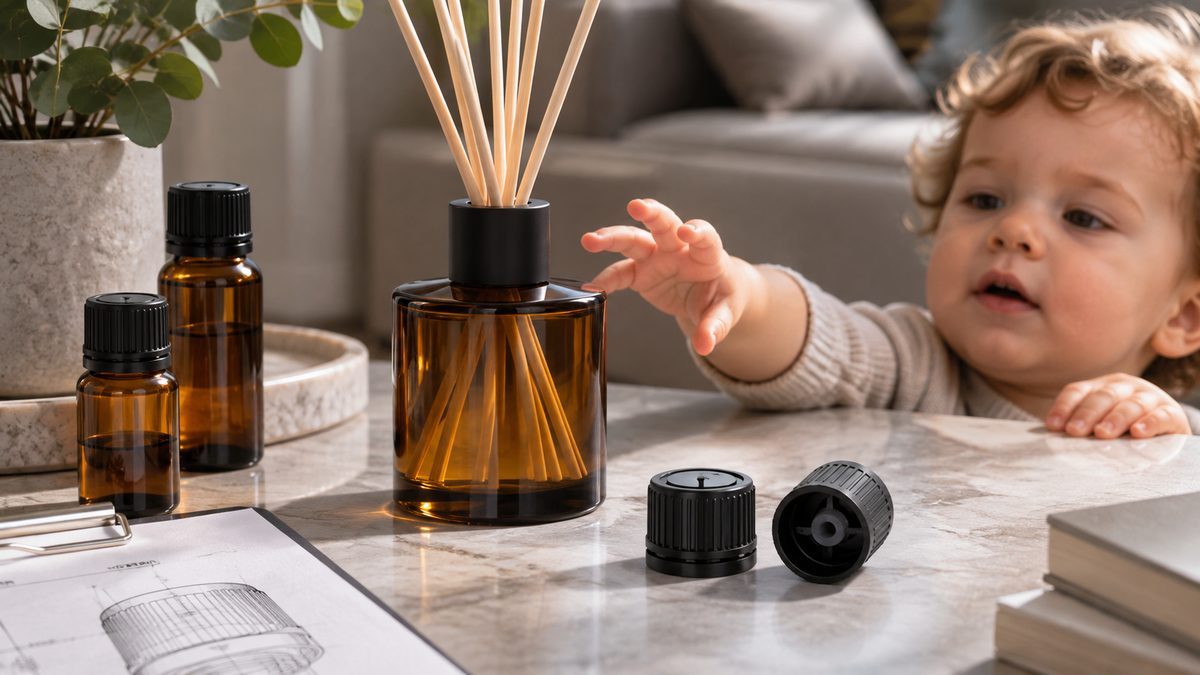
A reed diffuser base ships to a market, and the buyer is told the closure must be child-resistant because the liquid is classified as hazardous — yet the existing bottle has a plain screw cap, and no one on the project can say which regulation triggered the requirement or whether it applies to this specific formulation.
This article explains when a diffuser base requires a child-resistant closure, how the base formulation drives that decision, what testing and documentation are involved, and how to specify the closure correctly. It is written for private label buyers of reed diffusers who need to get the closure right without over-engineering or under-complying.
Table of Contents
- Why the question keeps arising
- What triggers the requirement
- Closure types and their trade-offs
- Testing panels, marking and documentation
- When it does not apply, and specifying the closure
- Practical guide: deciding and specifying a child-resistant closure
- Frequently asked questions
- Conclusion
Why the question keeps arising
Child-resistant closure requirements are triggered by the classification of the contents, not by the product category. A reed diffuser is harmless when filled with a gentle base, but the same bottle can require a child-resistant closure when the base contains a solvent carrying a hazard classification for aspiration, skin irritation or other effects.
Classification travels with the liquid
The base is a mixture, and its hazard classification is determined by the ingredients and their concentrations. When a base is classified as hazardous under the relevant rules, the packaging obligations — including child-resistant closures in some markets — attach to the mixture itself.
The requirement differs by market
The United States, the European Union and other markets each have their own trigger conditions and testing rules for child-resistant packaging. A closure that satisfies one market does not automatically satisfy another, so the target market must be confirmed before the packaging is specified.
What triggers the requirement
The trigger is generally the presence of a hazardous substance or mixture above a threshold, combined with the market's specific rule for when child-resistant packaging is mandated.
The formulation drives the decision
Read the safety data sheet for the base first: it states the classification and hazard statements. If the base carries a classification that triggers child-resistant packaging in the target market, the closure follows from that classification rather than from any assumption about diffusers generally. Certain glycol ethers and solvents used in diffuser bases can carry aspiration or skin irritation classifications.
Why a formulation change can change the packaging
If a buyer switches the base to a solvent with a different hazard profile, the classification of the finished mixture can change, and with it the packaging obligations. For this reason the base and the closure are reviewed together whenever the formulation is touched, not once at the first order.
Confirm the market rule against the official text
In the United States, child-resistant packaging is required for certain hazardous substances and categories under the poison prevention rules. In the EU, child-resistant fastenings are required for certain mixtures supplied to consumers where the classification meets defined criteria. The exact triggers are set out in the current legal text, which should be confirmed against the official source for the formulation in question.
Closure types and their trade-offs
Child-resistant closures come in a few families, and the choice is a balance between accessibility for adults, testing cost and the look of the product.
| Closure type | How it works | Typical trade-off |
|---|---|---|
| Push-and-turn | Downward pressure plus rotation | Reliable but less elegant on luxury packaging |
| Squeeze-and-turn | Squeeze the sides while rotating | Softer look, requires flexible side grips |
| Two-piece overcap | Outer cap drives an inner mechanism | More tooling, visually versatile |
| Standard screw cap | Simple rotation | No child resistance; only for non-triggering bases |
The closure must still seal the bottle
A child-resistant closure is first a closure: it must seal the bottle against evaporation and leakage while the product is on the shelf. The child-resistant mechanism is an additional feature, and the seal performance must be verified at the same time, a point covered in our evaporation and leak guide.
Testing panels, marking and documentation
Where child-resistant packaging is required, the closure must be tested to show that children cannot easily open it while most adults can. This is a physical test with panels of participants, not a paper declaration.
Two panels, two passing criteria
The closure is tested with a panel of children to confirm a high proportion cannot open it within a set time, and with a panel of older adults to confirm most can open and close it correctly. Both sides must pass; a closure that defeats children but also locks out adults fails.
The test report is the evidence
The test method, panel sizes and acceptance criteria are set by the market's standard, and the testing must be carried out to that protocol by a competent laboratory. The buyer should obtain the test report rather than relying on the supplier's assertion that the cap "is" child-resistant, and keep it with the product file. Some markets also require warning text or symbols on the label, which should follow the current official rules for the target market.
When it does not apply, and specifying the closure
Not every diffuser needs a child-resistant closure, and adding one where it is not required can raise cost and make the product harder to open for no compliance benefit.
Non-hazardous bases and professional formats
If the base is not classified as hazardous under the target market's rules, the requirement typically does not apply, and the decision rests on the SDS classification. Rules also often distinguish consumer products from those supplied for professional use, so confirm whether your distribution channel is treated as consumer or professional under the current official text.
Carry the classification into the specification
State the closure family, the finish on the bottle neck, and the requirement for a child-resistance test report to the target market's protocol. A vague instruction to "use a child-resistant cap" produces a closure without the evidence behind it, and the closure must be specified with a matching bottle neck finish.
| Spec element | What to state | Failure if vague |
|---|---|---|
| Closure family | Push-and-turn or equivalent | Wrong mechanism shipped |
| Neck finish | Matching bottle thread | Closure does not fit or seal |
| Test protocol | Target market standard | No evidence behind the claim |
| Test report | Child and adult panel results | Assertion without proof |
Pair the closure with the bottle
Our diffuser packaging guide and packaging range cover matching closures to bottles, so the mechanism is not specified in isolation from the neck it must fit.
Practical guide: deciding and specifying a child-resistant closure
Step 1 — Obtain the base SDS and classification
Get the current safety data sheet for the finished base and identify the hazard classification and statements before any packaging decision.
Step 2 — Confirm the target market rule
Check the current official text for the target market to see whether the base's classification triggers a child-resistant closure requirement for consumer supply.
Step 3 — Decide the closure type
Choose the closure family that meets the requirement while fitting the product's look, and confirm it is compatible with the bottle neck finish.
Step 4 — Arrange the two-panel test
Have the closure tested to the market's protocol with child and adult panels, and obtain the passing test report rather than a supplier assertion.
Step 5 — Verify seal performance at the same time
Confirm the child-resistant closure still seals the bottle against evaporation and leakage across the product's shelf life.
Step 6 — File the report and apply any marking
Keep the test report in the product file and apply any required warning text or symbols to the label according to the current official rules.
Frequently asked questions
What is a child-resistant closure?
It is a closure designed so that young children cannot easily open it within a set time while most adults can still open and close it, verified by physical testing with panels of participants.
Do all reed diffusers need a child-resistant closure?
No. The requirement depends on the hazard classification of the base and the target market's rules, so a non-hazardous base may not require one at all.
What triggers the requirement for a diffuser base?
The base's hazard classification, such as aspiration or skin irritation classifications, combined with the market rule that mandates child-resistant packaging for that classification in consumer supply.
How do I know if my base is classified as hazardous?
Read the safety data sheet for the finished base, which states the classification and hazard statements that determine whether the requirement applies.
How is a child-resistant closure tested?
It is tested with a panel of children to confirm most cannot open it, and a panel of adults to confirm most can, under a defined protocol with set acceptance criteria.
Is a supplier's claim that a cap is child-resistant enough?
No. You should obtain the actual test report showing the closure passed both the child and adult panels to the target market's protocol.
What happens if I reformulate the base?
The classification of the finished mixture can change, so the packaging obligations must be reviewed again, and the closure may move in or out of the requirement.
Where do I confirm the current triggers and test rules?
In the current official legal text and standards for the target market, confirmed against the official source rather than a supplier's summary.
Conclusion
A child-resistant closure is a consequence of the base's classification, not a property of diffusers in general. The buyer who starts from the safety data sheet, confirms the target market rule, and specifies the closure together with its test report avoids both an under-compliant bottle and an unnecessary, harder-to-open one.
Resolve the formulation question first, then carry the answer into the packaging spec: closure type, matching neck finish, two-panel test report and seal verification. When the closure decision follows the classification, the packaging is defensible and the product remains easy to open for the people who should open it.
Discuss your fragrance programme with our team:
WhatsApp: +86 17324762943
Email: adon@customperfumeoem.com
Website: customperfumeoem.com