Car Fragrance Mount Systems and Why They Decide the Tooling Budget
The housing and mount, not the scent, carry the tooling cost in a car fragrance programme. How the three mount families differ and how to amortise a platform across SKUs.
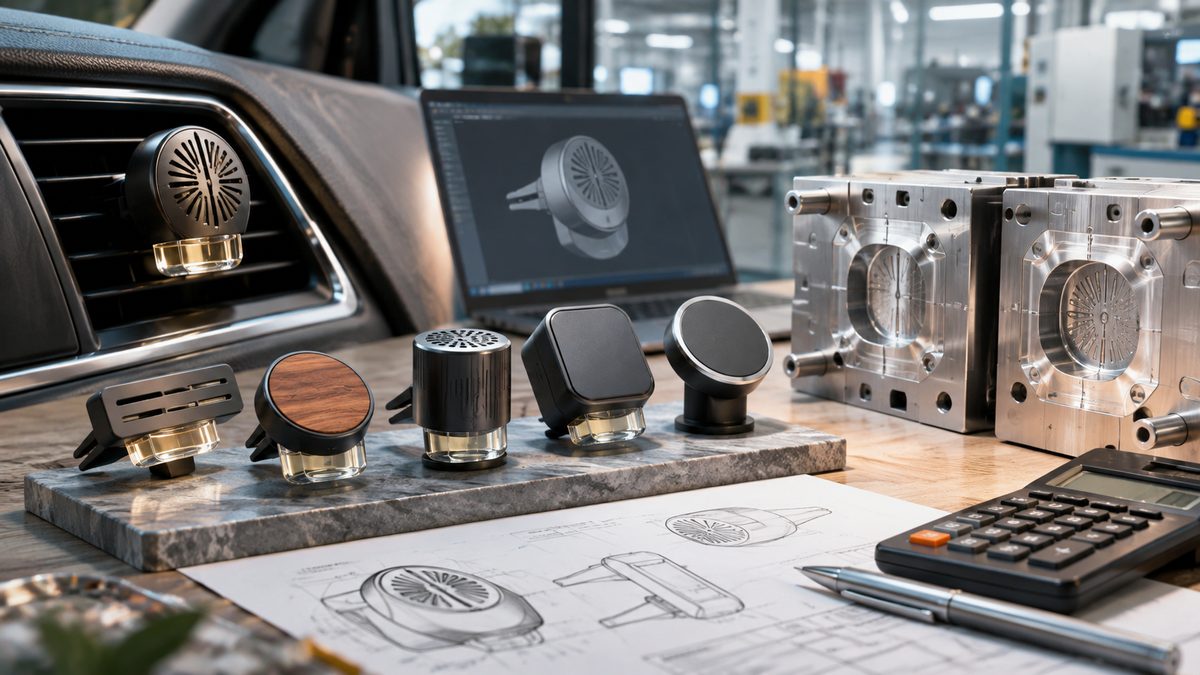
Car fragrance projects usually start with a scent brief and end with a tooling invoice nobody planned for. The reason is structural: the mount — the clip, hook, pad or housing that holds the product in a vehicle — is the most tooled part of the whole assembly, and it is decided long before the fragrance is finalised. Choose the mount late and the mould becomes the critical path.
This guide explains how mount families differ in tooling and risk, where the tooling budget actually goes, and how to amortise it across a range instead of paying it once per SKU.
Table of Contents
- Why the mount comes before the fragrance
- Three mount families and what each locks in
- Mount families compared
- Where the tooling budget actually goes
- Amortising tooling across SKUs
- A design review checklist
- Frequently asked questions
- Conclusion
Why the mount comes before the fragrance
A car fragrance is a mechanical product that happens to smell. The consumable — the liquid, gel or membrane pad — is cheap to change. The housing and the interface with the vehicle are not. Once a clip geometry, a housing shell and a cartridge interface are tooled, the brand has committed to a format for years, because the mould cost is sunk and the packaging, instructions and product photography all follow it.
That asymmetry means the mount decision sets more of the programme than the scent does. It determines tooling cost, minimum order, fit risk, the channel the product can sell into, and how easily the range can be extended.
Three mount families and what each locks in
Vent clip
A sprung or living-hinge clip that grips an air vent louvre. Cheap to tool, widely accepted by consumers, and the most competitive shelf space. It also carries the highest fit risk: louvre thickness and spacing vary across vehicles, and a clip that fits one dashboard may rattle in another. Retention force has to be high enough to hold the product and low enough not to damage the vent.
Hanging format
A cord, loop or hook that hangs from a mirror or a grab handle. Minimal tooling, low unit cost, and a long-established retail presence. The trade-off is that the fragrance housing is usually simple and the perceived value is lower, so it suits value channels and promotional programs more than premium accessory retail.
Dashboard or adhesive mount
A housing fixed with an adhesive pad or a weighted base. Tooling is heavier because the housing carries the product's visual identity, and the adhesive choice becomes a technical decision: temperature cycling, surface energy and residue on removal all matter. This family supports the highest perceived value and the highest tooling spend.
The hidden cost of a clip that looks generic
A generic-looking clip is not a cost saving if it forces the brand into a commodity price band. The tooling for a distinctive housing is a one-off; the price ceiling of an undifferentiated product lasts as long as the SKU does. The correct comparison is tooling amortised over expected volume against the margin difference the design supports.
Mount families compared
| Dimension | Vent clip | Hanging | Dashboard / adhesive |
|---|---|---|---|
| Retention principle | Spring or hinge gripping a louvre | Cord or hook under gravity | Adhesive pad or weighted base |
| Tooling weight | Low to moderate | Low | High |
| Fit risk | High — louvre geometry varies | Low | Medium — surface and temperature |
| Perceived value | Medium | Low to medium | High |
| Best channel | Accessory shops, fuel forecourts | Value retail, promotions | Premium accessory, gifting |
| Refill potential | Good — cartridge interface | Limited | Good — housing holds the unit |
Where the tooling budget actually goes
| Part | Tooling type | What drives the cost |
|---|---|---|
| Housing shell | Injection mould | Part size, number of cavities, surface finish, slide count |
| Clip or spring element | Mould plus secondary forming | Material choice, fatigue requirement, assembly method |
| Cartridge body | Injection mould | Sealing geometry, wall thickness, weld line control |
| Membrane or pad carrier | Mould or die | Tolerance on the vent area, material compatibility |
| Cap or plug | Mould | Seal integrity, opening force, child-resistance where applicable |
| Assembly fixture | Jig and fixture | Whether ultrasonic welding or adhesive is used |
| Packaging insert | Die | Whether the product ships assembled or flat |
The largest line is almost always the housing shell, and the cost driver is cavities. A single-cavity tool is cheap and slow; a multi-cavity tool costs more up front and reduces unit cost at volume. The correct choice depends on the annual volume, not on the launch quantity.
Amortising tooling across SKUs
A car fragrance range rarely stays at one SKU. Seasonal scents, retailer exclusives and regional variants all multiply the SKU count while the mechanical parts stay the same. The efficient structure is to tool the mechanical platform once and vary only the consumable and the graphics.
Three practices make that work. First, separate the housing from the scent identity: if the scent name is moulded into the shell, every new scent needs a new tool. Use a label, an insert or a printed collar instead. Second, standardise the cartridge interface so a new scent is a new cartridge, not a new assembly. Third, keep colour changes in the mould as material changes only, and confirm the minimum run per colour before promising a palette. Our customization process sequences platform tooling and scent development in parallel for this reason.
The counter-case is a market-specific mount. If one region needs a different clip geometry, that is a genuine second tool, and it should be justified by volume rather than by preference.
A design review checklist
Fit and retention
Specify the range of louvre thickness or surface conditions the product must accommodate, and require retention testing across that range rather than at a single nominal value.
Heat and material compatibility
Dashboard temperatures in a parked car are severe. Require heat-ageing data for the housing material and for the fragrance's interaction with it, since some concentrates attack certain plastics.
Sealing and venting
A sealed cartridge holds the fragrance until opening; a vented product releases continuously. Whichever is chosen, the sealing geometry and the vent area need to be specified and tested as a system.
Assembly method
Ultrasonic welding, adhesive and snap-fit each impose different tolerances and different failure modes. Choose before tooling, because the choice affects wall thickness and part design.
Shipping configuration
Whether the product ships assembled or flat determines the packaging insert, the carton dimensions and therefore the freight cost per unit.
Documentation carried with the part
Instructions, warnings and any required symbols have to fit on the pack. Check the available print area before the housing size is frozen. See packaging formats for the space that typical retail packs allow, and review the car fragrance formats against the mount you are tooling.
Frequently asked questions
What is private label car fragrance?
A car fragrance produced under a buyer's brand, with housing, mount, fragrance format and packaging agreed with the manufacturer.
Can I choose both the scent and the mount format?
Yes, but the mount should be chosen first because it drives tooling, minimum order and fit risk. The scent can change later at much lower cost.
What should I include in a car fragrance brief?
Target vehicles or vent types, channel, price band, scent direction, delivery format, refill intention, packaging preference, quantity and launch date.
Why does the vent clip cost more than expected?
Because the clip is a mechanical part with a fatigue requirement and a fit range across many vehicles. Testing and tolerance work, not the plastic, drive the cost.
Can one housing serve several scents?
Yes, and it should. Keep the scent identity on a label or insert rather than moulded into the shell, and standardise the cartridge interface.
Is a dashboard mount worth the tooling?
When the channel supports a premium price and the refill model is planned. Without those, a clip or hanging format usually returns the tooling faster.
What testing should precede approval?
Retention across the specified fit range, heat ageing, drop and vibration, sealing integrity and material compatibility with the fragrance. Agree the acceptance criteria before samples are made.
How does packaging affect freight?
Assembled products need larger cartons and inserts, which increases volumetric weight. Shipping flat can reduce freight but adds assembly labour at destination.
Conclusion
In car fragrance, the mount is the product platform and the fragrance is the variable. Decide the mount against channel, fit range and annual volume; tool the platform once; vary scent through the consumable and the graphics; and test retention and heat ageing across the range you claim to fit. Brands that sequence it this way pay for tooling once and amortise it across a range. Brands that start with the scent pay for it twice.
Discuss your car fragrance programme with our team:
WhatsApp: +86 17324762943
Email: adon@customperfumeoem.com
Website: customperfumeoem.com