Car Fragrance in EV Interiors: Why Cabin Materials Change Scent Performance
A car fragrance that has sold well for years is placed in a new electric model, and the same scent suddenly reads differently: the throw feels weak against the cabin's own background odour, and a buyer reports a faint stain on a light vegan
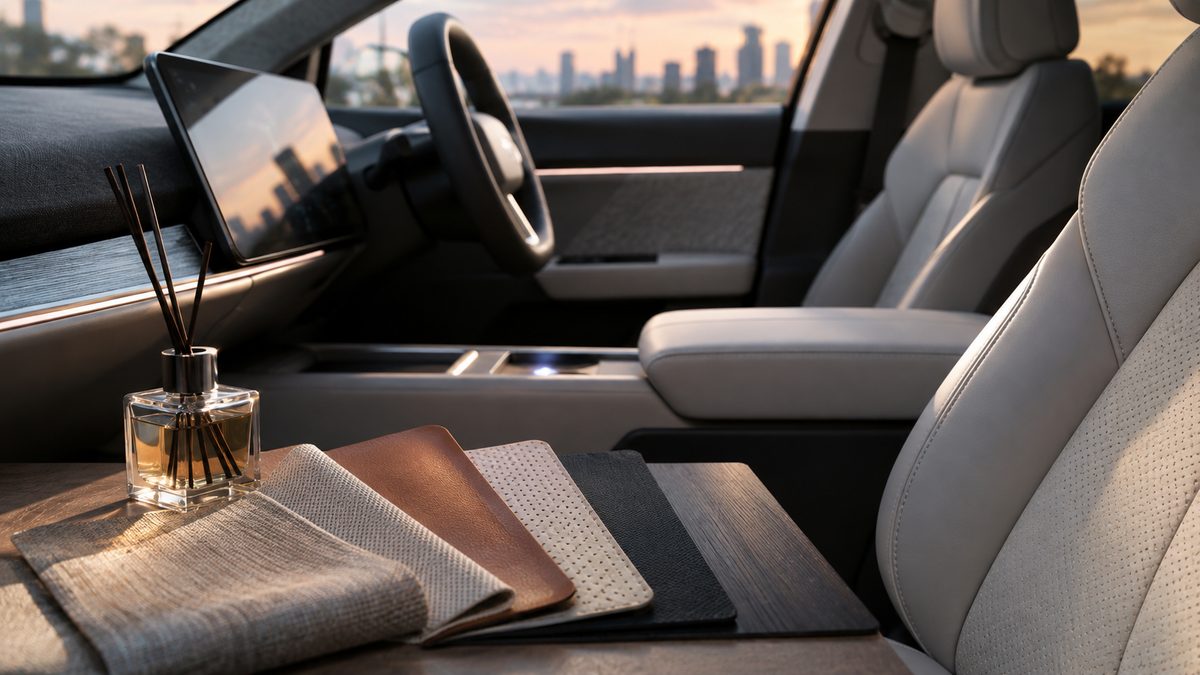
A car fragrance that has sold well for years is placed in a new electric model, and the same scent suddenly reads differently: the throw feels weak against the cabin's own background odour, and a buyer reports a faint stain on a light vegan-leather surface. The fragrance did not change; the cabin it sits in did.
This article explains why electric vehicle cabin materials change how a car fragrance performs, covering off-gassing, heat profiles, material compatibility and the residue risks on new surfaces. It is written for private label buyers of car fragrance who need to adapt their products to the vehicles now on the road.
Table of Contents
- Why EV interiors changed the fragrance question
- Cabin materials and off-gassing
- Heat profiles and fragrance stability
- Staining and residue on light materials
- Format changes and what to test for EV placement
- Practical guide: qualifying a car fragrance for EV cabins
- Frequently asked questions
- Conclusion
Why EV interiors changed the fragrance question
Electric vehicles changed the cabin in two ways that matter to a fragrance: the materials are new, and the thermal behaviour is different. A fragrance designed around a leather and hard-plastic cabin heated by an engine behaves differently in a vegan-leather, recycled-plastic cabin that warms by resistive heating and heat pumps.
The cabin is quieter and more sealed
Without engine noise, designers seal the cabin more tightly and use materials differently, which changes how scent disperses and how long it lingers. A fragrance that relied on constant air exchange in a combustion car may now sit in a more closed volume, and the odour baseline is different because new materials bring their own smell profile.
Cabin materials and off-gassing
The surface materials in EV interiors are changing, and each interacts with a fragrance differently. Off-gassing — the slow release of volatile compounds from the cabin materials themselves — sets the olfactory background against which any added fragrance must compete.
Vegan leather is not one material
Vegan leather spans polyurethane, silicone and plant-based coated fabrics, and they vary in how they absorb and release volatiles. Some are porous to fragrance molecules and hold them, while others shed them quickly or react with them. Recycled plastics can carry stabilisers, processing aids and residues from their previous life, all of which contribute to the background odour.
Low-VOC design raises the stakes
A new vehicle off-gasses most heavily in its first months, and the compounds released from adhesives, foams and coatings can mask or alter an added fragrance. Automakers now chase low-VOC interiors, which makes an added fragrance more prominent, but also makes any off-odour from the fragrance itself more noticeable against the cleaner baseline.
Why substrate testing beats open-air testing
A fragrance's performance is a property of the fragrance-plus-surface system, not the fragrance alone. Testing on the real dashboard, door card or vent material reveals absorption and interaction effects that a bench test in a dish cannot show.
Heat profiles and fragrance stability
The thermal environment of an EV cabin differs from a combustion car, and temperature is the dominant driver of fragrance evaporation and stability.
Faster warm-up, different soak behaviour
Resistive cabin heating warms the interior quickly, and the thermal mass and insulation strategies differ from a combustion vehicle. A parked EV in the sun still reaches high cabin temperatures, so the soak behaviour must be tested rather than assumed from combustion-car data, and a fragrance clipped to a vent is no longer sitting near engine heat, which changes the local temperature it experiences.
Absorption, retention and reactivity
Some cabin materials absorb fragrance molecules and release them slowly, which can either smooth the scent or mute it. Certain fragrance ingredients can react with the surface or with UV to shift colour or leave a mark, so compatibility is retested when the cabin material changes, and the ingredient-level screening described in our supplier ingredient checklist helps flag the compounds most likely to react.
Staining and residue on light materials
The residue risk is the most visible complaint, and it is amplified by the light, uncoated surfaces common in modern EV interiors.
| Surface | Residue risk | Why it matters |
|---|---|---|
| Light vegan leather | Visible staining from oils or dyes | High-visibility consumer complaint |
| Soft-touch dashboard | Absorbs liquid and holds marks | Hard to clean once stained |
| Piano-black trim | Shows streaks and film | Reads as poor quality immediately |
| Textile headliner | Traps residue invisibly | Odour lingers after removal |
Test for migration, not just contact
A fragrance that does not stain on direct contact may still migrate through evaporation and condensation onto nearby surfaces. The test should cover the mounted position over a full heat cycle, not a single drop placed on the material.
Format changes and what to test for EV placement
The format — liquid, gel, solid, vent clip or pad — interacts with the cabin differently, and EV conditions favour some formats over others.
Vent clips depend on airflow that has changed
A vent clip relies on airflow through the vent, and EV climate systems move air differently. A clip that worked on a combustion car's vents may receive less or more airflow in an EV, changing the throw. Gels can soften or weep at high soak temperatures, while solid formats may release too slowly when the cabin is cool.
The three conditions to reproduce
Reproduce the cabin's soak temperature, the target surface material and the airflow of the vent or mount position. These three conditions determine throw, stability and residue, and none of them is captured by a room-temperature bench test. Ask the supplier for evidence on the actual material at the actual temperature cycle, including any staining or colour-shift result.
| Test condition | What it reproduces | Why it matters |
|---|---|---|
| Soak temperature | Parked cabin peak | Drives evaporation and leakage |
| Surface material | Actual dash or trim | Reveals absorption and staining |
| Airflow position | Vent or mount location | Sets the effective throw |
Specify the placement and the evidence
This sits alongside the placement questions in our car fragrance pack planning guide, and the packaging considerations in our scent card packaging guide.
Practical guide: qualifying a car fragrance for EV cabins
Step 1 — Identify the target cabin materials
Confirm which surfaces the fragrance will be mounted on or near, and obtain samples or specifications of the actual vegan leather, plastic and trim.
Step 2 — Measure the cabin temperature cycle
Record the soak and operating temperature range for the target vehicle in your market, rather than reusing combustion-car data.
Step 3 — Test on the real substrate at the real temperature
Run throw, stability and residue tests on the actual material across the measured temperature cycle, not in open air at room temperature.
Step 4 — Check for staining and colour shift
Include a migration test that covers evaporation and condensation onto nearby surfaces, and record any staining or colour change on light materials.
Step 5 — Re-evaluate the format
Confirm the format still suits the new airflow and temperature range, and switch the format if the vent clip or gel no longer performs as intended.
Step 6 — Document the qualification
File the substrate, temperature and residue results with the product record so the EV-specific evidence is available when a buyer or retailer asks for it.
Frequently asked questions
What is a car fragrance?
It is a scented product in liquid, gel, solid or vent-clip form designed to release fragrance inside a vehicle cabin and mask or complement the interior's own odour.
Why does the same car fragrance smell different in an EV?
Because EV cabins use different materials with their own odour and off-gassing, and their thermal and airflow behaviour differs, which changes how the fragrance releases and is perceived.
What is off-gassing in a car interior?
Off-gassing is the release of volatile compounds from cabin materials, adhesives and foams, and it sets the background odour against which an added fragrance must compete.
Do vegan leather surfaces stain more easily than leather?
It depends on the specific material, but light vegan leather and soft-touch surfaces can show stains and marks from fragrance oils and dyes more readily, so residue must be tested on the actual material.
Why does the temperature profile matter for car fragrance?
Temperature drives fragrance evaporation and stability, and EV cabins warm and soak differently from combustion cars, so the fragrance must be tested across the actual cabin temperature range.
Can I keep using the same fragrance format in an EV?
Only after re-testing. Vent clips depend on airflow that has changed, and gels or solids behave differently under the new thermal cycle, so the format must be confirmed against the measured conditions.
What should I test before selling into EV owners?
Test throw, stability and residue on the actual cabin material across the actual soak temperature cycle, including migration and colour-shift checks on light surfaces.
How do I get evidence that works for EV placement?
Specify the substrate, temperature and airflow conditions to the supplier and request results on the real material at the real temperature, filed with the product record.
Conclusion
EV interiors changed the rules for car fragrance because the material, the odour baseline and the heat cycle all moved at once. A fragrance that was never re-tested for the new cabin is being sold on assumptions that no longer hold.
The buyer who identifies the target materials, measures the actual temperature cycle and tests on the real substrate at the real temperature will catch the throw, stability and residue problems before they reach a customer. Qualify the fragrance for the vehicle it will actually sit in, and the format decision follows from data instead of habit.
Discuss your fragrance programme with our team:
WhatsApp: +86 17324762943
Email: adon@customperfumeoem.com
Website: customperfumeoem.com