Bulk vs Bottled Fragrance Oil: Choosing the Delivery Format
A brand starts by buying fragrance oil in retail-sized bottles because that is how the supplier sells samples, then scales to drums and discovers the oil behaves differently, the cost structure changes, and the filling line cannot handle th
A brand starts by buying fragrance oil in retail-sized bottles because that is how the supplier sells samples, then scales to drums and discovers the oil behaves differently, the cost structure changes, and the filling line cannot handle the new format. Or the opposite: a brand orders bulk before it has the throughput, and the drum sits half-empty, oxidising while the investment sits in a warehouse corner.
This article compares bulk and bottled fragrance oil delivery so you can choose the format that matches your production volume, filling equipment, and shelf-life tolerance. It covers packaging formats, cost and minimums, oxidation risk, transport classification, and the checks to run when the oil arrives.
Table of Contents
- Delivery formats compared
- Cost and minimum order quantity
- Oxidation and headspace
- Transport and regulatory handling
- Quality control on receipt
- When to switch formats
- Practical guide: choosing a fragrance oil delivery format
- Frequently asked questions
- Conclusion
Delivery formats compared
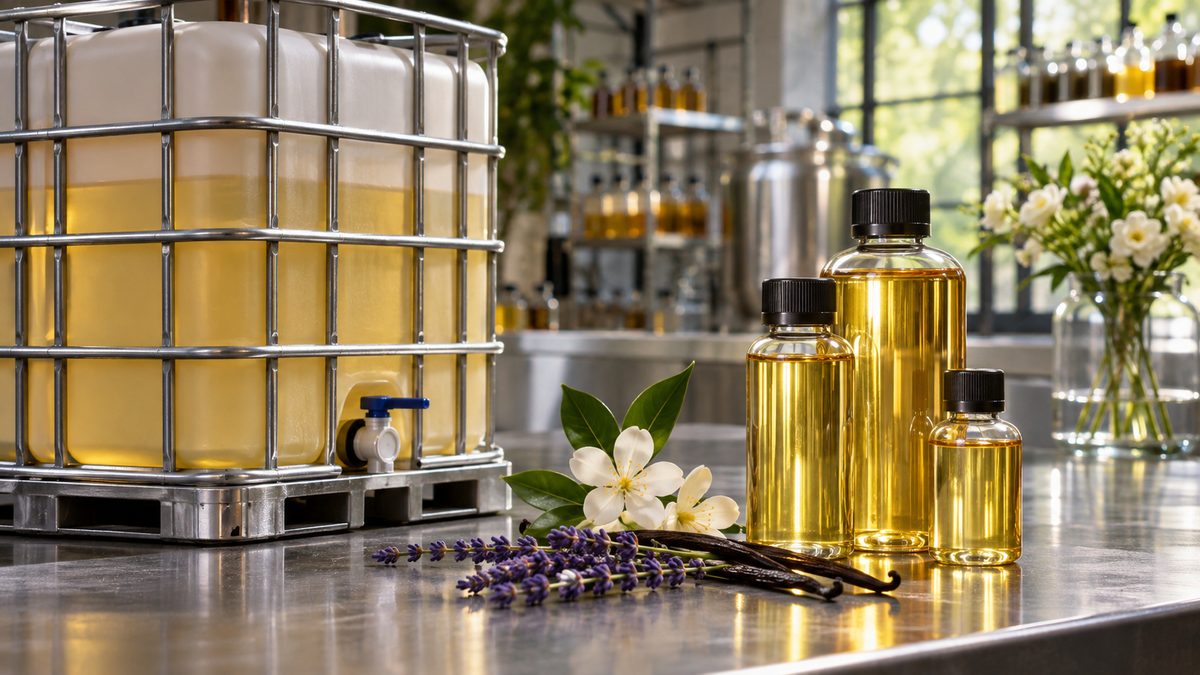
Fragrance oil moves in a small set of standard containers, and each trades cost against protection and handling. Bottles and jerry cans are the small-quantity formats, convenient for direct use and easy to pour, but they carry the highest packaging cost per kilogram. Steel and HDPE drums, and IBC totes above them, drive the per-kilo cost down but demand a pump, a safe dispensing area, and enough throughput to use them before they degrade.
| Format | Typical size | Best for | Main drawback |
|---|---|---|---|
| Bottle | 0.1–5 L | Sampling, small batches | Highest cost per kilo |
| Jerry can | 5–25 L | Small production runs | Manual handling, pour spillage |
| HDPE drum | 200 L | Steady production | Headspace as it empties |
| Steel drum | 200 L | Light-sensitive, flammable oils | Weight, cost, corrosion risk |
| IBC tote | 1,000 L | High-throughput lines | Large working capital, long dwell |
The container material matters as much as the size. HDPE is cheap but slowly permeable and can pick up odours; steel blocks light and oxygen but is heavier and can react with certain acids. Match the container to the oil's sensitivity, not just to the volume, because a light-sensitive citrus in an HDPE drum will age faster than the same oil in steel.
Cost and minimum order quantity
Bulk pricing is not a single number; it is a curve that steps down with volume and container size. The per-kilo price in a drum is typically well below the bottled price, but the savings arrive only when you buy the full container and use it in a reasonable window. A drum of a slow-moving scent is not a saving; it is working capital sitting on a shelf degrading.
Minimum order quantities usually attach to the container, not to the oil line. A supplier may sell any quantity in bottles but require a full drum or a minimum number of drums for bulk pricing. Ask for the price at each format boundary and plot it against your actual monthly usage, because the cheapest format on paper is often the most expensive once you account for waste and write-offs.
Oxidation and headspace
The dominant quality risk in bulk is headspace. As oil is drawn from a drum or tote, air replaces it, and the oil-air contact area drives oxidation and evaporation of top notes. A nearly empty drum is the worst state: a large air volume over a small oil volume, refreshed every time the container is opened.
Managing what you cannot avoid
Nitrogen blanketing, where dry nitrogen fills the headspace, is the standard fix and costs little relative to the value of the oil. Smaller practical measures help too: draw from one container until it is empty rather than opening several, keep dispensing bungs closed, and store containers out of direct sun and heat. The goal is to minimise the number of times fresh air meets the oil surface.
Why bottled oil can last longer in storage
A sealed retail bottle has a small, fixed headspace and is opened rarely, so an otherwise identical oil can age more slowly in a bottle than in a part-used drum. This is why small brands sometimes pay the bottled premium as de facto shelf-life insurance until their volume justifies bulk.
Transport and regulatory handling
Fragrance oils are frequently flammable, which changes how they must be shipped and stored. The flash point of the oil, not the container size, sets the transport classification, and a low-flash oil moves under dangerous-goods rules with documented packaging, labelling, and carrier restrictions. Bulk formats do not change the chemistry, but they do raise the quantity, and larger quantities can trigger different handling requirements.
| Factor | Bottled | Drum | IBC tote |
|---|---|---|---|
| Per-kilo packaging cost | High | Low | Lowest |
| Headspace control in use | Good (small, sealed) | Moderate | Moderate |
| Handling equipment needed | None | Pump, trolley | Forklift, pump |
| Working capital per unit | Small | Large | Largest |
| Flash-point relevance | Same chemistry | Same chemistry | Same chemistry |
Confirming documentation
Confirming the classification with the supplier
Do not infer the transport class from the oil name. Ask the supplier for the safety data sheet and the flash point, and confirm how the product is classified for transport in the destination market. Where a specific UN number or packaging instruction is cited, verify it against the current official text, because classification rules are updated and the supplier's last shipment may predate a change.
Quality control on receipt
Receiving checks differ by format only in where you sample. From a bottle you can draw directly; from a drum you sample through the bung or after gentle agitation, and from a tote you may need a top and bottom sample to catch stratification. Match your sampling method to the format, and keep a retained sample sealed against a reference standard.
The checks themselves are the same: appearance, odour against the standard, and any agreed density or GC marker. For a format change, re-run the checks even when the oil is nominally identical, because a new container system can introduce its own variables — a new liner, a washed tote, or a different fill site. Our complaint triage guide walks through what to do when a bulk delivery smells off, and our product pages list the delivery formats we can supply.
When to switch formats
The switch point is not a fixed volume; it is where the savings from a larger container exceed the cost of the extra degradation risk and working capital. A rough working rule: move to drums when a single scent is consumed fast enough that a drum turns over before the oil degrades, and to totes only when the line runs continuously and the scent is a permanent seller.
Run the change as a controlled trial before committing the whole range. Order one scent in the new format, measure quality at receipt and at intervals, and confirm the line can dispense it cleanly. Only after that trial passes do you convert the rest, because the cost of discovering a dispensing or storage problem at scale is the cost of the whole drum. For structuring the bottled side of the range, see our starter-set planning guide.
Practical guide: choosing a fragrance oil delivery format
Step 1 — Map monthly usage per scent
Record how much of each oil you consume per month and how fast a container of each size would turn over. Usage, not price, sets the format.
Step 2 — Price each format boundary
Get the per-kilo price in bottle, drum, and tote quantities, and note the minimum order for each. Plot the curve against your usage.
Step 3 — Factor in the oil's sensitivity
Light-sensitive or highly oxidisable oils justify a steel drum or nitrogen blanketing; robust oils tolerate HDPE. Match container to chemistry.
Step 4 — Confirm transport class and flash point
Obtain the safety data sheet and verify how the quantity is classified for transport in your market before you commit to a bulk order.
Step 5 — Trial one scent in the new format
Convert a single fast-moving scent, check quality on receipt and over time, and confirm the line dispenses it cleanly.
Step 6 — Scale only after the trial passes
Roll the new format across the range once the trial proves storage, dispensing, and quality hold up. Do not convert everything at once.
Frequently asked questions
What is bulk fragrance oil?
Bulk fragrance oil is fragrance oil supplied in large containers such as drums or IBC totes rather than retail bottles. It lowers the per-kilogram cost but shifts storage, dispensing, and shelf-life responsibility onto the buyer.
What is a fragrance oil?
A fragrance oil is a formulated blend of aromatic materials and a solvent carrier designed to scent a product. The same oil can be supplied in bottles, drums, or totes without changing its chemistry.
What is headspace in an oil container?
Headspace is the air-filled volume above the oil in a partially emptied container. A larger headspace means more oxygen in contact with the oil, which accelerates oxidation and the loss of top notes.
Does bulk oil smell the same as the bottled version?
The formulation is the same, but the oil's condition on arrival can differ if the bulk container was stored warm, part-filled, or opened repeatedly. Sampling and comparing against a retained standard is the only way to confirm equivalence.
What is the minimum order for bulk fragrance oil?
It is usually set by the container — a full drum or a minimum number of drums — rather than by the oil itself. Confirm the minimum at each format boundary and check whether partial containers carry a premium.
Is fragrance oil dangerous to transport?
Many fragrance oils are flammable, so transport classification depends on flash point, and larger quantities can trigger specific dangerous-goods handling. Obtain the safety data sheet and verify the current classification for your market rather than assuming.
How do I keep a part-used drum of oil fresh?
Draw from one drum until empty, keep bungs closed, store cool and dark, and consider nitrogen blanketing for oxidisable oils. The fewer times fresh air meets the oil surface, the longer the oil holds.
When should I move from bottles to drums?
Move when a single scent turns over fast enough that a drum is consumed before it degrades, and when the per-kilo savings outweigh the added working capital and handling. Trial one scent first before converting the range.
Conclusion
The delivery format is a production and shelf-life decision wearing a pricing costume. Bottles cost more per kilo but protect the oil with a small, rarely opened headspace; drums and totes cut the cost but hand you the storage, dispensing, and oxidation risks. The right format is the one whose turnover matches your actual consumption, not the one with the lowest number on the quote.
Choose by usage first, then by chemistry, then by transport class, and convert one scent at a time as a controlled trial. A format change is cheap to reverse at bottle scale and expensive to get wrong at tote scale.
Discuss your fragrance programme with our team:
WhatsApp: +86 17324762943
Email: adon@customperfumeoem.com
Website: customperfumeoem.com