
Barrier Pouch Evidence: Proving Scent Retention for a Shelf-Life Claim
You print a shelf life on a scent card and a retailer asks how it was established, but the answer you have is that the supplier "said the pouch holds the scent." There is no retention measurement, no control sample, and no document connecti
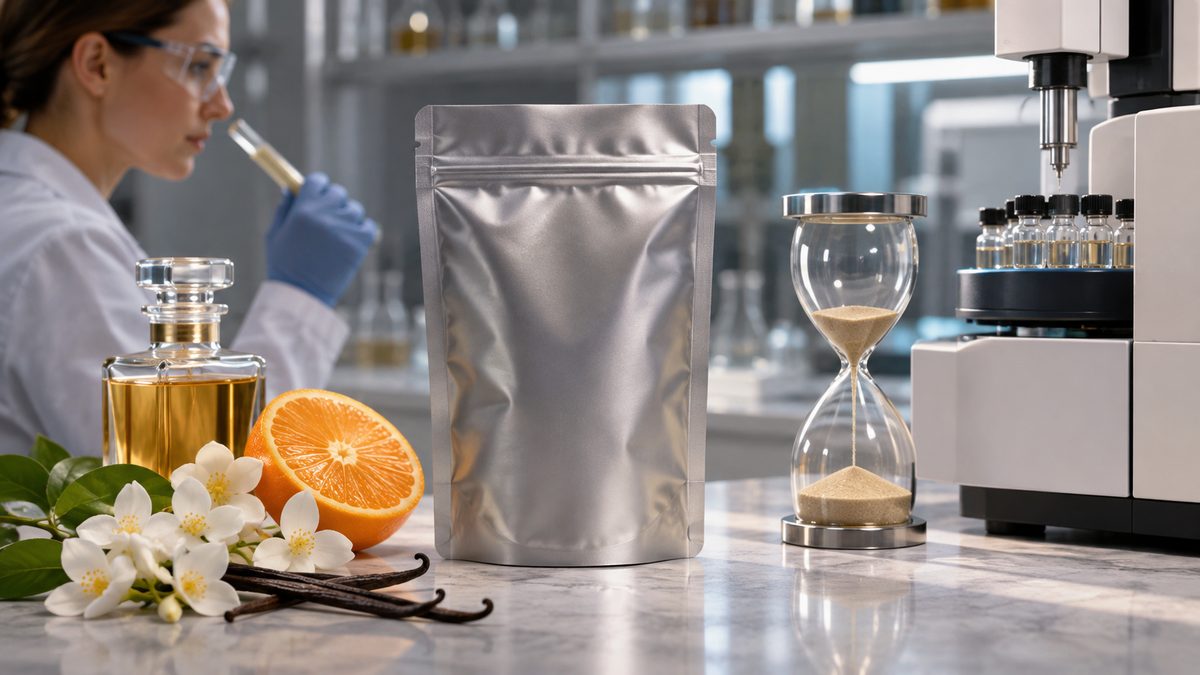
You print a shelf life on a scent card and a retailer asks how it was established, but the answer you have is that the supplier "said the pouch holds the scent." There is no retention measurement, no control sample, and no document connecting the pouch specification to the claim printed on the card.
This article explains how to prove scent retention for a shelf life claim, covering the pouch specification, barrier measurements, accelerated aging and the evidence file a retailer will accept. It is written for private label buyers of scent cards who need the claim backed by data rather than an assertion.
Table of Contents
- Why a shelf life claim needs evidence
- What scent retention actually measures
- Pouch spec, seal integrity and the barrier numbers
- Aging methods and designing the retention test
- The evidence file, and what to request
- Practical guide: proving scent retention for a shelf life
- Frequently asked questions
- Conclusion
Why a shelf life claim needs evidence
A shelf life claim is a promise about how the product will perform over time, and retailers increasingly treat that promise like any other product specification: it must be supported by a measurement, not a manufacturer's optimism.
The claim is printed, so it is auditable
Once a shelf life is printed on the pack, it becomes part of the product's declared performance. A retailer or platform review can ask how it was established, and an unsupported number reads as an unsubstantiated claim. A scent card is a thin substrate carrying volatile fragrance, sealed in a pouch, so the fragrance is constantly trying to migrate out and the retention question is more acute than for a stable solid product.
What scent retention actually measures
Scent retention is the degree to which the card still delivers its intended odour after a period of storage, compared against a freshly made reference.
It is measured as a difference, not an absolute
Retention is judged by comparing a stored card against a control kept under defined conditions, and recording how the odour intensity and character have changed. Two things change as scent is lost: the overall strength falls, and the top notes fade faster than the base, shifting the character, so a retention test should capture both rather than a single "still smells" judgement.
Why the control must come from the same batch
Comparing a stored card against a freshly made card from a different batch confuses storage loss with batch-to-batch variation. The control and the stored samples must come from the same production batch so the measured difference is genuinely the effect of storage, and where possible the evaluation should be blind so the result is not influenced by expectation.
Pouch spec, seal integrity and the barrier numbers
The pouch is the retention system, and its specification and seal are the first thing the evidence must nail down. Two numbers — the moisture vapour transmission rate and the oxygen transmission rate — describe how much passes through the film.
| Measurement | What it quantifies | How it is used |
|---|---|---|
| MVTR | Moisture vapour passing through the film | Checks humidity protection |
| OTR | Oxygen passing through the film | Checks oxidation protection |
| Scent retention | Odour intensity and character over time | Checks the actual fragrance loss |
| Seal integrity | Leakage at the pouch seal | Checks the weakest point of the package |
The barrier numbers do not replace the retention test
MVTR and OTR describe the film, but fragrance molecules are not water or oxygen, and a film with good MVTR and OTR can still let aroma molecules escape. The retention test on the actual card is what proves the claim, with the barrier numbers as supporting data. Most scent loss in a pouch happens at the seal, not through the film, so the evidence should include a seal integrity check, and the pouch structure and gauge must be named because the result only applies to that structure.
Aging methods and designing the retention test
A shelf life can be supported by real-time storage or by accelerated aging, and the two serve different purposes in the evidence file.
Real-time data is the strongest support
Keeping cards under defined storage and checking them at intervals produces the most defensible evidence, because it measures what actually happens; the limitation is that it takes as long as the shelf life you want to claim. Accelerated aging at elevated temperature gives an early indication, but extrapolating to a precise number of months requires care because the relationship is not always linear, so accelerated results are a screening tool, not a substitute for real-time data on a long claim.
Define the storage conditions and the intervals
State the storage temperature and humidity that the shelf life assumes, because the claim only holds under those conditions, and a shelf life without stated conditions is not testable. Then evaluate stored cards against the control at fixed intervals over the shelf life period, recording both intensity and character change.
The evidence file, and what to request
The evidence file ties the claim, the pouch and the measurement together so a reviewer can follow the logic end to end.
The chain from claim to measurement
The file should show the shelf life claim, the storage conditions it assumes, the pouch structure and seal, and the retention results at intervals against a control, each element connecting to the next. The result must be for the specific card, fragrance and pouch actually sold, identified by SKU and batch, and the same discipline of holding and rotating retain samples runs through our scent card starter and replacement guide.
The three documents that make the claim defensible
Request the pouch specification with structure and gauge, the seal integrity result, and the retention test with the control and the storage conditions. These three together let a reviewer verify the claim, and the result must be for the final fragrance and card construction, not an earlier sample.
| Document | What it must show | Failure if absent |
|---|---|---|
| Pouch specification | Structure and gauge | Result not tied to a package |
| Seal integrity result | No leakage at the seal | Loss path unverified |
| Retention test | Control, conditions, intervals | Claim unsupported by data |
Tie the evidence to the final fragrance
Our complaint triage guide and the scent card packaging guide both cover how the final construction is pinned down before the claim is made.
Practical guide: proving scent retention for a shelf life
Step 1 — Write the claim with its storage conditions
State the shelf life together with the storage temperature and humidity it assumes, so the claim is testable rather than a bare number.
Step 2 — Fix the pouch structure and seal
Confirm the pouch film structure, gauge and seal specification, and record them so the retention result is tied to the actual package.
Step 3 — Set up a matched control from the same batch
Keep a control card from the same production batch under defined conditions, so storage loss is measured against the right reference.
Step 4 — Run retention checks at intervals
Evaluate stored cards against the control at agreed intervals, recording both odour intensity and character change over the shelf life period.
Step 5 — Add seal integrity and barrier data
Include a seal integrity check and the film's barrier numbers as supporting data, while treating the retention test on the actual card as the primary evidence.
Step 6 — File the chain and tie it to the SKU
Store the claim, storage conditions, pouch spec, seal result and retention results together against the SKU and batch, so the evidence describes the product sold.
Frequently asked questions
What is scent retention?
It is the degree to which a scented product still delivers its intended odour after storage, measured as the difference in intensity and character from a fresh control.
Why does a shelf life claim need evidence?
Because the claim is printed on the pack and becomes part of the product's declared performance, so retailers and platforms can ask how it was established.
What is MVTR and OTR?
They are the moisture vapour transmission rate and oxygen transmission rate of a film, quantifying how much moisture and oxygen pass through, and they are used as supporting barrier data.
Do good MVTR and OTR prove scent retention?
Not by themselves, because fragrance molecules differ from water and oxygen, so the actual retention test on the card is the primary evidence.
Why does seal integrity matter for scent retention?
Most scent loss in a pouch occurs at the seal rather than through the film, so a strong film with a weak seal still fails the retention claim.
Is accelerated aging enough to support a shelf life?
It is a useful early indication, but the relationship between elevated temperature and real time is not always linear, so real-time data is the stronger support for a long claim.
Why must the control come from the same batch?
Because comparing stored cards against a different batch confuses storage loss with batch-to-batch variation, so the measured difference would not isolate the effect of storage.
What should the supplier provide to back the claim?
The pouch specification with structure and gauge, the seal integrity result, and the retention test with the control and storage conditions, tied to the final fragrance and SKU.
Conclusion
A scent card shelf life claim is only as strong as the chain behind it: the storage conditions it assumes, the pouch structure and seal that hold the scent, and the retention measurement against a matched control. When any link is missing, the printed number is an assertion rather than evidence.
Write the claim with its conditions, fix the pouch and seal, run retention checks against a same-batch control, and file the chain against the SKU. The claim then survives a retail review because every step from the number on the pack to the measurement in the file can be followed.
Discuss your fragrance programme with our team:
WhatsApp: +86 17324762943
Email: adon@customperfumeoem.com
Website: customperfumeoem.com


