Aldehyde Degradation in Citrus Oils: Predicting Shelf Life From Composition
A fragrance oil built around bergamot, lemon, or orange sells on brightness, and that brightness is the first thing to die. Six months after filling, the lemon note has turned dull and soapy, the colour has deepened, and a customer files a
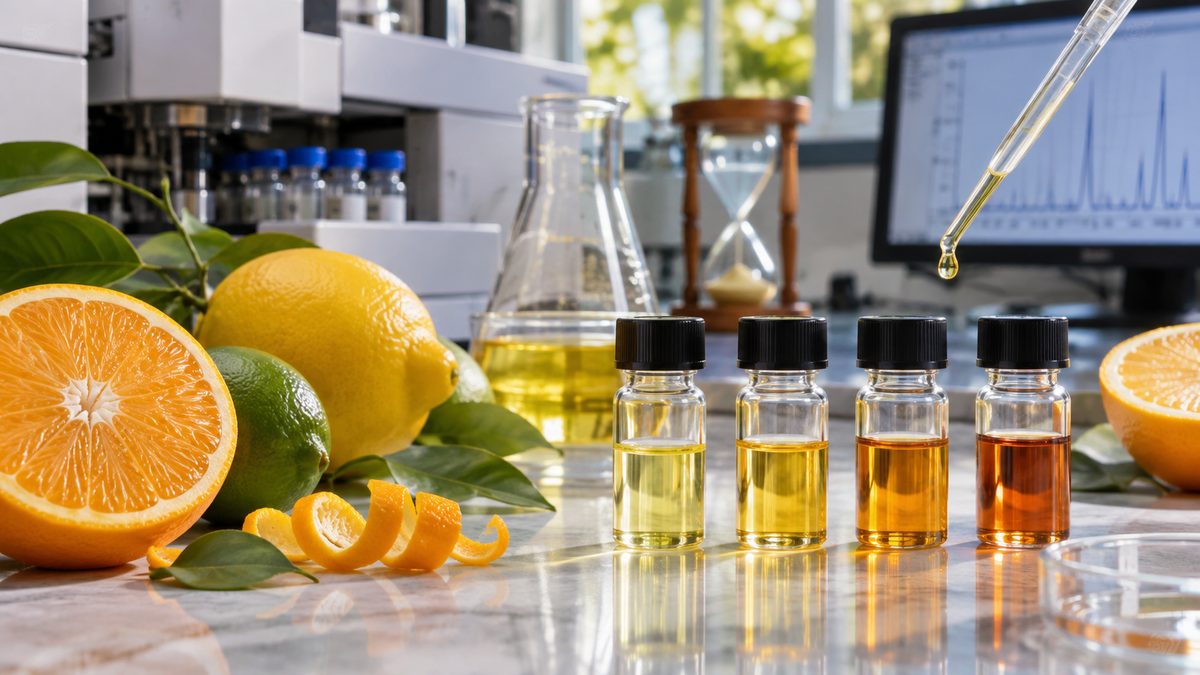
A fragrance oil built around bergamot, lemon, or orange sells on brightness, and that brightness is the first thing to die. Six months after filling, the lemon note has turned dull and soapy, the colour has deepened, and a customer files a complaint about a product that smelled different when they first opened it.
This article explains why citrus oils degrade, which aldehydes go first, how to measure the damage, and how to predict shelf life from the oil's composition rather than from a printed expiry date. It covers oxidation chemistry, antioxidant strategy, and the QC checks to run on every incoming batch.
Table of Contents
- What oxidises first in citrus oils
- Measuring degradation
- Factors that accelerate oxidation
- Antioxidant strategy
- Estimating shelf life from composition
- Supply-chain quality control
- Practical guide: predicting citrus oil shelf life before you buy
- Frequently asked questions
- Conclusion
What oxidises first in citrus oils
Citrus essential oils are dominated by terpenes and aldehydes, and the two degrade by different chemistry. Limonene, the main terpene, reacts with oxygen to form hydroperoxides that later decompose into off-odour compounds and, at high levels, skin sensitisers. The aldehydes — citral, octanal, decanal — oxidise more slowly than limonene but are far more noticeable, because a small loss of aldehyde erases the fresh, juicy character the oil is bought for.
This is why two citrus oils can share a name and differ in shelf life by months: the ratio of limonene to aldehyde, the initial peroxide value, and the presence of antioxidant all shift the clock. An oil pressed and stored cold behaves differently from one held warm in a partly filled drum, even from the same harvest.
Measuring degradation
Three measurements give you an objective read on citrus oil condition. Peroxide value (PV) counts hydroperoxides and rises early, before the smell turns; it is the standard early-warning number. Aldehyde content, typically by titration or GC, shows how much of the fresh character remains. Sensory scoring by a small trained panel catches the soapy or rancid notes that instruments describe only indirectly.
What the numbers mean in practice
A low PV does not guarantee a long life, and a high PV means the oil has already started down the path. The useful approach is to measure at receipt and then at intervals, because the trend matters more than any single reading. A batch whose PV doubles in a month will fail soon regardless of the absolute number, while a stable reading on a properly stored batch says the oil is holding.
Colour as a secondary signal
Oxidised citrus oils deepen in colour, from pale yellow toward amber, and some develop a slight haze. Colour is a useful screening flag on the dock but is not quantitative; use it to trigger a PV check rather than to make a reject decision on its own.
Factors that accelerate oxidation
Oxidation is catalysed by light, heat, oxygen in the headspace, and trace metals. Ultraviolet light is the most aggressive driver for citrus, which is why clear bottles on a bright shelf age faster than amber glass in a drawer. Heat roughly accelerates the reaction in line with standard chemical kinetics, so a warehouse cycle through a hot summer shortens life measurably.
Headspace oxygen is the lever buyers most often ignore. A drum that is one-third full holds a large air volume over the oil, and every opening refreshes it. Nitrogen blanketing or a full container with minimal ullage extends life at almost no cost, yet it is rarely written into a purchase spec.
Antioxidant strategy
Antioxidants do not stop oxidation; they delay it by scavenging free radicals, and they are consumed in the process. Once the antioxidant is exhausted, degradation proceeds at the normal rate, which is why an antioxidant-protected oil can look stable for months and then turn quickly. The practical rule is to dose at the start and verify the level, not to assume protection lasts forever.
| Antioxidant | Typical use level | Strengths | Limits |
|---|---|---|---|
| BHT | 0.01–0.1% | Cheap, effective at low dose | Some market sensitivity to the name |
| Alpha-tocopherol (vitamin E) | 0.02–0.2% | Natural-label friendly | Can add slight colour over time |
| Rosemary extract | 0.05–0.3% | Natural, colour-stable | Weaker per unit dose |
| Citric acid (chelator) | Trace | Binds trace metals | Not an antioxidant on its own |
Chelators such as citric acid are the quiet half of the strategy: they bind the trace metals that catalyse oxidation, so an antioxidant paired with a chelator usually outperforms a higher dose of antioxidant alone. Ask the supplier whether the oil is already protected and at what level, then record it, because re-dosing an already-protected oil can be wasteful or, in the wrong system, counterproductive.
Estimating shelf life from composition
Shelf life is a property of composition, storage, and packaging together, not a number printed by the supplier. You can estimate it by combining three inputs: the aldehyde-to-terpene profile, the initial peroxide value, and the storage conditions the product will actually see. A high-aldehyde oil with low PV in an amber, well-sealed container will outlast a terpene-heavy oil in clear glass.
| Input | What it tells you | How to read it |
|---|---|---|
| Aldehyde content | Fresh-character reserve | Higher aldehyde = more to lose before off-note |
| Peroxide value | How far oxidation has run | Rising PV = failure approaching |
| Terpene load (limonene) | Oxidation potential | Higher limonene = faster oxidation |
| Antioxidant level | Protection remaining | Exhausted antioxidant = cliff ahead |
Turning inputs into an estimate
Building a real-time shelf-life curve
Instead of trusting a static expiry, plot PV against time at your real storage temperature. The curve rises slowly during the induction period, then steepens once the antioxidant is gone. The bend in that curve is your true shelf-life signal, and it lets you set re-test dates and rotation rules that a calendar date on a label never could.
Supply-chain quality control
Citrus oil quality varies by harvest, pressing method, and how the intermediate was stored before it reached your supplier. The only defence is a fixed incoming specification: aldehyde content, PV limit, colour, and sensory descriptor, checked on every batch. A supplier who cannot supply the PV number is usually a supplier who is not measuring it. Our fragrance oil range ships with this batch data.
Write the storage conditions into the purchase agreement as well — temperature ceiling, light exclusion, and headspace policy — because a drum that arrives hot from a container that sat in the sun has already lost life you paid for. Our complaint triage guide covers what to do when a batch smells wrong on arrival, and our ingredient-check checklist shows where oxidation risk fits into a broader supplier gate.
Practical guide: predicting citrus oil shelf life before you buy
Step 1 — Demand the composition and PV on the quote
Ask for aldehyde content, limonene content, and peroxide value for the specific batch, not a generic data sheet. If it is not available, treat the quote as unverified.
Step 2 — Benchmark against a retained standard
Keep a sealed reference sample of a batch you accepted. Every new batch is compared to the standard, not to memory.
Step 3 — Check storage on the way in
Record the temperature and container fill level at receipt. A hot, part-full drum has already used up shelf life.
Step 4 — Run an accelerated hold
Hold a sample at 40°C for a set period and measure PV and aldehyde before and after. The delta, not the absolute value, predicts real-world drift.
Step 5 — Plot the curve over time
Track PV at intervals and watch for the steepening bend that marks antioxidant exhaustion. Set re-test dates from the curve.
Step 6 — Write storage and rotation into the spec
Fix temperature, light, and headspace requirements, and rotate stock on measured condition rather than a printed date.
Frequently asked questions
What is a fragrance oil?
A fragrance oil is a formulated blend of aromatic materials and a solvent carrier, made to scent a product such as a diffuser, candle, or personal-care item. Citrus fragrance oils are usually built on citrus essential oils plus synthetic materials that reinforce the fresh notes.
What is the shelf life of a fragrance oil?
Shelf life is the period over which an oil keeps its intended odour and safety profile under defined storage conditions. It is not a fixed number; it depends on composition, antioxidant protection, packaging, and how the oil is stored.
What is peroxide value?
Peroxide value is a measure of the hydroperoxides formed when an oil reacts with oxygen. It rises early in oxidation, before the smell turns, and is the standard early-warning number for citrus and other unsaturated oils.
Why do citrus oils smell soapy after a few months?
The aldehydes that carry the fresh citrus character oxidise first into compounds that read as soapy or dull. Limonene oxidation adds its own rancid notes, so the bright top of the oil fades into a flat, off character.
Does adding more antioxidant make the oil last longer?
Only up to a point. Antioxidants are consumed as they work, and once they are gone the oil degrades at the normal rate. A higher dose extends the induction period but does not stop the chemistry, and over-dosing can introduce its own odour or colour.
Should I use amber glass or clear glass for citrus oil?
Amber or otherwise light-blocking packaging is the safer choice, because ultraviolet light is the most aggressive accelerator of citrus oxidation. If the brand requires clear glass, expect a shorter shelf life and plan rotation accordingly.
Can I re-test an old batch and still use it?
Yes, if the measured PV, aldehyde content, and sensory score still pass your specification. A measured re-test is always more reliable than a printed expiry date, but re-testing only makes sense against a fixed pass limit.
How do I hold a supplier accountable for citrus oil quality?
Put aldehyde content, PV, colour, and a sensory descriptor into the purchase spec, require the numbers on every batch, and write storage conditions into the agreement. A supplier that cannot supply the PV number is not measuring the thing that matters.
Conclusion
Citrus oil shelf life is predictable if you stop treating it as a label date and start treating it as a set of measured inputs. The aldehydes tell you how much fresh character is in reserve, the peroxide value tells you how far oxidation has already run, and the antioxidant level tells you where the cliff is. Together they give you a curve, not a guess.
The cheap interventions — light-blocking packaging, minimal headspace, cold storage, and a fixed incoming specification — buy more shelf life than any amount of re-formulation after the fact. Measure at receipt, plot the trend, and rotate on data rather than on a printed expiry, and citrus oil stops being the SKU that quietly goes bad in the warehouse.
Discuss your fragrance programme with our team:
WhatsApp: +86 17324762943
Email: adon@customperfumeoem.com
Website: customperfumeoem.com