
Writing a Fragrance Brief a Perfumer Can Actually Work From
A brief is a constraint document, not a mood board. This article sets out the nine fields a perfumer needs, explains why adjectives produce extra rounds, and shows a one-page brief that produces a usable submission first time.
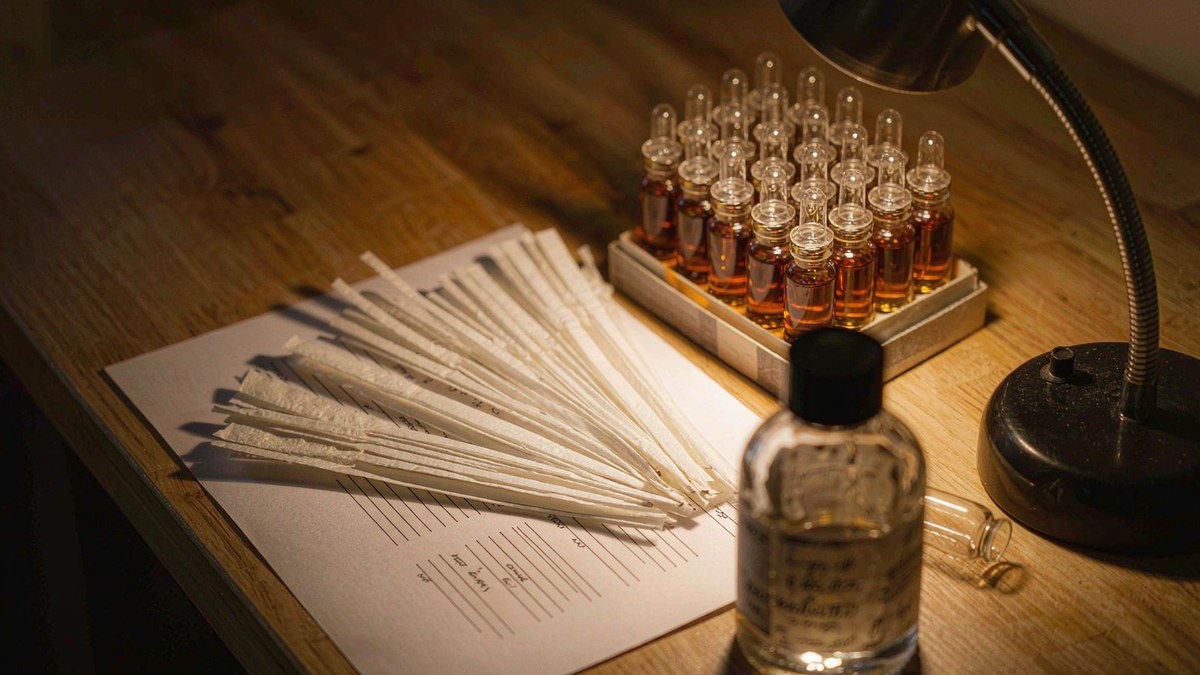
A perfumer reads your brief in about ninety seconds and decides from it whether they can work with you. Most briefs fail in those ninety seconds for the same reasons: the format is not stated, the price ceiling is missing, the references are brand names rather than smells, and there is no named person who can approve a submission.
This article explains how a fragrance brief actually functions in an OEM programme — what the perfumer needs, in what order, and how to write one page that produces a usable submission in the first round rather than the third.
Table of Contents
- What a brief actually does
- The nine fields
- References: why brand names fail
- The price ceiling
- Restrictions and exclusions
- A one-page example
- Practical guide: writing the brief
- Frequently asked questions
- Conclusion
What a brief actually does
A brief is a constraint document, not a mood board. Its job is to reduce the number of directions a perfumer could take so that the submissions are comparable. Every unstated constraint becomes a variable the perfumer has to guess, and guesses produce rounds.
This is why briefs that read beautifully produce poor results: adjectives are not constraints. "Warm, luxurious, slightly smoky" describes a thousand accords. "A woody amber with a dry cedar backbone, no vanilla, under €X per kg, for a candle at 8% load" describes perhaps six.
The nine fields
| Field | Why it matters | Common omission |
|---|---|---|
| Product format and base | Determines the diluent and the performance | Stated as "perfume" only |
| Fragrance dosage | Sets concentration and cost | Left to the factory to choose |
| Fragrance family | Narrows the palette | Described as a feeling |
| Two or three references | Gives a sensory anchor | Brand names with no reason given |
| Target consumer and occasion | Shapes intensity and sweetness | Omitted entirely |
| Market and climate | Affects stability and performance | Not stated |
| Cost ceiling per kg | Prevents unusable submissions | Missing in most briefs |
| Restrictions | Allergens, materials, claims | Added after the first round |
| Decision-maker and date | Creates a schedule | Left to a committee |
References: why brand names fail
Naming a competitor product is not a reference; it is a target for copying, which the perfumer should refuse and which may create legal exposure. The useful reference names the product and states what to take from it: "the dry cedar opening, not the sweetness", "the diffusion in the first ten minutes, not the base".
Better still, send physical references: blotters of accords you like, a raw material, or a sample of your own previous product. Smell travels better than language.
The price ceiling
Fragrance compound cost is the single most consequential number in the brief and the one most often withheld. A perfumer working without a ceiling may produce something excellent and unusable, costing a full round and a relationship. State the ceiling per kilogram of compound, and state whether it is fixed or has headroom for a clearly better submission.
Two related numbers belong beside it: the dosage and the format. A compound at €40/kg used at 15% in a 50 ml bottle is a different commercial proposition from the same compound at 8% in a candle.
Restrictions and exclusions
Restrictions are cheaper to state than to discover. List allergens you must avoid for label reasons, materials excluded by brand policy, market-specific limits, and any certification the product must hold. If the product must be vegan or halal, say so before the first submission — reformulating a signed-off accord for a certification is expensive.
A one-page example
Format: 200 ml reed diffuser, alcohol-free base. Dosage: 12%. Family: woody aromatic with a green opening. References: the dry cedar of X without its sweetness; the diffusion of Y at 30 minutes. Consumer: 30-45, home, premium retail. Markets: DE, FR, UK. Ceiling: €38/kg compound. Restrictions: no oakmoss, no citrus oils above 0.4% (phototoxicity), IFRA category 10B conformity required. Decision: [name], by [date].
That paragraph produces a usable submission. A page of adjectives produces an argument.
Practical guide: writing the brief
Step 1 — State the format and dosage first
Everything else is secondary to what the fragrance has to perform in.
Step 2 — Choose a family, not a mood
Name the family and the two or three materials or effects that define it.
Step 3 — Give references with a reason
What to take and what to leave. Physical references where possible.
Step 4 — State the ceiling
Per kilogram, plus dosage. Without it the brief is incomplete.
Step 5 — List restrictions upfront
Allergens, exclusions, certifications, market limits.
Step 6 — Name one decision-maker and a date
Feedback from a committee is not feedback a perfumer can act on.
Frequently asked questions
How long should a brief be?
One page. If it needs more, the extra pages are usually references or specifications, which should be attachments rather than prose.
Can I just send a competitor's product?
You can send it as a reference, but you should not ask for a copy. State which aspect you want and let the perfumer build an original accord.
What if I do not know the cost ceiling?
Derive it from the retail price and the dosage, or ask the factory for a range by market position. Guessing produces submissions you cannot use.
Should I specify the fragrance house's restrictions?
Yes. Allergens you must avoid and materials excluded by policy belong in the brief, not in the feedback round.
How many directions should I ask for?
Two or three. More than three makes comparison harder and delays the decision rather than improving it.
What if the first round misses?
Say what missed in sensory terms — too sweet, too dry, too diffusive — and change one variable. A second round that changes three things teaches nothing.
Do I need to state the market?
Yes. Climate affects performance, and regulation affects which materials are usable. A brief for Germany and a brief for Saudi Arabia are not the same brief.
Can the factory write the brief for me?
It can help structure it, but the commercial decisions — price ceiling, target consumer, market — are yours. Delegating them produces a fragrance that suits the factory's stock accords.
Conclusion
A brief is a constraint document. Its quality determines how many rounds you need, and rounds are the most expensive unit of time in a fragrance programme.
State the format, the dosage, the family, the references with reasons, the ceiling, the restrictions and the decision-maker. One page, written before the first sample, saves two weeks and a disagreement.
We invite you to explore our capabilities and discuss your next product line.
You can reach us directly via WhatsApp +86 17324762943
Email: adon@customperfumeoem.com
Website: customperfumeoem.com


