
Solubilisers and Clarity: Making a Clear Perfume Without Haze
Haze is undissolved material suspended in an alcohol-water system, and it appears at the worst possible moment. This article explains the three causes, the solubiliser options and their trade-offs, and the test protocol that actually predicts a clear product.
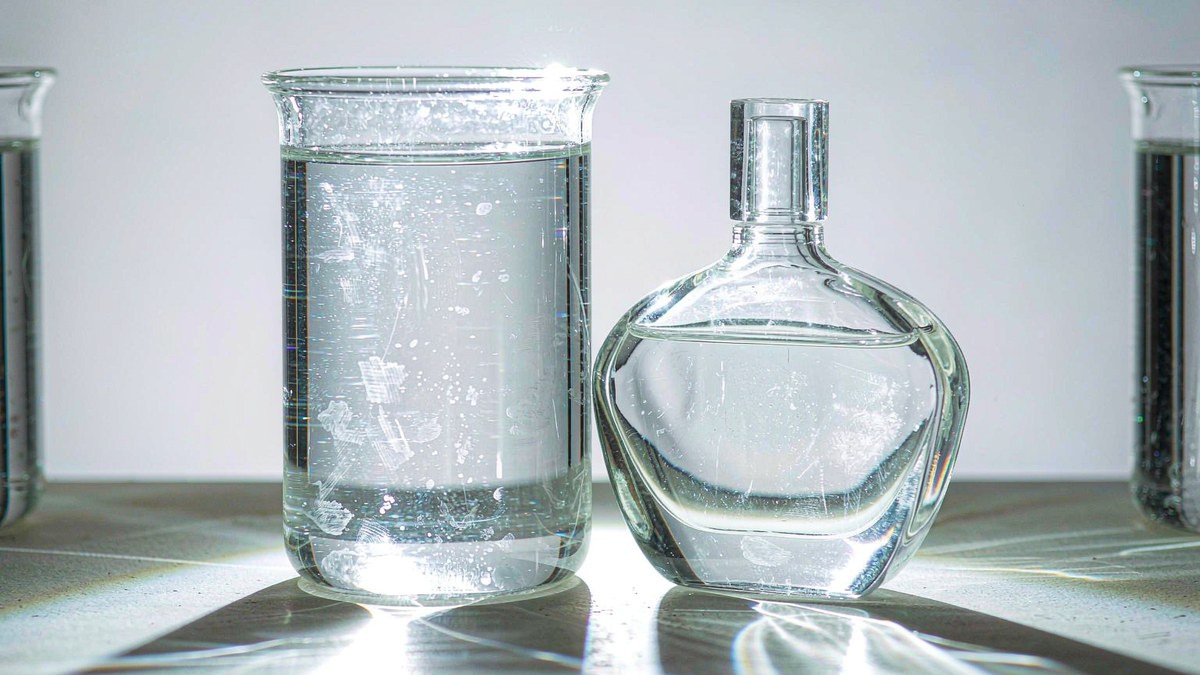
A clear perfume that turns cloudy after a week is one of the most common and least discussed failures in private-label fragrance. The formula was clear when it left the factory. Then it met a cold warehouse, or a slight water content in the alcohol, or a fragrance oil that was borderline soluble at that dosage, and the haze appeared.
This article explains why haze happens, how solubilisers work, and how to specify clarity so that it survives transport, storage and the shelf.
Table of Contents
- Why haze happens
- What solubilisers actually do
- The solubiliser options
- Testing clarity properly
- Alcohol grade and water content
- The trade-offs
- Practical guide: specifying a clear product
- Frequently asked questions
- Conclusion
Why haze happens
Haze is undissolved material — usually fragrance oil, wax or a botanical extract — suspended in the alcohol-water system at a particle size that scatters light. Three conditions create it: concentration above the solubility limit, temperature below the cloud point, and water content above what the system tolerates.
The third is the one buyers underestimate. Ethanol absorbs water from the air, from a cleaning process or from a supplier's specification, and a small increase in water content can push a borderline formula out of solution.
What solubilisers actually do
A solubiliser is a surfactant or coupling agent that forms micelles around the insoluble material, keeping it dispersed rather than dissolved. That distinction matters commercially: a solubilised product is thermodynamically stable only within limits, and if temperature or concentration moves outside those limits, the haze returns.
The solubiliser options
| Option | Effect | Trade-off |
|---|---|---|
| Ethoxylated castor oil derivatives | Standard solubiliser for fragrance in alcohol | Can add slight odour and affect clarity at high dose |
| Polysorbates | Effective in water-rich systems | Can foam; taste and odour issues in some uses |
| Dipropylene glycol | Couples fragrance into alcohol | Reduces alcohol concentration; viscosity change |
| Increased alcohol strength | Improves solubility directly | Duty, flammability and cost implications |
| Formula simplification | Removes the insoluble component | Changes the scent |
Testing clarity properly
Clarity must be tested at the worst case, not the best. That means the lowest temperature the product will meet in transit, held for long enough for crystallisation to occur, then returned to room temperature and re-examined. A 24-hour room-temperature check proves almost nothing.
Test protocol that works: chill to 0-4°C for 48 hours, inspect against a black and white background under a light source, return to 20°C for 24 hours, inspect again. Then repeat with a deliberately water-spiked sample to establish the tolerance margin.
Alcohol grade and water content
Perfumery ethanol is usually specified with a water content limit, and the specification matters as much as the grade. Denatured alcohol introduces its own variables: the denaturant can add odour and can affect solubility. For markets where duty treatment differs by denaturation, the choice is commercial as well as technical.
The trade-offs
- More solubiliser improves clarity and can mute the fragrance
- Higher alcohol strength improves solubility and raises cost and hazard
- Lower fragrance load improves clarity and reduces performance
- Simpler formulas are clearer and less distinctive
The right combination depends on where the product will be sold. A perfume destined for a hot market needs a different margin than one sold in a temperate one.
Practical guide: specifying a clear product
Step 1 — Write clarity into the specification
With a test method and a temperature profile, not as an adjective.
Step 2 — Fix the alcohol grade and water limit
Grade, denaturation and maximum water content, in writing.
Step 3 — Test at the cold extreme
0-4°C for 48 hours, then return to room temperature and re-inspect.
Step 4 — Establish the tolerance margin
Water-spiked samples show how much headroom the formula has.
Step 5 — Check the pack
Clear glass reveals haze; a coloured or frosted bottle hides it. If clarity matters, specify clear glass for the test.
Step 6 — Re-test after any change
Fragrance version, alcohol supplier or dosage change all affect solubility.
Frequently asked questions
Why is my perfume cloudy?
Most often undissolved fragrance oil, water content above tolerance, or storage below the cloud point. Test at cold temperature to identify which.
Can I filter out haze?
Filtration removes existing particles but not the cause. If the system is supersaturated, haze returns.
Do solubilisers change the smell?
They can mute or slightly alter the fragrance, and some carry their own odour. Always evaluate the finished product, not the concentrate.
Does a frosted bottle solve the problem?
It hides it. If the product is sold in clear glass in another SKU, the haze will be visible there.
Is haze a safety issue?
Not usually, but it is a quality and perception issue, and it can indicate a formula outside its intended composition.
Can water content vary between batches?
Yes, with alcohol supplier and with handling. That is why the specification needs a maximum water content and each batch needs a check.
Do oil-based perfumes have this problem?
Less, because there is no alcohol-water system, but oils can still cloud at low temperature or when a wax-based material crystallises.
How do I test for a hot market?
Run the same clarity protocol plus an elevated-temperature stability check; heat can cause separation or colour shift rather than haze.
Conclusion
Clarity is a solubility question with a temperature and a water content attached. It is decided by the formula, the alcohol and the storage conditions, and it is verified at the cold extreme rather than at room temperature.
Write the test into the specification, fix the alcohol grade, establish the tolerance margin and re-test after every change. A clear product is a designed outcome, not a lucky batch.
We invite you to explore our capabilities and discuss your next product line.
You can reach us directly via WhatsApp +86 17324762943
Email: adon@customperfumeoem.com
Website: customperfumeoem.com


