
Reading a Fragrance Formula: Top, Middle and Base at 20% Concentration
Thirty to eighty materials with percentages that look arbitrary are actually a structure about time. This article explains how to read a formula for a private-label brief, what concentration really changes, and which numbers reveal whether a submission will perform.
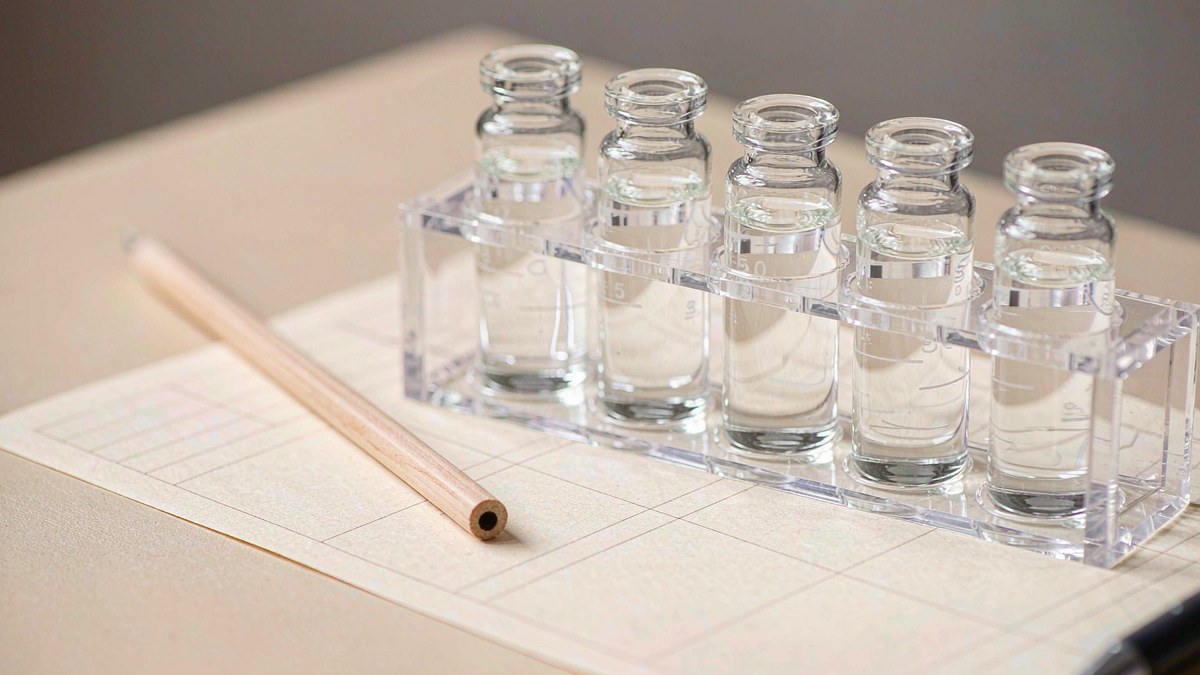
A fragrance formula looks like a spreadsheet of thirty to eighty materials with percentages that seem arbitrary. They are not. They are an argument about time: what is perceived in the first minute, what carries the middle, and what remains on skin or in wax hours later.
This article explains how to read a formula for a private-label brief — how the top, middle and base structure shows up numerically, what the concentration actually means, and which numbers reveal whether a submission will perform as promised.
Table of Contents
- The three-part structure, numerically
- What concentration really changes
- Reading the material list
- Balance: the three ratios that matter
- Volatility and the dry-down
- Red flags in a submission
- Practical guide: evaluating a formula
- Frequently asked questions
- Conclusion
The three-part structure, numerically
There is no fixed rule, but a workable convention for a 20% eau de parfum is roughly 20-30% top-note materials, 30-40% middle, and 35-50% base, with the balance in solvents and specialty materials. A formula with 45% citrus is a cologne in disguise; one with 10% base will smell thin within an hour.
| Layer | Typical materials | Perception window | Formula share |
|---|---|---|---|
| Top | Citrus oils, aldehydes, green notes, light aromatics | 0-30 minutes | 20-30% |
| Middle | Florals, spices, fruity esters, ionones | 30 minutes to 3 hours | 30-40% |
| Base | Musks, woody ambers, resins, vanillin, patchouli | 3 hours to 24+ hours | 35-50% |
What concentration really changes
Concentration changes more than intensity. At 8%, a formula reads as fresh and linear; at 20%, the same materials behave differently because the base components dominate the evaporation curve and can mask the top. This is why raising a dosage to make a product stronger often makes it smell heavier and less defined rather than better.
The practical consequence for a private-label brief: specify the dosage before evaluating a submission. A sample judged at 15% tells you little about the same compound at 8% in a candle.
Reading the material list
Three things are visible in the material list even without knowing every ingredient. The proportion of naturals versus synthetics tells you about cost and consistency. The presence of strong aromatics at low percentages tells you where the character comes from. And the number of materials tells you about complexity: thirty materials can be excellent; eighty usually means someone was compensating.
Balance: the three ratios that matter
- Sweet to dry. Vanillin and ethyl maltol against woods and mosses. Too sweet reads as cheap in home fragrance.
- Diffusion to substantivity. Light molecules project; heavy molecules persist. A formula can be strong and short, or soft and long, but rarely both without cost.
- Natural to synthetic. Naturals bring complexity and variability; synthetics bring consistency and specific effects.
Volatility and the dry-down
Every material has an evaporation curve, and the formula's performance is the sum of those curves. This is why a submission that smells excellent on a blotter for ten seconds can be dull after an hour: the blotter rewards top notes. Evaluate on skin or in the intended base, and evaluate at three time points — ten minutes, two hours, six hours.
Red flags in a submission
- No stated dosage, so the formula cannot be assessed commercially
- Heavy reliance on one high-impact material, which usually means the accord will collapse when that material is restricted
- No fixative structure, presenting as a strong opening and a weak tail
- Allergen content high enough to force a long declaration for no perceptual benefit
- Cost per kilogram absent from the sheet
Practical guide: evaluating a formula
Step 1 — Ask for the structural breakdown
Top, middle and base shares, plus dosage. Without these the numbers are not interpretable.
Step 2 — Check the concentration against the format
8% in a candle and 20% in an extrait are different products, not different strengths of the same one.
Step 3 — Evaluate at three time points
Ten minutes, two hours, six hours, in the intended base.
Step 4 — Look at the fixative spine
Musks, woods and resins that hold the structure together. Their absence is felt, not seen.
Step 5 — Check the allergen load
Declarable substances at finished-product concentration, against the market's labelling rules.
Step 6 — Compare cost to the ceiling
A formula that exceeds the brief's ceiling is a failed submission regardless of quality.
Frequently asked questions
How many materials should a fragrance have?
No fixed number. Twenty to fifty is typical for a commercial accord; the count matters less than whether each material has a function.
Does a higher percentage always mean better performance?
No. Beyond an optimum, the base can mask the top and the product reads heavier rather than stronger. Performance depends on the balance, not the number.
Why does my fragrance smell different in a candle than on skin?
Because the base and temperature differ. Wax volatilises materials differently, and combustion adds heat. A skin-optimised formula is not automatically a candle formula.
What is a fixative?
A material that slows evaporation and holds the structure together — musks, resins, woody ambers. Without them, a formula opens strongly and fades quickly.
Can I judge a fragrance from a blotter?
Only for direction. Blotters reward top notes and suppress the base, so performance on skin or in wax must be tested separately.
Why do formulas change between sample rounds?
Usually because the brief moved. Each material change also changes the allergen calculation, which is why late changes are expensive.
What does a very short material list indicate?
Sometimes efficiency, sometimes a simple accord that will read as flat. The evaluation is in the dry-down, not in the count.
How do I compare two submissions objectively?
Same dosage, same base, same time points, and a cost per kilogram beside each. Then ask which one you would still wear at hour six.
Conclusion
A formula is a time-based argument expressed in percentages. The structure tells you what happens when, the concentration tells you how strongly, and the fixative spine tells you whether it holds.
Ask for the breakdown, check the dosage against the format, evaluate at three time points and put the cost beside the result. That is how a submission becomes a decision.
We invite you to explore our capabilities and discuss your next product line.
You can reach us directly via WhatsApp +86 17324762943
Email: adon@customperfumeoem.com
Website: customperfumeoem.com


