
QC Gates in Fragrance Production: AQL, In-Line Checks and Pre-Shipment
Quality control is not a final inspection. By the time a pallet is ready, the fill volumes are set and the labels are on. This article sets out the five gates from incoming materials to pre-shipment and explains how to use AQL sampling without treating it as a guarantee.
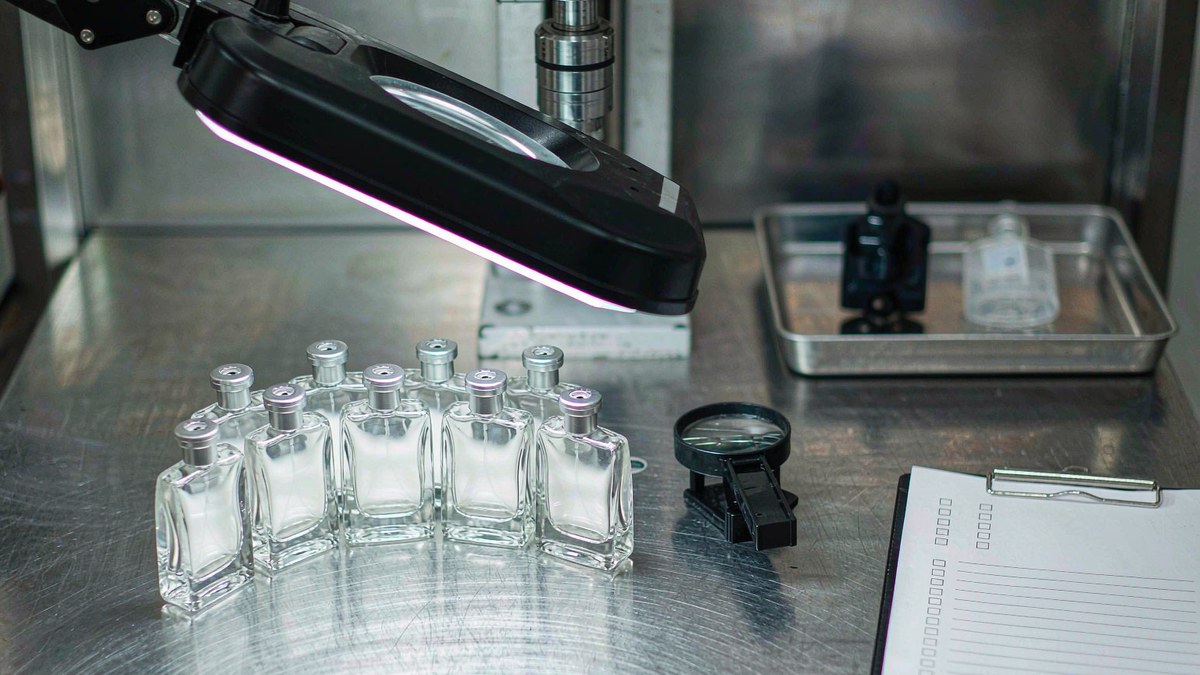
Quality control in fragrance production is usually described as a final inspection. It is not. By the time a pallet is ready for inspection, the fill volumes are set, the labels are on and the only decisions left are pass, rework or reject. Useful QC happens at gates along the line, where a problem can still be corrected cheaply.
This article sets out the gates that matter for perfume, candles, diffusers and car fragrance, what each one checks, and how to use AQL sampling without pretending it is a guarantee.
Table of Contents
- The five gates
- Incoming materials
- In-process
- Post-fill and closure
- Final inspection and AQL
- Pre-shipment
- Practical guide: setting QC gates
- Frequently asked questions
- Conclusion
The five gates
| Gate | Checks | Cost of catching it here |
|---|---|---|
| Incoming materials | Bottle weight, colour, closure fit, fragrance lot | Low |
| In-process | Fill volume, temperature, mixing uniformity | Low |
| Post-fill and closure | Torque, leak, label placement | Medium |
| Final inspection | Appearance, function, packing | Medium-high |
| Pre-shipment | Quantity, carton marks, documents | High if missed |
Incoming materials
Most defects enter the plant before production starts. A bottle with a 15 mm neck finish received against a 15 mm specification that is actually 15.2 mm will leak at the capping station, and no amount of line adjustment fixes it. Incoming checks should cover dimensional fit for closures, glass weight against specification, colour against a retained standard, and fragrance lot against the approved reference.
In-process
Fill volume is the check that matters most, because it is legally declared on the label. Weigh or measure at intervals across the run rather than at the start, since nozzles foul and volumes drift. For candles, pour temperature and cooling conditions belong here, because they determine surface finish and adhesion.
Post-fill and closure
Torque testing and a leak check at temperature are the two checks that prevent most transport failures. Label placement should be checked on the actual decorated surface, not on clear glass, because coating changes adhesion and visual alignment.
Final inspection and AQL
AQL sampling is a statistical statement about a lot, not a guarantee about every unit. It is useful because it is objective and repeatable, and it is misleading when treated as proof that no defects exist. Choose the inspection level by the consequence of a defect: a premium gift set warrants a tighter level than a promotional giveaway.
Pre-shipment
The last gate is administrative as much as physical: carton counts, marks, label version, batch codes matching the COA, and documents matching the goods. Most documentary holds could have been caught in fifteen minutes at this gate.
Practical guide: setting QC gates
Step 1 — Write the checks into the specification
Gate, parameter, method, acceptance range. Otherwise QC is discretionary.
Step 2 — Define who performs each gate
Factory, third party or buyer. An unassigned gate does not happen.
Step 3 — Fix the AQL level by product class
Tighter for premium, looser for promotional, and stated in the contract.
Step 4 — Require records, not assurances
Fill data, torque readings and leak results, dated and signed.
Step 5 — Reconcile documents before dispatch
Batch code, COA, label version, carton count.
Step 6 — Review defects by gate
A defect that keeps appearing at final inspection is a failure at an earlier gate.
Frequently asked questions
What AQL level should I specify?
Commonly 1.0 to 2.5 for major defects depending on product class, with a stricter level for critical defects such as leakage. The number matters less than applying it consistently.
Does AQL inspection guarantee quality?
No. It estimates the defect rate in a lot with a defined confidence. It is a decision tool, not a warranty.
Who should perform final inspection?
Ideally a third party for a first order, and the factory's own QC with periodic third-party checks thereafter.
What is the most commonly missed gate?
Incoming material checks, particularly dimensional fit between bottle and closure.
How do I check fill volume correctly?
By weight converted through density, or by volume with a calibrated measure, sampled across the run rather than at the start.
Should leak testing be destructive?
It can be, on a sample. A non-destructive pressure or vacuum check plus a destructive sample at temperature is a common compromise.
What records should I ask for?
Fill data, torque readings, leak results, label version check, and the batch record. Dated and signed.
How do I handle a failed lot?
The production samples and gate records show whether it is systemic. Rework, reject or concession should follow the contract, not the conversation.
Conclusion
QC is a sequence of gates, not an inspection at the end. The earlier a defect is caught, the cheaper it is, and the only way to catch it early is to specify the check, assign the owner and require the record.
Fix the five gates, the AQL level and the reconciliation step, and a defective lot becomes a correction rather than a recall.
We invite you to explore our capabilities and discuss your next product line.
You can reach us directly via WhatsApp +86 17324762943
Email: adon@customperfumeoem.com
Website: customperfumeoem.com


