
Hotel Amenity Fragrance — OEM & Private Label Scent Programs
How hotel groups specify one signature scent across rooms, corridors, amenities and the retail shelf — the format that fits each surface, the MOQ arithmetic for a 120-room property, the compliance folder procurement will ask for, and a sampling protocol that predicts guest reaction.

A hotel does not buy a fragrance the way a retailer does. It buys a replenishment cycle, a compliance folder and a promise that the third reorder will smell like the first. That single difference reshapes the brief, the packaging, the minimum order quantity and the documents that have to travel with the pallet. This guide sets out how a property or a group should specify an amenity scent programme in 2026, using the formats, MOQs and lead times we actually run at our Guangzhou facility — so you can plan a launch against real numbers rather than a brochure.
We build these programmes as a private label perfume manufacturer for hotel brands, and we have shipped hotel amenity sets and space scenting projects for lobbies, showrooms and suites. What follows is the working version of that experience: where the money goes, which formats make sense on a per-property basis, and how to run a scent trial that predicts guest reaction instead of flattering a blotter.
At a glance
- Formats that suit hotels: 30 ml room mist, 100 ml reed diffuser, diffuser oil in 10/30/100 ml or bulk jerrycan, 180/220 g candle, A6/A7 scent card, 8 ml car clip.
- Per-category MOQ: perfume 1,000 pcs · candle 500 pcs · fragrance oil 300 pcs · reed diffuser 500 pcs · car fragrance 2,000 pcs · scent card 5,000 pcs.
- Sampling: 30 ml development samples at USD 30–60 each, refundable against the first production order; 7–10 working days per round, up to three modifications per round.
- Production: 20–25 working days after artwork approval on stock components, plus 15–30 days if secondary packaging is custom.
- Documents per shipment: IFRA certificate, EU allergen declaration, MSDS, COA per batch, ISO 22716 and GMPC certificates, plus free-sale and origin certificates.
Why a hotel programme is not a retail launch
In retail, the customer chooses. In a corridor, the guest cannot leave. That asymmetry should drive every technical decision in the project, and it usually drives none of them, because the brief is written by marketing rather than by the person who has to live with the result for ninety days.
Three consequences follow. First, there is an intensity ceiling: the target is detectable at one metre and polite at three, which almost always means a lower fragrance load than the same scent would carry in a bottle. Second, cost per millilitre matters less than cost per room-night, so a slightly more expensive concentrate that survives a full quarter without turning is the cheaper choice. Third, documentation is not an afterthought: a hotel group's procurement team, its insurer and its brand-standard auditor will each ask for a different piece of paper, and all three ask before the first delivery, not after.
It also changes what "the product" is. A property rarely needs one hero item. It needs a small family of formats that carry the same accord across four different exposure contexts — arrival, corridor, room, and the shop by the front desk.
The four scent surfaces inside a property
Before choosing a bottle, map where the scent will live. Most hotel programmes collapse because the same concentration is asked to do four incompatible jobs.
| Surface | Typical format | Who is exposed | Refresh rhythm | Spec note |
|---|---|---|---|---|
| Arrival & public areas | 200 ml reed diffuser or HVAC dosing | Every guest, every day | 8–12 weeks | Lowest intensity ceiling; needs the widest safety margin |
| Corridor & lift lobby | 150 ml diffuser, oil top-up | Transient, repeated | 12 weeks | Must not compete with the arrival scent |
| Guest room | 30 ml room mist, 100 ml diffuser, A6 scent card | One guest, alone, for hours | Monthly or per stay | Highest risk of complaint; keep it quiet and dry |
| Retail & gifting | 50/100 ml EDP, 180 g candle, gift set, car clip | The guest who wants to take it home | Seasonal | Here you can use full retail concentration |
The mistake we see most often is a retail-strength eau de parfum sprayed in a corridor because the marketing team loved the bottle version. At 15–20% concentration, a corridor becomes a statement, and statements generate complaints at the front desk three days later.
Six formats, six different minimums
MOQ in this industry is set by line setup, not by the juice. A candle line needs a wax melter and a curing window; a scent-card line needs a die and a drying tunnel. That is why a property that can comfortably order 500 diffusers cannot order 500 scent cards, and why the category choice is a supply-chain decision before it is a creative one.
| Category | Format we run | MOQ | Monthly capacity | Best hotel role |
|---|---|---|---|---|
| Eau de Parfum | 30 / 50 / 100 ml glass, custom cap | 1,000 pcs | 300,000 pcs | Amenity mist and retail bottle |
| Scented Candle | 180 / 220 g, soy-coconut wax, 45-hour burn | 500 pcs | 200,000 pcs | Lobby signature, gift-with-stay |
| Fragrance Oil | 10 / 30 / 100 ml dropper or bulk jerrycan, up to 30% load | 300 pcs | 500,000 pcs | Diffuser refill and HVAC dosing |
| Reed Diffuser | 100 / 150 / 200 ml, alcohol-free base, 90-day diffusion | 500 pcs | 150,000 pcs | Room and corridor |
| Car Fragrance | 8 ml vent clip, 5 g solid, blister card | 2,000 pcs | 800,000 pcs | Valet fleet, courtesy cars, retail |
| Scent Card | A6 / A7 die-cut, 60-day scent retention | 5,000 pcs | 2,000,000 pcs | Wardrobe, drawer, turndown |
Two of these numbers deserve a second look. The reed diffuser uses an alcohol-free base specifically so that a 100 ml vessel delivers a steady ninety days without the top notes collapsing in week three. The fragrance oil is formulated up to a 30% fragrance load, which matters because the cheapest way to scent a large lobby is not a bigger diffuser — it is a stronger oil dosed more sparingly, topped up from a jerrycan by the engineering team. Working as a fragrance oil manufacturer for hotel brands, we formulate the same accord at two strengths for this reason: a retail-grade oil that behaves predictably in a sealed 100 ml vessel, and a bulk concentrate the engineering store can decant without a measured dose going wrong.
The intensity ceiling is a specification, not a taste
Ask a perfumer for "a fresh scent" and you will get something lovely that fails in a corridor. Ask for a fragrance that reads clean at one metre, holds for ninety days in a moving airstream, and contains no material that a guest might identify as a cleaning product, and you get a specification that can be tested.
In practice, hotel air scents belong to families that age well in the air: citrus and aromatic openings, green and tea accords, dry woods, soft musk. Sweet gourmands and heavy white florals concentrate in enclosed corridors and are the first to draw complaints, not because they are bad fragrances but because they are being asked to perform in the wrong room. When a brand insists on a sweet signature — and many boutique groups do — the answer is usually to move it into the candle and the retail bottle, and keep the diffuser in a dry woody register so the two read as the same world without competing.
Stability, climate and the ninety-day refill
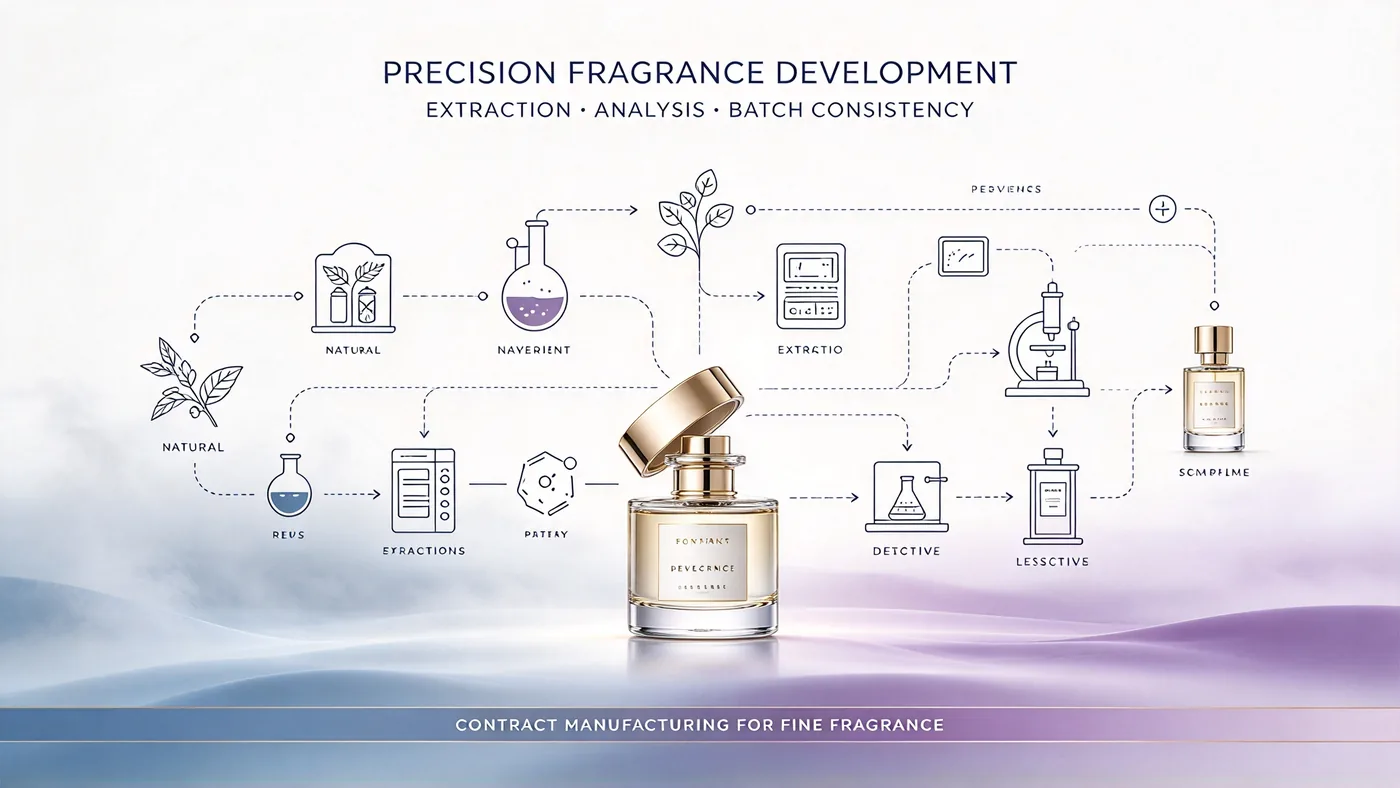
A reed diffuser is an open system. For ninety days the oil sits in a warm room, wicks up rattan, and meets a constant supply of oxygen. Oxidation does not announce itself; it simply removes the top notes first, so month three smells flatter than month one and nobody can say exactly why. The same is true of a room mist left on a housekeeping cart in a hot service corridor.
This is a stability problem before it is a creative one, and it has three practical answers. Choose an alcohol-free diffuser base so the carrier does not accelerate the change. Specify UV-stable colourants, or no colourant at all, because a pale amber oil that darkens in sunlight will be rejected by a brand auditor even though it still smells correct. And run the formulation through an accelerated protocol — elevated temperature, light exposure, and a re-evaluation of the top, heart and base after the cycle — rather than approving it on the day it was blended.
Our own workflow keeps micro, stability and allergen testing at every stage, and retains a sample from each batch on file. That retained sample is the only honest answer to the question "has it changed?" six months later, and it is the reason we can defend a formula across a multi-property rollout where the third delivery lands in a different season from the first.
Writing a brief a perfumer can actually work from
A brief that says "luxury, spa-like, memorable" produces three rounds and a compromise. A brief that can be built in one round contains seven things: three to five reference fragrances with a note on what specifically you like in each; the guest segment and the property's price position; the destination climate and whether rooms are air-conditioned year-round; the format and the concentration you are willing to pay for; the price ceiling per unit at your volume; the materials you must exclude for religious, vegan or brand reasons; and the one word you want a guest to use in a review.
Be equally clear about what you cannot have. We will not reproduce a trademarked commercial fragrance exactly — we can build a close interpretation and will tell you honestly when a reference is not achievable at your target cost. Groups that shortcut this end up with a legal letter and a relaunch. With 1,800 ready accords in house, there is almost always a defensible direction within two steps of the reference, and starting from an existing accord is what keeps a first programme to a realistic budget.
How to sample a room instead of a blotter
Paper strips answer the wrong question. They tell you whether a material is interesting; they do not tell you whether it survives a carpeted corridor at 24 °C with the air handling running. Budget a real perfume sample order rather than a single strip: 30 ml development samples run USD 30–60 each and are refundable against your first production order, so testing four directions costs less than one rejected production run.
The protocol that has worked for hotel clients:
- Test three to five directions, never one. A single sample invites a yes or no; a set invites a ranking, which is the information you actually need.
- Put the diffuser or mist in the real room, unlabelled, for seven days. Label the vessels with a code, not a name.
- Evaluate at three moments: on entry from outside, after twenty minutes in the room, and on waking. The third is where complaints are born.
- Collect six opinions — three staff who work in the space, three guests who do not. Staff notice intensity; guests notice character.
- Never evaluate in the perfume lab. After an hour in a formulation room your nose is saturated and everything reads as "fine".
Each sampling round takes 7–10 working days and includes up to three modifications of the same direction — sweeter, drier, more citrus, more woody. A change of fragrance family is a new round, not a modification, and it is worth knowing that before you ask for a jasmine version of a fig accord.
The document stack hotels actually ask for
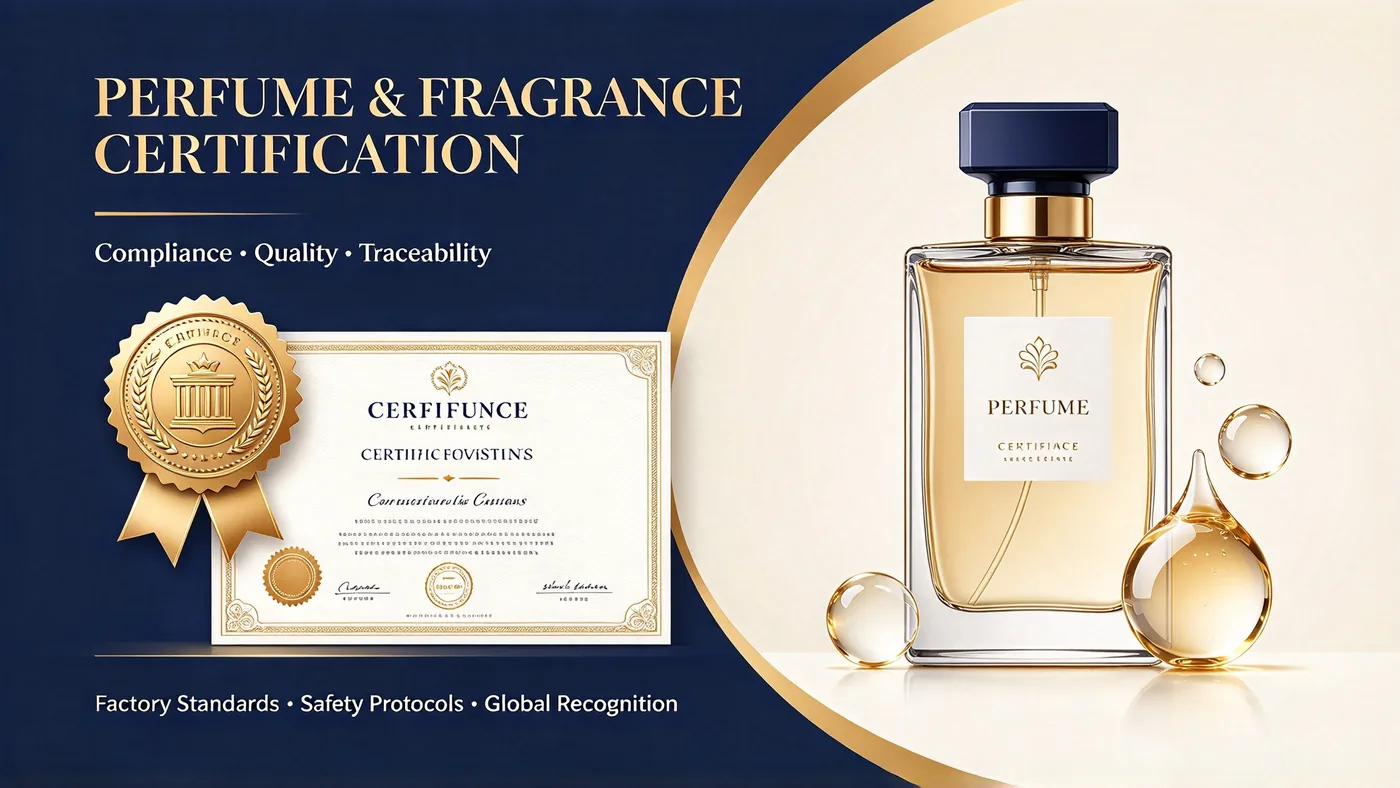
A hotel group's procurement process is closer to a cosmetics brand's than to a wholesaler's. Expect the following to be requested in the first exchange, not at shipment.
- IFRA certificate per formula, plus an EU allergen declaration listing the declarable allergens at their concentration in the finished product.
- MSDS for every SKU — essential for alcohol-based perfume, which is regulated as dangerous goods for air freight.
- COA per batch. We issue one for 100% of batches; a programme that cannot produce a certificate for delivery three is a programme with no traceability.
- ISO 22716 (GMP) and GMPC, the latter audited by Intertek — the two documents most often named in a brand-standard manual.
- HALAL certification where the property portfolio includes Gulf or Southeast Asian markets, and a clear statement on alcohol and animal-derived materials.
- Cruelty-free confirmation, and for retail lines sold in the EU a CPSR coordinated through approved assessors, plus CPNP notification; ASEAN notification for those markets.
- Free-sale and certificate of origin for customs, and FDA facility registration support if the amenity range is sold into the United States.
Two of these cause more delay than the rest: the allergen declaration, because it depends on the final formula rather than the concentrate, and the CPSR, because it needs a third party. Build ten to fifteen working days into the plan for both, and do not schedule a photoshoot against an unapproved formula.
Where the money actually goes
Hotel buyers are usually quoted a single unit price and left to guess why it moved. These are the ranges we see across amenity briefs; treat them as a map, not a quotation, because every programme is priced line by line.
| Cost driver | Typical share of unit cost | The lever that moves it |
|---|---|---|
| Fragrance concentrate | 15–30% | Concentration and the share of naturals; a 30% oil load costs more per litre but doses further |
| Primary pack (glass, tin, card) | 20–35% | Stock mould versus custom; a custom mould moves the run to 10,000 pcs |
| Closure and decoration | 8–15% | Sprayed or frosted colour versus print or hot stamp |
| Secondary packaging | 8–20% | Kraft carton versus rigid box; unprinted amenity cartons are the cheapest legitimate option |
| Filling, labour, QC | 8–12% | Batch size and how many SKUs share the run |
| Freight and documents | 5–15% | Sea versus air, and whether the goods are classed as dangerous |
The counter-intuitive line is the concentrate. Cutting the load from 30% to 18% in a diffuser oil saves money on paper and costs more in practice, because the vessel has to be refilled sooner and the guest notices the drop before the finance team notices the saving.
Packaging: three packs, one programme
A mature programme needs three different packs, and buying them from one perfume packaging manufacturer for hotel brands is what stops the corridor scent, the room mist and the shop display from looking like three different companies.
The first is bulk: fragrance oil in 10/30/100 ml dropper or jerrycan, shipped to the engineering store and decanted by housekeeping. This is the cheapest millilitre in the whole programme and the one most often forgotten in the brief. The second is guest-facing: a 30 ml mist or a 100 ml diffuser, where the bottle carries the brand promise and the label has to survive a bathroom. The third is retail: 50/100 ml EDP, a 180/220 g candle, or a boxed set, where the packaging is doing the selling and can justify rigid board and a heavier closure.
On stock components, a bottle can be sprayed, frosted, printed or hot-stamped, and a cap can be colour-matched, engraved or replaced with a custom mould — the mould being the one decision that moves the minimum to 10,000 pieces. If the group requires a bespoke silhouette, plan the mould as a separate project with its own lead time rather than folding it into a seasonal launch.
The MOQ arithmetic of a 120-room property
This is the part of the conversation that decides whether a programme is viable. Take a 120-room boutique property, four scent refreshes a year, one 30 ml mist per room per month, and eight public-area diffusers.
| Item | Units per year | Category MOQ | One order covers | Verdict |
|---|---|---|---|---|
| 30 ml room mist, 1 per room per month | 1,440 | 1,000 | About 8 months | Comfortable |
| 100 ml reed diffuser, 4 cycles per room | 480 | 500 | About 1 year | Comfortable |
| Diffuser oil for 8 public positions | 32 vessels | 300 | Nine years | Buy bulk jerrycan instead |
| 220 g ambient candle, 2 positions | ≈66 | 500 | About 7 years | Move to retail or group order |
| A6 scent card, 2 per room, 4 refreshes | 960 | 5,000 | About 5 years | Group order or gift-with-stay |
| 8 ml car clip for a 10-car valet fleet | 20 | 2,000 | — | Retail SKU only |
Read correctly, the table is not a list of problems. It says that a single property should build its programme around two formats — the room mist and the reed diffuser — and treat everything else as either a group-level purchase or a retail line. A twenty-property group consolidates 960 scent cards into 19,200, and suddenly the 5,000 minimum is a single pallet instead of a five-year inventory. That consolidation, not a discount negotiation, is where the real saving sits.
From brief to pallet: the actual clock
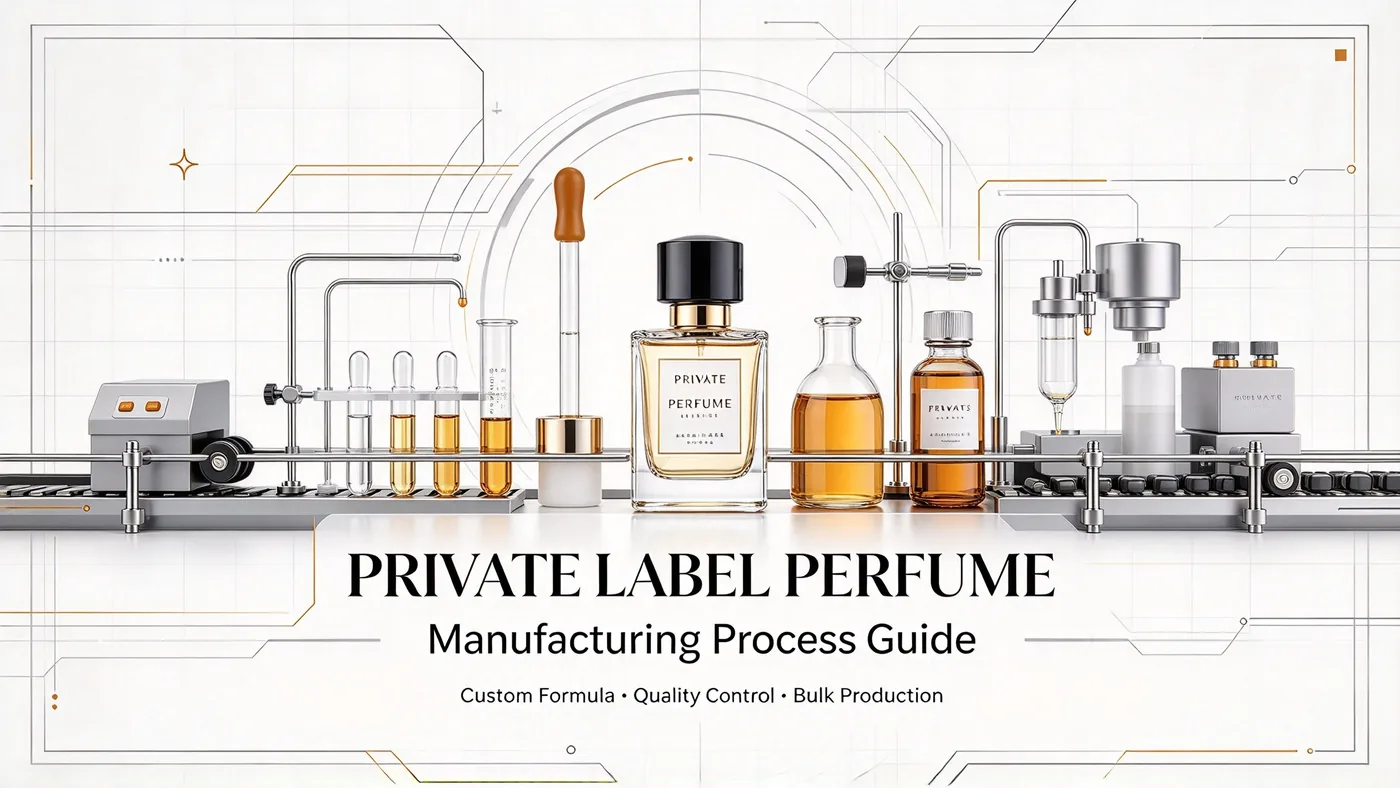
Requirements take 3–5 days and a quotation 2–3. Sampling runs 7–10 working days, testing 5–10, and bulk production 20–25 working days after artwork approval on stock components — plus 15–30 days if the secondary packaging is custom. Our ready-formula and stock-packaging route lands a first launch in 8–10 weeks; an exclusive formula with bespoke bottle, cap and box runs 14–18 weeks. Repeat orders on existing components come back to 8–10 weeks.
Payment is normally 50% deposit and 50% before shipment for a new account, with repeat customers able to move to 30% deposit and the balance against a copy of the bill of lading. We quote EXW, FOB Shenzhen or Guangzhou, CIF, and DDP for selected markets. Twelve working days is not a promise anyone should make about a hotel group's internal sign-off, so the practical advice is to lock the formula first and let the property's procurement calendar run in parallel.
Batch consistency: the thing nobody tests until it fails
The risk in a hotel programme is not the first delivery. It is the difference between the second and the third, six months apart, when a guest who stays monthly notices that the lobby "smells different". Six filling lines and a retained sample per batch are the mechanical part of the answer; the process part is a written reference standard held by both sides, with the approved sample sealed and dated. As a contract fragrance manufacturer for hotel brands, we would rather over-specify that standard at the sampling stage than repair the perception a year later, because a scent that drifts is far harder to defend in a brand audit than a scent that was simply never approved.
Ask for the batch record with each reorder, and compare the COA against the original. If you are running several properties from one formula, keep the reference standard with the group's brand team rather than at a single property — otherwise a refurbishment quietly becomes a formula change.
Beyond the property: retail, resale and distribution
A well-built hotel scent has a second life. Guests ask for the candle at reception, the group opens a small e-commerce line, and the amenity becomes a gift-with-stay. That is where an ODM perfume manufacturer for distributors becomes relevant: the same accord has to be documented, priced and packed for a wholesale channel that sells into gift shops, spas and travel retail, often in several countries at once.
Two things make that transition work. The formula must be exclusive and covered by an NDA, so the scent remains a brand asset rather than a catalogue item. And the retail pack must be specified from the start — a 50 ml EDP or a boxed candle is a different brief from a 30 ml amenity mist, and retrofitting a retail line onto an amenity formula usually means re-doing the stability work for a new container.
Questions we get at the brief stage
What information is needed to start an OEM perfume project?
Seven inputs close a brief: the scent direction with three to five references; the formats and sizes you want, even if provisional; the target unit cost at your expected volume; the destination markets, because they decide the document set; the materials you must exclude; the artwork status, since packaging lead time starts at approval; and your launch window. Send those seven and a quotation is a two-to-three-day exercise. Send "something luxurious for a five-star" and the project starts with a discovery call instead.
Can I customize the bottle, cap, label, and packaging?
Yes, at three levels. On stock components you can spray, frost, print or hot-stamp the bottle, and colour-match or engrave the cap, which keeps the order at the standard minimum. A custom cap or an unusual silhouette requires a mould and moves the run to roughly 10,000 pieces. For secondary packaging we handle structural design, artwork review, proofing and printing for rigid boxes, folding cartons and sleeves, with digital proofs approved before mass production — so what you sign off on screen is what leaves the floor.
Start with the two formats that fit your building
The programmes that succeed are the ones that begin with arithmetic rather than inspiration: count the rooms, count the refreshes, compare the result with the category minimum, and choose two formats to anchor the scent. Everything else — the candle at reception, the scent card in the wardrobe, the car clip in the valet fleet — follows as retail or as a group-level order.
We invite you to explore our capabilities and discuss your next product line. You can reach us directly via WhatsApp +86 17324762943 Email adon@customperfumeoem.com Website https://customperfumeoem.com/
Working on a launch?
Send us the brief — we will reply with a development plan and indicative pricing.