
From Kilograms to Bottles: Converting a Fragrance Oil MOQ
A 25 kg minimum sounds generous until the dosage is applied. This article walks through the mass-to-volume conversion, allowances for trials and retention samples, and how to size a first order that neither wastes oil nor runs short.
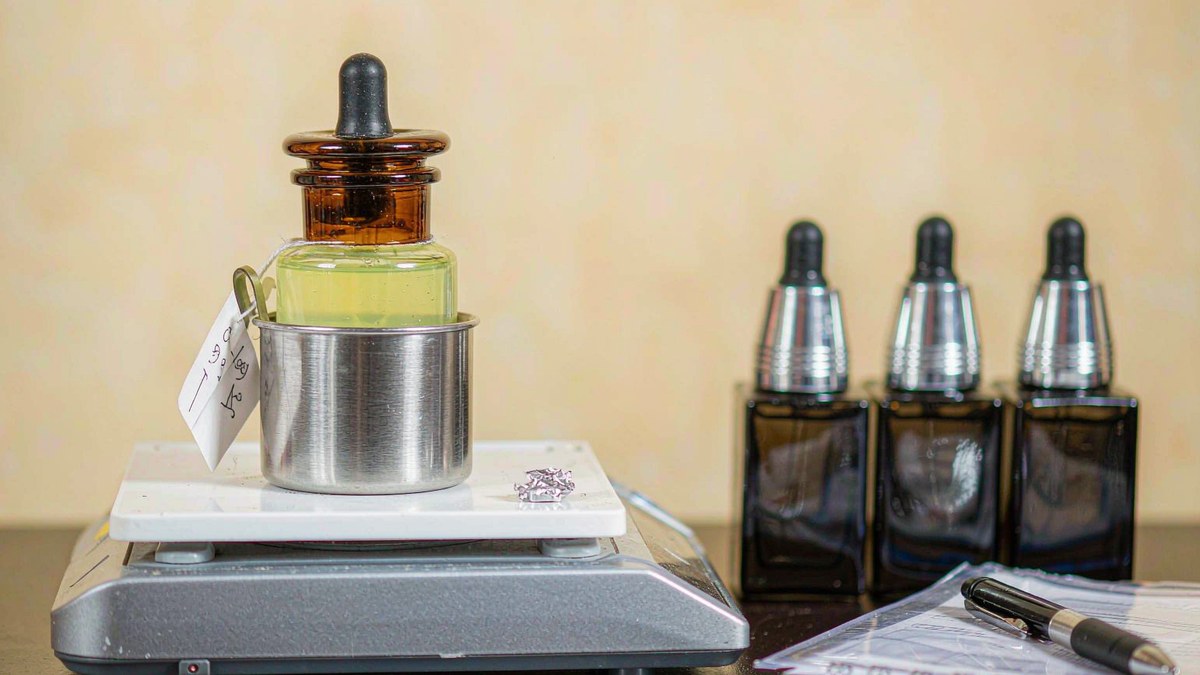
A fragrance oil quote says 25 kg minimum. A brand reads that as "25 bottles" or "25 litres" and plans accordingly, then discovers the oil makes either 12 bottles or 400 depending on the dosage. The conversion between kilograms and units is arithmetic, and it decides whether a first order is viable.
This article walks through the calculation, the allowances that are usually forgotten, and how to size an order that neither wastes oil nor runs short.
Table of Contents
- Mass versus volume
- The addition fraction
- The conversion, step by step
- Allowances people forget
- Sizing a first order
- When the oil minimum exceeds the run
- Practical guide: calculating units
- Frequently asked questions
- Conclusion
Mass versus volume
Oil is sold by mass; perfume is sold by volume. Converting requires the density of the finished product, not the density of the oil. A 50 ml fill weighs roughly 48–52 g depending on the alcohol and fragrance load, which changes the count by a few percent.
The addition fraction
| Product | Typical fragrance share | Oil needed per 1,000 units |
|---|---|---|
| Eau de toilette | 8–10% | ~4–5 kg |
| Eau de parfum | 15–20% | ~7.5–10 kg |
The share is by weight in the finished product. If the oil is a prepared blend containing carrier, its share is not the fragrance share — read the specification, not the label.
The conversion, step by step
Finished mass = fill volume × density. Oil per unit = finished mass × fragrance share. Units available = usable oil mass ÷ oil per unit. For a 50 ml EDP at 18% and a density of 0.9, finished mass is 45 g, oil per unit is 8.1 g, and 25 kg makes roughly 3,000 units before losses.
Allowances people forget
- Development and trial samples
- Retention samples per batch
- Transfer losses in compounding and filling
- Rejects during production
- Replacement units for complaints
Ten to fifteen percent is a sensible allowance for a first run; more if the product is new to the line.
Sizing a first order
Work backwards from sellable units rather than forwards from the oil. If a channel can absorb 600 units in three months, an oil quantity that yields 1,200 is a decision about inventory, not about minimums.
When the oil minimum exceeds the run
This happens when a compound minimum is 25 kg but the first run needs 8 kg. Options: choose a stock compound with a lower minimum, accept the excess and store it against a reorder, or buy a prepared oil at a lower minimum with a higher per-kilogram price. Each is a cash decision, not a technical one.
Practical guide: calculating units
Step 1 — Get the density of the finished product
From the formula, not from the oil.
Step 2 — Confirm the fragrance share by weight
And whether the oil includes a carrier.
Step 3 — Calculate oil per unit
Finished mass × share.
Step 4 — Subtract the allowances
Ten to fifteen percent for a first run.
Step 5 — Compare with the oil minimum
And with the channel's realistic sell-through.
Step 6 — Record the calculation
So the reorder can be sized from the same basis.
Frequently asked questions
How many bottles does 1 kg of oil make?
For a 50 ml EDP at 18%, roughly 120 before losses. The figure moves with volume, density and share.
Does a prepared oil change the calculation?
Yes. Its share includes carrier, so the fragrance fraction is lower than the label suggests.
Should I use litres or kilograms?
Use mass throughout, then convert to volume at the density of the finished product.
What allowance is realistic?
Ten to fifteen percent for a first run; five to eight for a repeat with known yields.
Can I pool several scents into one minimum?
Sometimes. Ask explicitly whether the minimum is per scent or per order.
Is it cheaper to buy extra oil?
Only if storage and shelf life allow. Oil that sits past its life is a loss, not a saving.
How do I handle a minimum larger than my run?
Stock compound, prepared oil, or a planned reorder. Compare cash, not just unit price.
What if the factory quotes in litres?
Convert using density and confirm which product the density refers to.
Conclusion
Kilograms and bottles are connected by three numbers: volume, density and fragrance share. Get them right and the minimum stops being a surprise.
Calculate from the finished product, subtract the allowances and size the order from sell-through. The oil quantity is a cash decision wearing a technical costume.
We invite you to explore our capabilities and discuss your next product line.
You can reach us directly via WhatsApp +86 17324762943
Email: adon@customperfumeoem.com
Website: customperfumeoem.com


