
Building an FOB Cost Model for a Private-Label Fragrance SKU
An FOB price is materials plus conversion plus margin, and most quotes collapse the three into one number. This article shows how to build the model line by line, where the money actually sits in a perfume SKU, and which levers move unit cost.
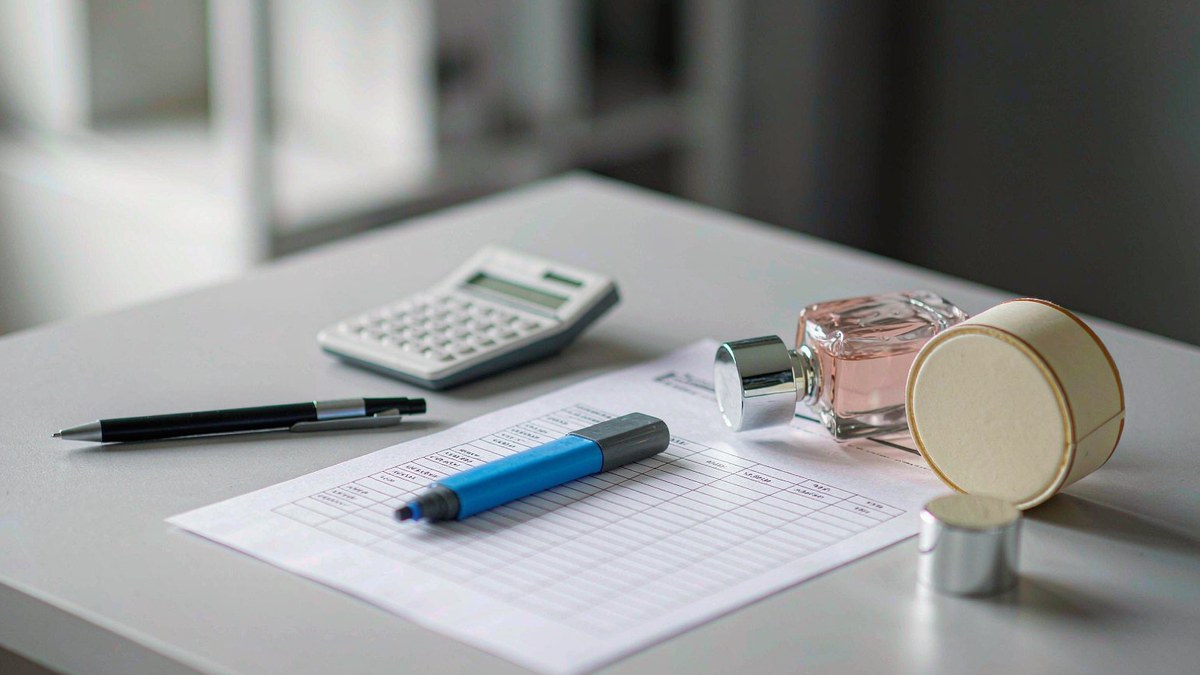
Two brands order the same 50 ml eau de parfum from the same factory and get FOB prices 22% apart. Neither was overcharged. One specified a 15% fragrance load in a coated bottle with a magnetic cap and a printed rigid box; the other accepted a stock bottle, 12% load and a folding carton. The difference was not negotiation; it was the bill of materials.
This article sets out how to build an FOB cost model for a fragrance SKU, line by line, so that a quote can be checked rather than trusted, and so that a design decision can be costed before it is made.
Table of Contents
- The structure of an FOB price
- Materials: the six lines that matter
- Conversion cost
- Overheads, margin and tooling
- Building the model
- The levers that actually move unit cost
- Practical guide: costing a new SKU
- Frequently asked questions
- Conclusion
The structure of an FOB price
A properly built FOB price has three blocks: materials, conversion and margin. Materials are the bill of components plus the liquid. Conversion is labour, energy, machine time and setup. Margin covers overheads and profit and is where a factory's efficiency shows.
Most quotes collapse these into a number. Asking for the three blocks separately is the single most useful thing a buyer can do, because it shows where the money is and which lever to pull.
Materials: the six lines that matter
| Line | Typical share of a perfume FOB | What moves it |
|---|---|---|
| Fragrance compound | 10-25% | Dosage, accord complexity, exclusivity |
| Alcohol or carrier | 3-10% | Grade, duty status, denaturation |
| Primary pack (glass) | 20-35% | Mould, weight, decoration |
| Closure and pump | 8-15% | Material, sealing, brand detail |
| Label and carton | 5-12% | Substrate, print method, embellishment |
| Protective packaging | 2-6% | Insert type, carton grade |
The shares shift with format. In a candle, wax and vessel dominate and fragrance is smaller. In a diffuser, the liquid and the glass both matter, and the closure is where leaks originate.
Conversion cost
Conversion is usually quoted per unit and hides its own arithmetic: labour minutes per unit, line speed, setup amortised over the run, and the cleaning time between fragrance changes. At low volume, setup dominates; at high volume, speed does.
The practical implication is that doubling an order often reduces unit conversion cost more than negotiating a discount on materials. Ask what the conversion is at 1,000, 3,000 and 10,000 pieces — the shape of that curve tells you the factory's real constraints.
Overheads, margin and tooling
Overheads cover factory running costs and are rarely negotiable. Margin is competitive and varies by market position. Tooling is the line buyers most often miss: a new mould, a decorating plate or a printing cylinder is a fixed cost that must either be paid up front or amortised into the unit price.
Ask explicitly whether tooling is included in the unit price. If it is, the price will not fall when the tool is paid off unless the contract says so.
Building the model
A workable model has one row per component and one row per conversion step, with columns for unit cost, quantity and extended cost, plus a separate block for one-off costs. Once built, it answers questions in seconds: what happens if the bottle goes from 45 g to 55 g, what happens at 12% versus 15% load, what does the rigid box add.
The levers that actually move unit cost
- Bottle weight and mould choice. The largest single lever in perfume.
- Fragrance dosage. A percentage point is a visible cost, and often a visible performance difference.
- Decoration method. Coating plus print plus foil is three process steps; one is cheaper.
- Closure specification. Magnetic caps and metal collars add cost quickly.
- Order structure. Fewer SKUs per run means less setup per unit.
Practical guide: costing a new SKU
Step 1 — Write the bill of materials before asking for a price
Every component with weight, material and finish. This is the model's skeleton.
Step 2 — Ask for the three blocks separately
Materials, conversion, margin. A single number cannot be checked.
Step 3 — Get conversion at three volumes
1,000, 3,000 and 10,000. The curve shows where setup stops dominating.
Step 4 — Isolate tooling
Cost, ownership and whether it is amortised or invoiced.
Step 5 — Run two design scenarios
Premium pack versus stock pack. The delta is the design decision, costed.
Step 6 — Add freight, duty and testing
FOB is not landed. Add the layers and compare per unit delivered.
Frequently asked questions
Why do two factories quote very different prices for the same brief?
Usually because the brief left specification gaps. Fragrance load, bottle weight, decoration and carton grade are the four most common sources of divergence.
Is a lower fragrance load always cheaper?
Cheaper per unit, yes, but performance and perceived quality fall. The correct load is the lowest one that passes the performance test in the intended format.
Should tooling be amortised or paid upfront?
Paying upfront usually reduces the unit price and clarifies ownership. Amortising spreads cash but can leave ownership ambiguous.
What is a normal margin for an OEM?
It varies with volume and market position, and it is rarely disclosed as a line. Asking for the three blocks gives you enough to judge whether the number is plausible.
How much does decoration add?
It depends on the method and the number of passes. Coating, print and foil are separate steps, each with setup and waste.
Can I reduce cost without changing the design?
Sometimes — consolidation across SKUs, longer delivery windows, and ordering components in the factory's standard sizes all reduce cost without changing how the product looks.
Why does the unit price not fall when volume doubles?
Because materials dominate at scale and materials are not volume-discounted much. Conversion falls, materials do not.
How do I compare FOB and DDP quotes?
Add freight, duty, insurance and clearance to the FOB price and compare per unit delivered. The cheapest FOB is often not the cheapest landed.
Conclusion
An FOB price is a bill of materials plus conversion plus margin. When those three are visible, a quote becomes a set of decisions rather than a number to accept.
Write the bill of materials, ask for the blocks separately, get the conversion curve and isolate tooling. Then cost two design scenarios before you commit to either.
We invite you to explore our capabilities and discuss your next product line.
You can reach us directly via WhatsApp +86 17324762943
Email: adon@customperfumeoem.com
Website: customperfumeoem.com


